
Your Brain on E-commerce: The Science of Sales.
Article 3 min read

Your Brain on E-commerce: The Science of Sales.
Why do 97% of ad clicks fail to convert? The answer lies in the "Mid-Funnel" and the science of cognitive load. When users are bombarded with information, they bounce. This deep dive explores how to design e-commerce experiences that respect the buyer's brain, maintain "ad scent," and use AI-driven smart design to turn fragile intent into committed sales by making the path to purchase effortless.

Team IntelliAssist

Team IntelliAssist

Author

Key Takeaways

Why do 97% of ad clicks fail to convert? The answer lies in the "Mid-Funnel" and the science of cognitive load. When users are bombarded with information, they bounce. This deep dive explores how to design e-commerce experiences that respect the buyer's brain, maintain "ad scent," and use AI-driven smart design to turn fragile intent into committed sales by making the path to purchase effortless.

Your Brain on E-commerce: The Science of Sales.

The Digital Maze: Why "Mid-Funnel" is Where Sales Go to Die

Ever feel overwhelmed after clicking a promising ad, only to land on a page that assaults you with information, leaving your brain scrambled? You're not alone, and it's costing businesses a fortune. The culprit? Often, it's a poorly designed mid-funnel experience.

Shocking Reality

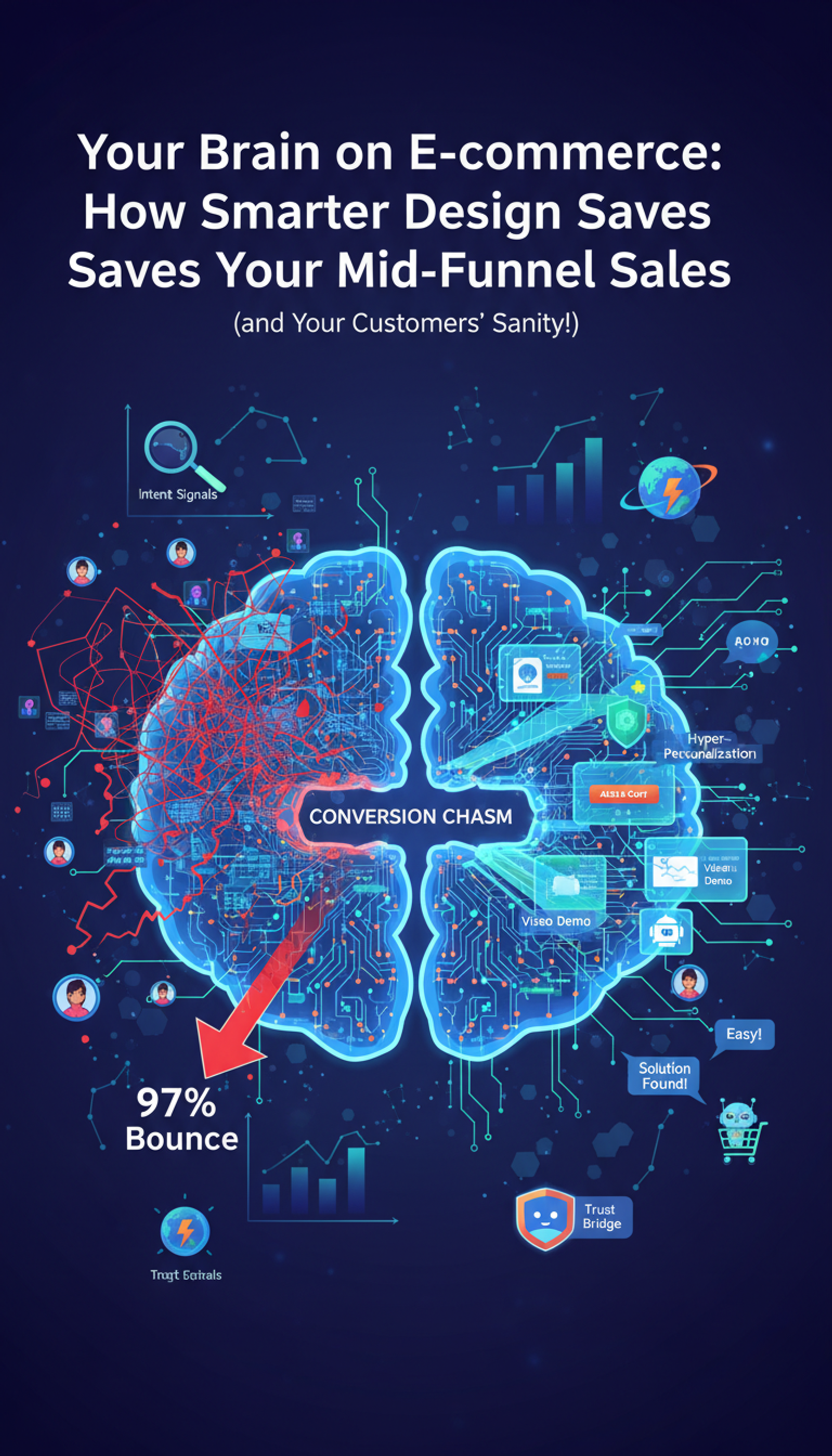
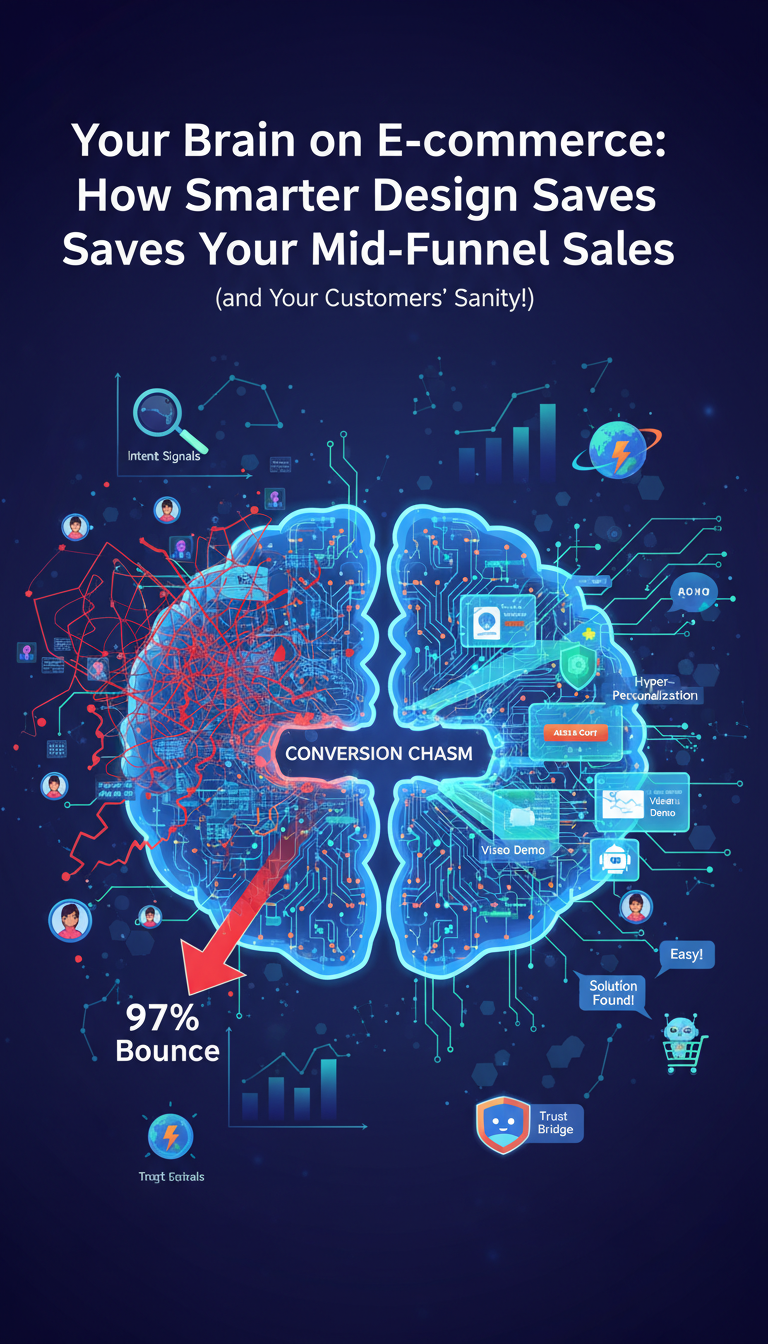
The "Conversion Chasm" sees a staggering 97% of ad clicks evaporate into the digital ether.

Think of the e-commerce journey as a carefully constructed path. The Mid-Funnel, or MoFu, is that crucial, often neglected, stage after an ad click lures a potential customer, but before the satisfying thunk of an "Add to Cart." Buyers here are teetering on the edge of a decision, considering your offering, but their intent is as fragile as spun glass.

Enter Cognitive Load: The amount of mental heavy-lifting your brain has to do. It's a concept as relevant to e-commerce as it is to neuroscience. In the MoFu, too much cognitive load means buyers bounce faster than a dropped superball.

From Static Scrolls to Smart Screens

The evolution of the landing page mirrors our evolving understanding of the human mind. Let's take a quick trip down memory lane.

Early 2000s

The Digital Pamphlet era

Simple, static, one-size-fits-all info dumps. A wall of text punctuated by a few stock images.

Mid-2000s onwards

The CRO Revolution

Clear calls to action, persuasive copywriting, and the dawn of A/B testing to understand real-time conversion.

The Smart Design Playbook for 2024

How do we build a better MoFu that guides rather than frustrates? Here is the strategy:

  • 01 Speak Their Language, Literally :Deliver content that screams "solution!" with in-depth demos and side-by-side product comparisons.
  • 02 It's All About You:Hyper-personalization via retargeting and tailored content based on past interactions.
  • 03 More Than Just Text: Engage your audience with videos, interactive guides, and community-driven webinars.

The Great Debates: "Less is More" Gets Tricky

The Minimalism Paradox: Sleek vs. Seen. Minimalist UI aims for beautiful simplicity, but what if "minimalist" means hiding critical features? Users can't convert if they can't find what they need.

The Jam Experiment: Researchers found that shoppers presented with *fewer* choices were far more likely to make a purchase. Offering too many options leads to decision paralysis.

The Future of Frictionless Funnels

The future of e-commerce is intelligent, adaptive, and relentlessly focused on the individual user. AI agents are reshaping landing pages for each individual visitor—analyzing behavior to adjust layout and CTAs in real-time.

Respect the Buyer's Brain

By intentionally designing for low cognitive load, you're not just optimizing for conversions; you're respecting your customer's time.

Key Takeaways

  • Minimize Extraneous Load to prevent bounce.
  • Maintain Ad Scent for trust and consistency.
  • Use Intent Signals to time your offers perfectly.

Share this article

Help others discover this content

E-commerceMarketingAI

More Stories

Omnichannel Re-engagement: Keeping your brand top-of-mind.

Omnichannel Re-engagement: Keeping your brand top-of-mind.

In a world of glittering digital distractions, the "abandoned cart" is a modern ruin. This guide explores the evolution of re-engagement—from the "Dark Ages" of disjointed silos to the "Glow-Up" of synchronized, omnichannel grace. Discover how giants like Nike and Sephora use Unified Customer Views to turn transactional noise into personable resonance, navigating the "Cookie-pocalypse" by building genuine, data-driven empathy that respects privacy while driving immense value.

Smashing the "Scaling Wall" Without Emptying Your Bank Account

Smashing the "Scaling Wall" Without Emptying Your Bank Account

In 2026, growth is no longer a function of volume, but of precision. As "The Scaling Wall" halts traditional expansion, a new era of "Agentic AI" has emerged. This deep dive explores how specialized AI squads—from Ad Spy Investigators to Landing Page Architects—are helping D2C brands maintain a 3:1 LTV:CAC ratio by replacing expensive, brute-force ad spend with autonomous, high-velocity workflows that bridge the conversion chasm.

The 70.19% Ghost Story: Why Your Customers Are Ghosting You (and How to Win Them Back)

The 70.19% Ghost Story: Why Your Customers Are Ghosting You (and How to Win Them Back)

Seven out of ten shoppers vanish at the final click—a statistical "Ghost Story" that has haunted e-commerce for a decade. This 2026 guide explores why the "Conversion Chasm" persists and how modern D2C brands are using AI Plugin Agents to orchestrate "Just-in-Time" support. From neutralizing the "Complexity Tax" with biometrics to the rise of "Invisible Commerce," learn how to turn the chore of checking out into a frictionless, automated experience.

Ready to Transform?

Start Boosting Your Conversions Today

Join thousands of businesses that have transformed their e-commerce experience with our AI-powered platform.

No credit card required
Setup in minutes
24/7 Support