
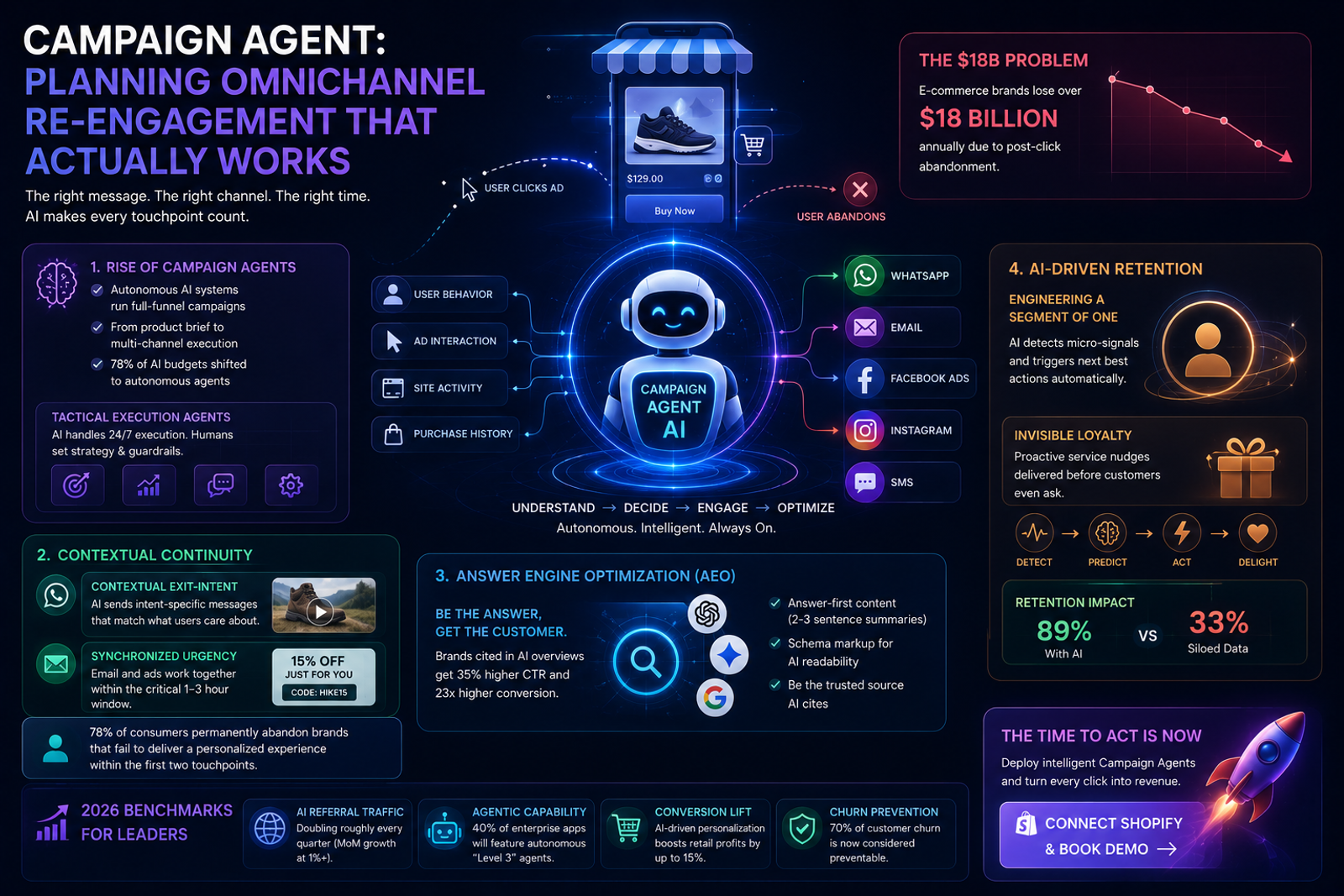

Most e-commerce brands don’t lose customers because their products are bad. They lose them because the buying experience breaks somewhere between interest and action. A customer clicks on an ad, explores a product, maybe even adds it to the cart — and then disappears. No purchase. No response. No second visit. This isn’t just a minor marketing problem anymore.
Brands are losing billions every year because the experience after the click often feels disconnected, generic, and forgettable. That’s where modern AI-powered Campaign Agents are changing the game. Instead of relying on static email flows and repetitive retargeting ads, brands are now using intelligent systems that understand customer behavior in real time and respond with personalized actions across multiple channels.
The goal is simple:
Reconnect the customer before the intent disappears.
Why Traditional Re-Engagement No Longer Works
Consumers today move across platforms constantly. They might discover your product on Instagram, search reviews on Google, compare alternatives through ChatGPT, open your site on mobile, and then abandon the purchase because something felt off. Most brands still treat these interactions separately.
One team runs ads. Another sends emails. Another manages SMS. But customers experience everything as one continuous journey. When the messaging feels inconsistent or irrelevant, trust drops instantly. This is why post-click abandonment has become such a major issue in e-commerce.
People don’t just want reminders anymore.
They want relevance.
What Are Campaign Agents?
Campaign Agents are AI-powered systems designed to manage and optimize customer re-engagement automatically. Unlike traditional automation tools that follow fixed workflows, these systems continuously analyze customer behavior and decide what action should happen next.
That could mean:
- Sending a personalized WhatsApp message
- Triggering a retargeting ad
- Recommending a product bundle
- Adjusting the landing page experience
- Offering a discount at the right moment
- Changing messaging based on user intent
The biggest difference is that these decisions happen dynamically and in real time. Instead of treating every shopper the same, Campaign Agents help brands create what feels like a one-to-one experience.
The Real Problem: Broken Post-Click Experiences
A lot of brands spend heavily on ads but ignore what happens after the click.
For example:
A customer clicks an ad for waterproof hiking boots. The ad feels premium, adventurous, and specific. But when they land on the website, they see a generic product page with no connection to what originally caught their attention. That disconnect kills momentum. Modern re-engagement strategies are focused on maintaining what marketers call “contextual continuity” — making sure the customer journey feels connected from start to finish.
When the experience stays aligned with the customer’s intent, conversions naturally improve.
Smarter Re-Engagement Strategies That Actually Feel Helpful
1. Personalized Exit Recovery
Traditional pop-ups saying “Wait! Don’t Leave!” rarely work anymore. Customers have learned to ignore them. AI-driven Campaign Agents take a more intelligent approach. Instead of generic messaging, they analyze what the customer was actually interested in. If someone leaves after viewing hiking gear, the system might send:
- A short product demo video
- A review from another customer
- A size recommendation
- A restock alert
- A limited-time offer tied specifically to that product
The experience feels relevant instead of intrusive.
2. Omnichannel Synchronization
Customers don’t stay on one platform. That’s why modern re-engagement has to work across:
- SMS
- Meta Ads
- Google Ads
- Push notifications
The key is consistency. If a shopper receives a discount email, the retargeting ad should reflect the same offer. If they interacted with a skincare product, the next message shouldn’t promote something unrelated. Campaign Agents help synchronize all of this automatically.
3. Real-Time Behavioral Triggers
The timing of re-engagement matters just as much as the message itself. Sometimes customers abandon a cart because:
- Shipping costs surprised them
- They became distracted
- They needed more reassurance
- They wanted to compare options
AI systems can now identify these patterns based on behavior.
For example:
- Repeated visits to the return policy may signal hesitation
- Long pauses on pricing sections may indicate budget concerns
- Frequent comparison activity may mean the shopper needs more trust signals
Instead of waiting hours or days, Campaign Agents respond instantly with the right type of support.
Why AI Search Is Changing Re-Engagement
Search behavior itself is evolving.
More consumers now discover products through AI-generated recommendations from tools like ChatGPT, Gemini, and Perplexity. This means brands can no longer optimize only for traditional search rankings. They also need to become visible inside AI-generated answers. This shift is often called Answer Engine Optimization (AEO). The brands that structure their content clearly, answer customer questions directly, and maintain strong product data are becoming more visible in AI-driven discovery. And interestingly, visitors coming from AI tools often convert at much higher rates because they arrive with stronger intent.
The Future of Retention: Invisible Loyalty
Traditional loyalty programs are becoming less effective. Most customers don’t want another points dashboard. What they really value is a smoother experience. That’s why many brands are moving toward what can be called “Invisible Loyalty.” Instead of asking customers to earn rewards manually, AI systems proactively improve the experience.
Examples include:
- Automatically offering store credit when a delivery is delayed
- Prioritizing support for repeat customers
- Sending replenishment reminders at the right time
- Personalizing recommendations based on previous purchases
When done correctly, customers feel understood rather than marketed to.
Why This Matters for E-Commerce Growth
Customer acquisition costs continue to rise every year. For many brands, improving retention and post-click conversion is now far more profitable than simply spending more on ads. The brands seeing the strongest growth today are not necessarily the ones with the biggest budgets. They’re the ones creating faster, more connected, and more personalized customer journeys.
That’s the role Campaign Agents are starting to play. Not replacing marketers — but helping them respond to customers with more speed, relevance, and intelligence than manual systems ever could.
The Bigger Shift Happening in Commerce
E-commerce is moving away from static experiences. The future is adaptive. Instead of websites behaving like digital catalogs, they’re becoming intelligent systems that react to customer intent in real time. Campaign Agents are one part of that evolution.
They help brands:
- Recover abandoned revenue
- Improve customer retention
- Reduce wasted ad spend
- Personalize communication at scale
- Create more human shopping experiences
And in a world where customers expect relevance instantly, that advantage matters.
Final Thoughts
The future of re-engagement isn’t about sending more notifications. It’s about understanding customers better. Brands that continue relying on generic retargeting and disconnected marketing flows will struggle to retain attention. The brands that win will be the ones creating seamless, personalized journeys across every touchpoint. That’s where AI-powered Campaign Agents can make a real difference. Not by replacing human strategy — but by making every interaction more timely, contextual, and useful.
Ready to Reduce Post-Click Drop-Offs?
IntelliAssist helps e-commerce brands create intelligent customer journeys that improve retention, reduce abandonment, and maximize conversion opportunities.
Share this article
Help others discover this content