
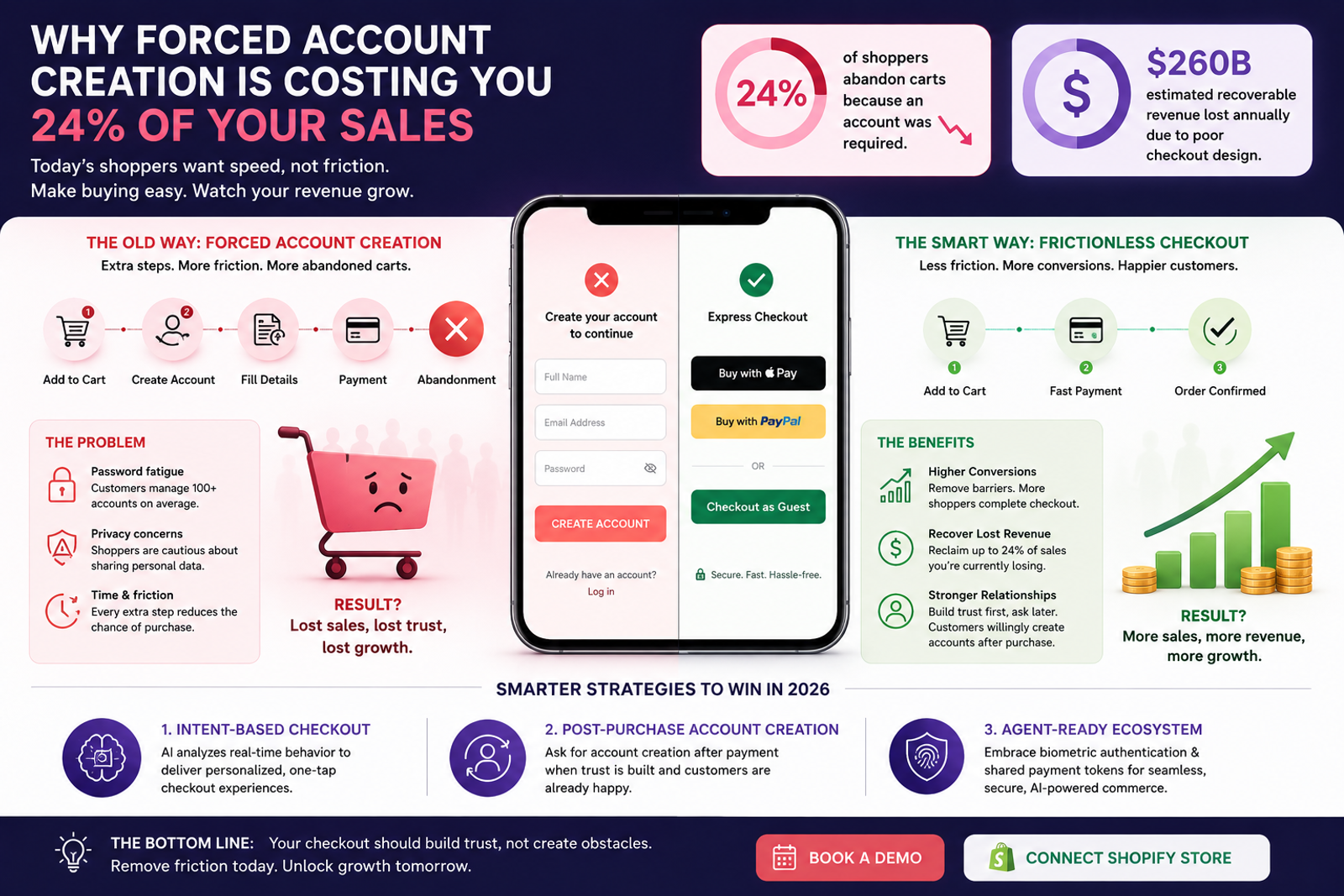

In e-commerce, brands spend thousands driving traffic to their websites — optimizing ads, improving creatives, and scaling campaigns — only to lose customers at the final step because of one simple decision:
“Create an account to continue.”
It seems harmless. Logical, even. Most brands believe account creation helps build customer relationships, collect data, and improve retention. But for shoppers, especially in 2026’s fast-moving digital environment, it often feels like unnecessary friction. And friction kills conversions. Studies continue to show that nearly 1 in 4 shoppers abandon their cart when forced to create an account before checkout. That means brands are potentially losing a huge portion of revenue not because customers dislike the product — but because the buying process feels exhausting.
Today’s consumers expect speed, convenience, and flexibility. If checkout feels complicated, they simply leave.
The Real Problem Isn’t Checkout — It’s Interrupting Intent
When someone clicks “Buy Now,” they’ve already made an emotional decision. That moment is valuable. But forcing users to stop, think of a password, verify an email, or fill out extra information interrupts momentum. Suddenly the experience shifts from shopping to work.
And in a world where consumers are shopping on mobile devices, during commutes, between meetings, or late at night while multitasking, even small interruptions feel frustrating. Most shoppers don’t want another account.
They want a smooth purchase.
Consumer Behavior Has Changed Faster Than Most Checkouts
The way people buy online today is completely different from just a few years ago.
- Over 70% of e-commerce purchases now happen on mobile.
- Customers expect instant checkout experiences.
- AI-powered shopping assistants are beginning to influence buying decisions.
- Convenience has become more important than brand loyalty.
People are now used to:
- one-tap payments,
- biometric authentication,
- autofill experiences,
- guest checkouts,
- and frictionless mobile apps.
So when a website forces account creation before payment, it immediately feels outdated. The result? Abandoned carts, wasted ad spend, and lower ROAS.
Why Brands Still Force Account Creation
Most businesses don’t do it intentionally to hurt conversions.
Usually, the thinking is:
- “We need customer data.”
- “We want repeat purchases.”
- “Accounts improve retention.”
- “It helps email marketing.”
And those goals are valid.
But the mistake is trying to collect everything before earning the sale.
Modern e-commerce brands are learning that the relationship should begin after the purchase — not before it.
The priority should always be:
- Complete the transaction first.
- Build loyalty second.
The Rise of Frictionless Commerce
The brands growing fastest in 2026 are reducing effort everywhere across the customer journey. Instead of asking shoppers to adapt to rigid checkout systems, they’re designing experiences around customer behavior.
That means:
- Guest checkout by default
- One-click payment options
- AI-assisted checkout flows
- Personalized post-purchase engagement
- Smart account creation prompts after payment
This shift is especially important as AI-driven commerce becomes more common. Shopping assistants and automated buying systems are designed for speed. If your checkout flow creates unnecessary barriers, those systems simply move on to another brand.
Smarter Ways to Collect Customer Data Without Hurting Conversion
The good news is: you do not need to choose between customer data and conversion rates. You can have both — if the timing is right.
1. Offer Guest Checkout First
Let users complete purchases quickly without forcing commitment.
Once trust is established, many customers willingly create accounts later.
A smoother checkout experience almost always leads to higher conversion rates.
2. Move Account Creation to Post-Purchase
After someone buys, the emotional dynamic changes completely.
At this stage:
- they already trust your brand,
- they want order tracking,
- and they’re more open to saving information.
This is the perfect moment to ask:
“Would you like to save your details for faster checkout next time?”
That feels helpful instead of intrusive.
3. Use AI to Personalize the Checkout Experience
Not every customer behaves the same way.
AI-powered systems can identify:
- hesitation patterns,
- repeat visitors,
- mobile users,
- high-intent buyers,
- or customers likely to abandon.
Instead of showing the same checkout flow to everyone, brands can adapt experiences in real time.
For example:
- returning users can get express checkout,
- hesitant shoppers can receive reassurance prompts,
- and high-intent visitors can bypass unnecessary steps entirely.
This is where modern commerce is heading:
less friction, more intelligence.
The Financial Cost of Checkout Friction
Brands often focus heavily on improving ad performance while ignoring checkout inefficiencies. But recovering even a fraction of abandoned carts can dramatically improve profitability. Reducing friction means:
- higher conversion rates,
- lower customer acquisition costs,
- better ROAS,
- and stronger customer retention.
Sometimes growth doesn’t come from spending more on ads. It comes from making it easier for customers to buy.
The Future of Checkout Is Invisible
The future of commerce is not about adding more steps.
It’s about removing them. As AI-assisted shopping continues to evolve, the best-performing brands will be the ones creating experiences that feel effortless. Customers don’t remember complicated checkout systems.
They remember brands that made buying easy. And in a highly competitive e-commerce landscape, that simplicity becomes a competitive advantage.
Final Thoughts
If your checkout process still forces account creation before purchase, it may already be costing you sales without you realizing it. Consumers today value convenience more than ever. The brands winning in 2026 are the ones reducing friction, respecting intent, and designing around real customer behavior. Because sometimes the biggest conversion problem isn’t your ads, pricing, or products.
It’s one extra step between the customer and the checkout button.
Share this article
Help others discover this content