
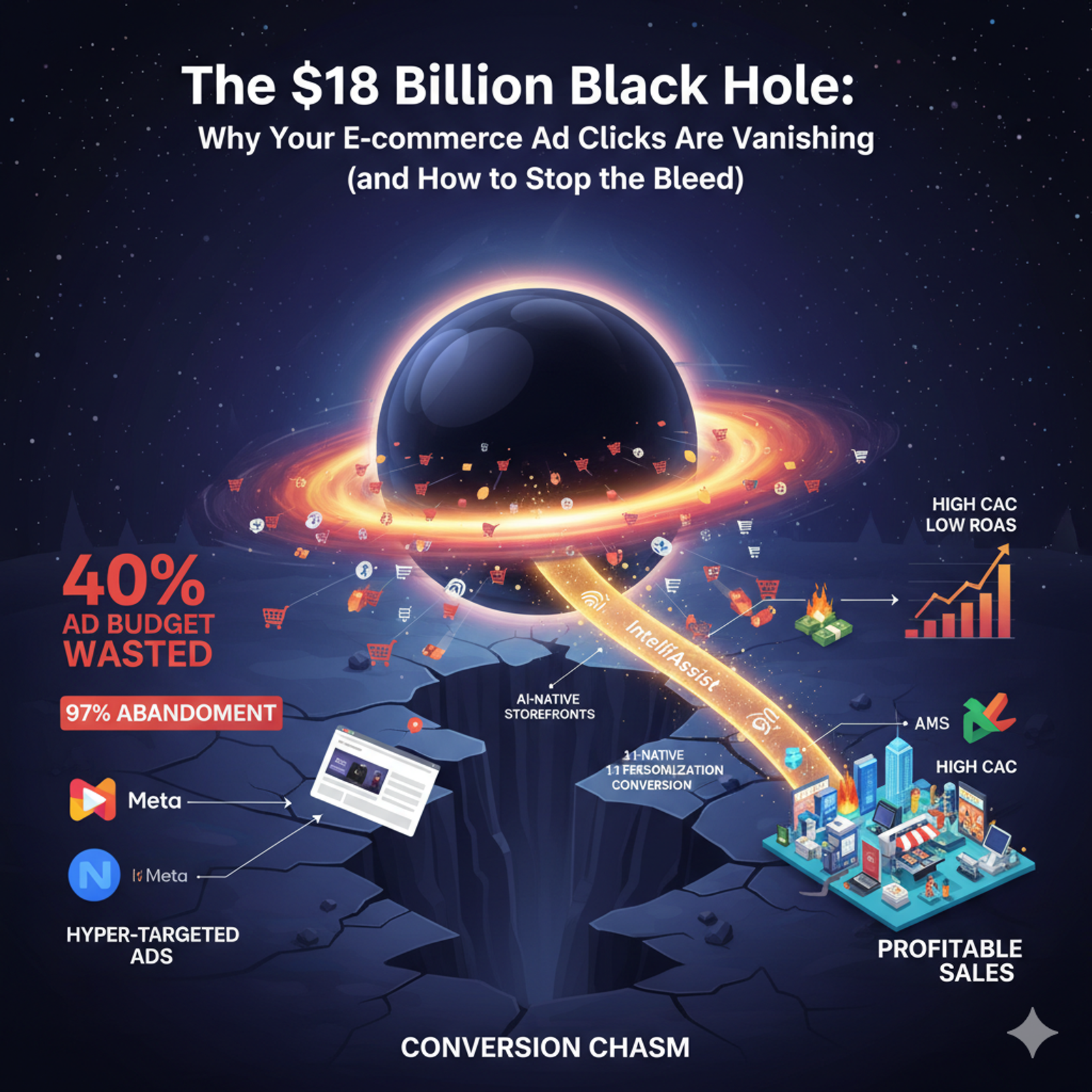

You're spending billions on e-commerce ads, diligently crafting campaigns and targeting your ideal customer. Yet, a gut-wrenching 97% of those clicks simply vanish, swallowed whole. That's not just a leaky bucket; it's a massive financial hemorrhage, with global ad fraud losses projected to reach $41.4 billion in 2025, up from $37.7 billion in 2024, and overall wasted ad spend estimated at $71.37 billion annually. The question isn't just why we're losing these clicks, but how this catastrophic waste has become the accepted norm in digital advertising.
The Staggering Scale of Ad Spend Waste
The numbers paint a devastating picture of digital advertising inefficiency. Global digital ad spend reached $646 billion in 2024, yet a substantial portion vanishes into the void through multiple channels of waste. Click fraud alone accounts for 76.6% of invalid traffic, while 30% of small business ad spend is wasted on fraudulent clicks. In the United States, with $271.2 billion in digital ad spend and a 16.73% fraud rate, approximately $45.3 billion disappears annually to fraud alone.
The financial impact extends far beyond direct fraud. Marketing and advertising technologies not working well together leads to 12% of ad budgets worldwide being wasted, according to Forrester Consulting data. Even when tech stacks are properly configured, 28% of US small- and mid-size business advertisers still aren't using them to their full capacity.
A Quick Trip Down Memory Lane: How We Got Here
The evolution of e-commerce conversion rates tells a sobering story. The "Good Old Days" of e-commerce (circa 2000-2010) were simpler times when websites were clunky and dial-up was common, yet conversion rates hovered around 1.5-2.5%. The UX Revolution (2010-2020) brought sleek interfaces and streamlined payments, pushing conversion rates to 2.5-4%. The Pandemic Boom (2020-2024) saw everyone flocking online, creating temporary spikes before settling back down.
But here we are in 2025, and global conversion rates still linger around 2-4%. The average e-commerce conversion rate globally is 3.76%, with personal care products and food & beverages leading at 6.8% and 4.9% respectively. Despite technological advances, we're trapped in a cycle where the vast majority of clicks fail to convert.
The Usual Suspects: Why Your Clicks Aren't Converting
The Mobile-Desktop Divide
The statistics reveal a critical disconnect in our mobile-first world. While mobile accounts for 63.7% of e-commerce traffic, conversion rates tell a different story. The average mobile e-commerce conversion rate is just 1.8%, compared to desktop's 3.9%. Mobile cart abandonment reaches a staggering 85.65%, compared to desktop's 70%.
This mobile conversion gap represents billions in lost revenue. The average cart abandonment rate on mobile devices reaches 80.2%, while tablet devices achieve the highest conversion rate at 3.1%, highlighting the importance of screen size and user experience in conversion optimization.
The Cart Abandonment Crisis
Cart abandonment has reached epidemic proportions. The average shopping cart abandonment rate globally is 70.22% according to Baymard Institute, while other studies show rates as high as 76.26%. Beauty & Personal Care sees the highest abandonment rates at 80.88%, while Pet Care & Veterinary Services has the lowest at 51.12%.
The regional breakdown is equally telling: APAC witnesses 80.56% cart abandonment, followed by EMEA at 78.38%, and Americas at 72.6%. 48% of users abandon carts due to extra costs like shipping fees and taxes, while mandatory account creation causes 24% of shoppers to abandon. These friction points represent up to $260 billion in recoverable lost revenue with better checkout design.
The Trust and Experience Nightmare
User experience remains a conversion killer. Pages that load slowly, particularly on mobile, destroy conversion potential - you have three seconds to capture attention. Cluttered, confusing design turns websites into digital mazes, while weak calls-to-action leave users uncertain about next steps.
Trust factors are paramount. No reviews, questionable security, and unclear policies cause immediate user exodus. 22% of shopping cart abandonment occurs during the checkout process itself, often due to unexpected fees, complex multi-step processes, or forced account creation.
The Big Debates: What's Stirring the Pot in E-commerce Ads?
Ad Fraud: The Invisible Enemy
Click fraud has evolved into a sophisticated ecosystem of deception. AI-powered bots now generate fake engagement at scale, creating realistic user behavior that's increasingly difficult to detect. Financial services face a 14.3% average ad fraud rate, telecommunications 11.1%, and real estate 7.6% - all significantly above the global average of 5.1%.
Fraudulent clicks convert at dramatically lower rates than legitimate traffic, depressing overall campaign performance and skewing optimization algorithms. The projected global cost of ad fraud exceeds $41.4 billion in 2025, representing a 10% increase from 2024.
The Privacy-Personalization Paradox
Privacy regulations like GDPR and the "cookieless future" are making personalization increasingly challenging. Yet 92% of businesses now use AI-driven personalization, and personalized calls-to-action outperform generic CTAs by 202%. However, 24% of consumers express concerns about personalization, creating a delicate balance between relevance and privacy.
73% of business leaders agree that AI will redefine personalization strategies, yet 24% of consumers want brands to better understand their needs, highlighting the ongoing tension between personalized experiences and privacy concerns.
Glimpse into the Future: Technology as the Solution
AI and Machine Learning Revolution
Artificial intelligence is transforming digital advertising through hyper-personalization and automated optimization. 54.8% of marketers feel optimistic that AI can enhance efficiency and personalize interactions. AI enables real-time content adaptation based on browsing behavior, device type, geolocation, and time of day.
The global artificial intelligence market was valued at about $200 billion in 2023 and is expected to grow to almost $2 trillion by 2030. This explosive growth is driving innovation in predictive analytics, automated bidding, and personalized content generation.
Immersive Commerce and AR/VR
71% of consumers say they'd shop more if AR were available, and over 30% of marketers are already integrating AR/VR into campaigns. These technologies can increase conversion rates by up to 40% by allowing virtual product trials and immersive shopping experiences.
3D visualization has shown remarkable results, with conversion rates increasing by 53.3% in Argentina and 47.2% in Mexico when implemented on e-commerce platforms.
Taking Action: Strategies to Turn Clicks into Customers
Mobile-First Optimization
With mobile expected to account for 44.2% of all e-commerce sales by 2025, optimizing the mobile experience is critical. Focus on lightning-fast loading times, simplified checkout processes, and thumb-friendly navigation. The average mobile ecommerce conversion rate of 1.8% has enormous room for improvement.
Conversion Rate Optimization Mastery
Email cart abandonment recovery achieves a 29.9% success rate, making it one of the most effective retention strategies. Implement comprehensive retargeting campaigns, simplify checkout processes, and eliminate unexpected costs that drive 48% of cart abandonments.
Trust Building and Transparency
Build bulletproof trust with customer reviews, security badges, clear policies, and exceptional customer service. Address the 24% of shoppers who abandon due to mandatory account creation by offering guest checkout options.
AI-Powered Fraud Prevention
Implement advanced fraud detection systems that can identify AI-powered bots and sophisticated click fraud schemes. Use attention metrics rather than click-through rates to measure genuine engagement and avoid the trap of fraudulent traffic inflation.
Conclusion: The Future of E-commerce is Smart, Not Just Loud
The $41.4 billion ad fraud problem and 70%+ cart abandonment rates represent critical challenges demanding immediate action. Global e-commerce sales are projected to reach $6.86 trillion in 2025, yet the majority of advertising investment continues to be wasted through preventable inefficiencies.
Success in 2025 requires shifting from volume-based to intelligence-based strategies. By addressing mobile conversion gaps, implementing robust fraud prevention, optimizing checkout experiences, and leveraging AI for genuine personalization, e-commerce brands can transform vanishing clicks into valuable customers.
The future belongs to brands that combine technological sophistication with customer-centric experiences, moving beyond simply being loud in the marketplace to being strategically smart about every advertising dollar spent. With over 3 billion people expected to shop online in 2025, the opportunity is massive - but only for those who can stop the bleed and convert their traffic effectively.
Share this article
Help others discover this content