

In the competitive landscape of online retail, every advertising dollar you invest needs to work hard for your business. You spend time crafting campaigns, selecting audiences, and driving traffic to your store—but how do you really know if those efforts are translating into profit? The answer lies in mastering one of digital marketing's most important metrics: Return on Ad Spend, or ROAS.
While ROAS might seem straightforward on the surface, it's a nuanced metric that can either drive tremendous growth or mislead you if used in isolation. This guide breaks down what ROAS truly means, where it falls short, and how the landscape is shifting so you can build smarter, more profitable advertising strategies.
Understanding ROAS: The Basics
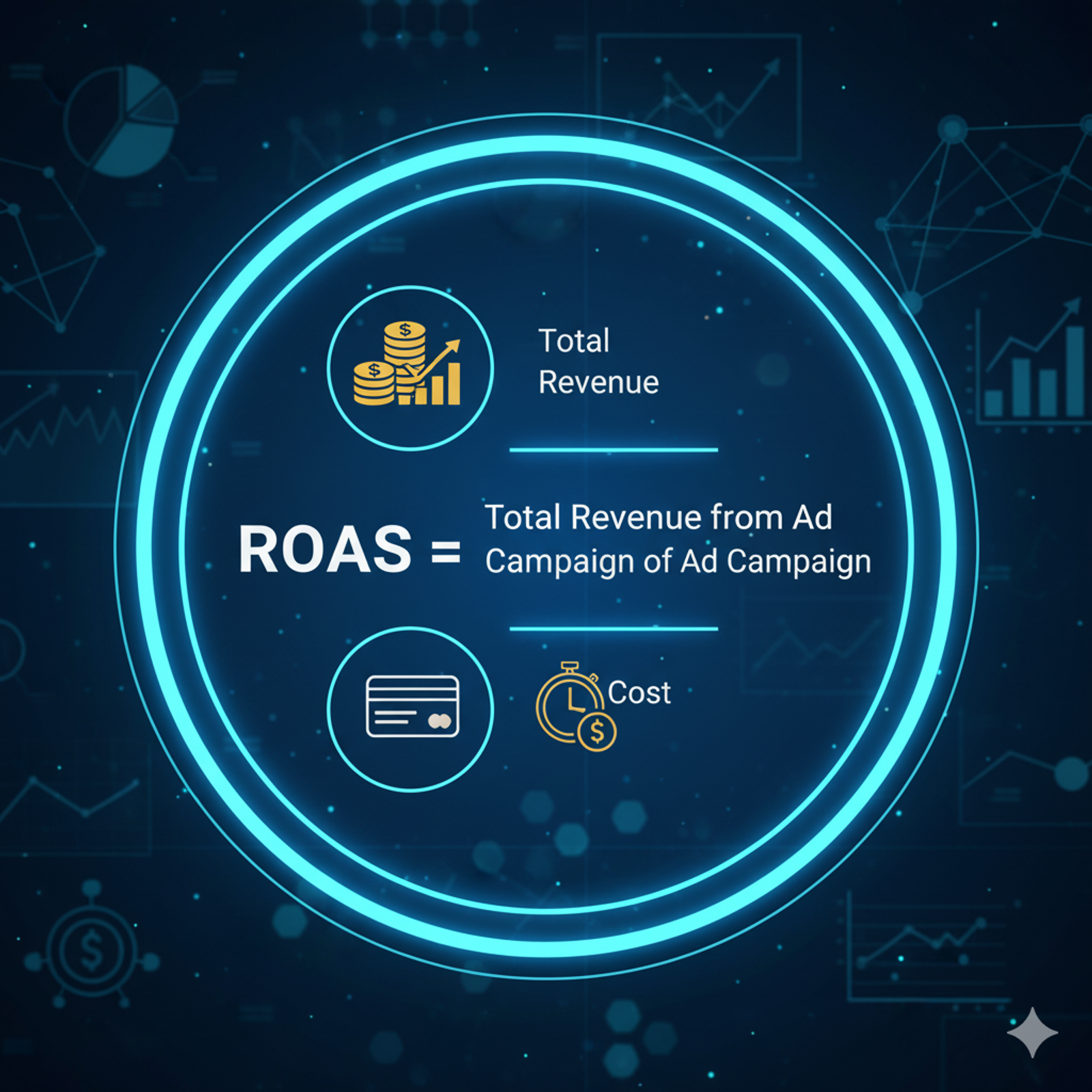
Return on Ad Spend measures the revenue generated for every dollar spent on advertising. It answers a simple but critical question: "How much money did I earn for each dollar I invested in this ad?"
The calculation is straightforward:
ROAS=Total Revenue from Ad CampaignTotal Cost of Ad CampaignROAS=Total Cost of Ad CampaignTotal Revenue from Ad Campaign
For instance, if you spend $1,000 on a campaign that brings in $4,000 in revenue, your ROAS is 4:1—meaning you earned $4 for every dollar spent.
Key Metrics That Support ROAS Tracking
To maximize your ROAS effectively, keep an eye on these supporting metrics:
Clicks, Impressions, and Click-Through Rate (CTR): These tell you whether your ads are compelling enough to capture attention and drive interest.
Conversions and Cost Per Acquisition (CPA): Conversions represent completed sales, and CPA shows what you're paying for each one. Just remember—chasing a low CPA without considering order value can be counterproductive.
Break-Even and Target ROAS: Your break-even ROAS is where ad costs equal the profit from resulting sales. You're neither gaining nor losing money at this point. Setting your target ROAS above this threshold ensures campaigns actually contribute to your bottom line.
From Guesswork to Precision: How ROAS Evolved
Tracking advertising effectiveness used to be notoriously difficult. For decades, marketers struggled to connect print ads or TV commercials to actual sales. The guessing game ended with the arrival of digital advertising platforms in the late 1990s and early 2000s.
Pay-per-click advertising revolutionized accountability in marketing. Suddenly, sophisticated analytics tools allowed marketers to trace a customer's journey from initial ad click all the way to purchase. This ability to directly link spending to revenue made ROAS an indispensable metric, particularly for the booming eCommerce industry.
ROAS in 2025: A Powerful Tool with Limitations
Today, ROAS remains essential, but the conversation has matured considerably. Marketers now understand it shouldn't be treated as the single source of truth. Two perspectives have emerged:
The Supporters appreciate ROAS for its clarity and immediacy. It offers a quick snapshot of which campaigns generate direct revenue, making it invaluable for short-term optimizations and budget allocation. While many cite 4:1 as a benchmark for "good" ROAS, current data shows the average across eCommerce has dropped to around 2.87:1 in 2025. Platform-specific averages vary dramatically—Google Ads leads with around 13.76:1, while TikTok averages closer to 2.5:1.
The Critics warn that over-reliance on ROAS can be misleading and even dangerous. Their primary concern? ROAS measures revenue, not actual profit. A campaign might boast impressive ROAS numbers while selling low-margin products that actually lose money. Additionally, ROAS typically relies on last-click attribution, which assigns 100% credit to the final ad a customer clicked—completely ignoring earlier touchpoints like social media posts, emails, or brand awareness campaigns that influenced the buying decision.
The Hidden Costs of ROAS Tunnel Vision
Focusing exclusively on maximizing ROAS can lead to short-sighted decisions that undermine long-term growth:
Starving Your Brand-Building Efforts: Marketing activities designed to build awareness—like video content or social media engagement—rarely produce immediate sales. When judged solely by ROAS, these upper-funnel campaigns appear unsuccessful. However, they're crucial for introducing your brand to new audiences and nurturing future customers. Research shows that 81% of marketers focus on brand marketing for long-term success, with optimal budget allocation typically falling between 40-70% on brand-building and the remainder on activation campaigns.
Overlooking Customer Lifetime Value: ROAS typically captures only the revenue from a customer's first purchase. It treats a one-time bargain hunter the same as a loyal customer who'll make repeated purchases over years. A campaign with modest initial ROAS might acquire high-value customers worth significantly more over time. Industry data shows that average eCommerce customer lifetime value sits around $168, though this varies widely by category. Returning customers spend roughly 3 times more per visit than first-time shoppers.
Vulnerability to Fraud and Attribution Errors: The digital advertising ecosystem faces significant challenges. Studies suggest that 17-22% of all paid search clicks in retail are fraudulent, with bot traffic accounting for roughly 10% of eCommerce ad clicks. On social platforms like Meta and TikTok, invalid clicks can exceed 25% during peak periods. This artificially deflates your ROAS. Meanwhile, different platforms often claim credit for the same conversion, inflating reported ROAS and making it difficult to understand true performance.
The Future: Smarter Ways to Measure Success
The limitations of ROAS are driving the industry toward more sophisticated measurement approaches:
Shift to Profit-Oriented Metrics
More businesses are adopting Profit on Ad Spend (POAS) as their north-star metric. POAS factors in Cost of Goods Sold (COGS) and other variable costs, measuring actual profit rather than just revenue.
For example, imagine two campaigns: Campaign A sells a product for $200 with a $100 manufacturing cost ($100 profit margin), while Campaign B sells a product for $200 but with $190 in costs ($10 profit margin). Both campaigns spend $10,000 and generate $200,000 in sales. ROAS for both looks identical at 20:1. However, POAS tells the real story—Campaign A achieves 10:1 POAS while Campaign B barely breaks even at 1:1 POAS.
AI-Powered Attribution and Bidding
Artificial intelligence is transforming how we understand campaign performance. Sophisticated AI models analyze thousands of customer journey touchpoints, providing far more accurate assessments of each channel's contribution than simple last-click attribution. AI also powers automated bidding strategies that optimize for specific ROAS or POAS targets with remarkable efficiency, adjusting bids in real-time based on user demographics, behavior patterns, device type, location, and conversion probability.
Privacy-First Measurement
With third-party cookies disappearing and privacy regulations like GDPR and CCPA reshaping the landscape, tracking individual users across the web has become increasingly challenging. Marketers must now rely heavily on first-party data—information collected directly from their own customers through websites, apps, and email interactions. Businesses using first-party data strategies experience roughly 2x higher conversion rates and 30% reductions in customer acquisition costs.
The Marketing Mix Modeling Renaissance
In response to tracking limitations, Marketing Mix Modeling (MMM) is making a strong comeback. This statistical approach uses aggregate data to measure marketing impact over time without relying on individual user tracking. Recent surveys show that 49% of global marketers currently use MMM, with 56% of US ad buyers planning to lean more heavily on it in 2025. Modern MMM has evolved dramatically from its 1970s origins—open-source tools from Google (Meridian) and Meta (Robyn) now make it faster, more accessible, and more transparent. AI automation enables weekly or bi-weekly insights instead of quarterly reports.
Building a Balanced Measurement Strategy
Return on Ad Spend remains valuable and important for eCommerce businesses. It provides a quick pulse check on campaign efficiency and helps guide day-to-day optimizations. But sustainable growth requires looking beyond this single metric.
Smart marketers in 2025 are building comprehensive measurement frameworks that include:
Profit on Ad Spend (POAS) to understand true profitability, not just revenue
Customer Lifetime Value (CLV) to measure long-term customer worth
Blended ROAS to see performance across all channels, not just platform-reported numbers
Marketing Efficiency Ratio (MER) to calculate total revenue divided by total marketing spend, including creative, influencers, and agency fees
By investing in full-funnel marketing strategies that balance immediate performance with long-term brand building, you can create a more resilient, profitable advertising engine. The brands that thrive won't be those chasing the highest ROAS on every campaign—they'll be the ones who understand when to optimize for immediate returns and when to invest in building lasting customer relationships.
The future of advertising success isn't about choosing between metrics—it's about using the right combination to tell the complete story of your marketing performance.
Share this article
Help others discover this content