

The Learning-First Philosophy for Initial Ad Spend
Transforming initial advertising expenditure into a strategic investment for knowledge and sustainable growth.
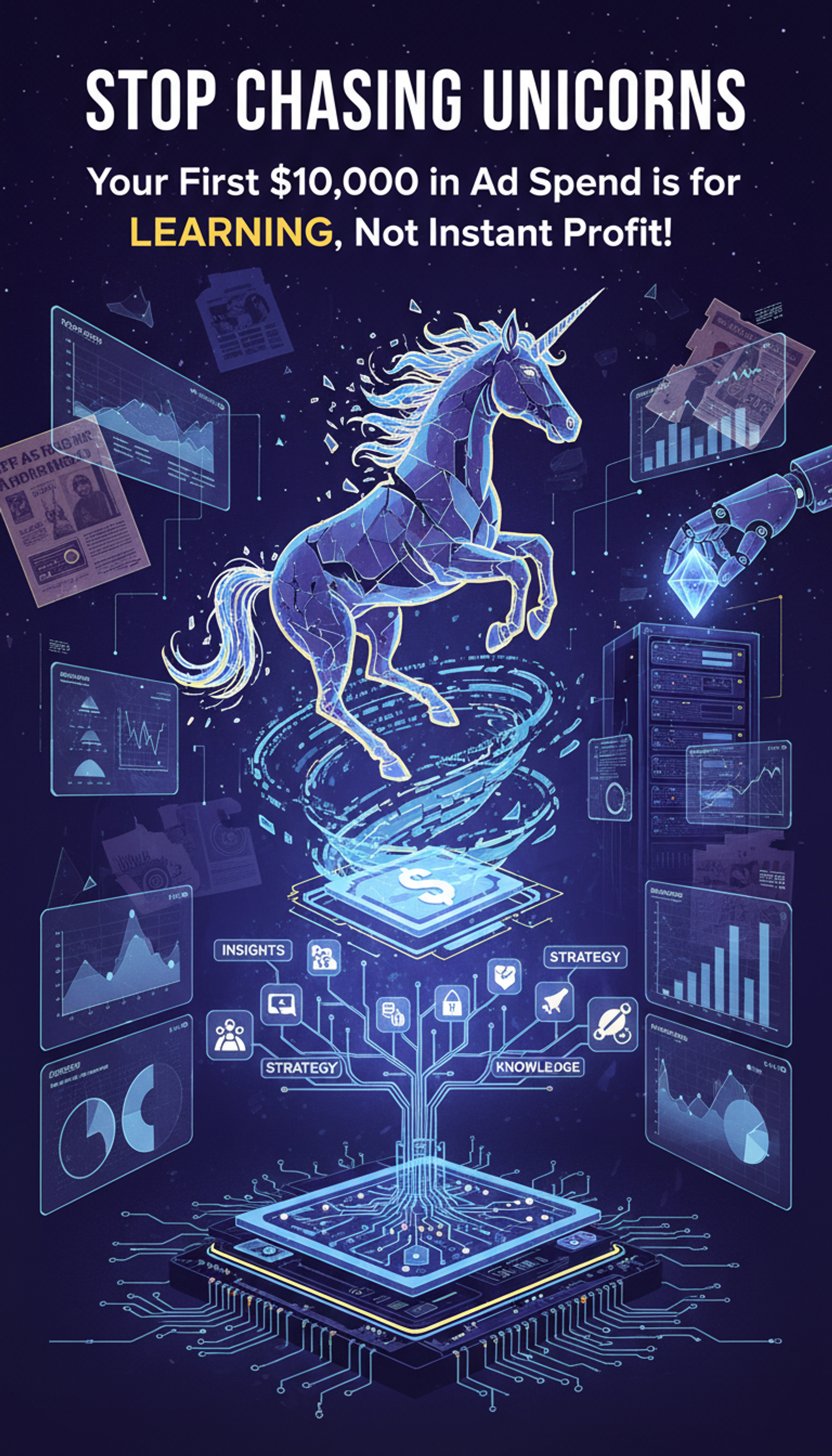
An abstract visualization of data insights and growth, representing the "Learning-First" approach.
The "Learning-First" Philosophy for Initial Ad Spend
The core principle of the "learning-first" philosophy is to view initial advertising expenditure, such as the first $10,000, not as a pursuit of instant profit, but as a crucial investment in gaining knowledge and insights. This approach acknowledges that advertising platforms, especially those utilizing AI, require data to optimize effectively, and initial performance may be erratic as algorithms learn.
Key Learnings from Initial Ad Spend:
- ✓Price Point Validation: Analyzing click-through rates versus abandoned carts can indicate if the price is misaligned with perceived value.
- ✓Channel Efficiency: Understanding the baseline Cost Per Thousand Impressions (CPM) for a specific niche is critical for effective budgeting.
- ✓Product-Market Fit: Gauging genuine interest in an offering determines if there is a market demand or if the product is being forced.
- ✓Messaging Resonance: Identifying which angles capture attention, spark curiosity, and drive engagement.
The Evolution of Advertising:
"Spray and Pray" Era:
Early advertising (print, radio, TV) was mass-market, with budgeting and impact measurement relying on guesswork, surveys, and intuition.
Digital Revolution:
- 1994: First banner ad launched.
- Early 2000s: Google AdWords (now Google Ads) introduced Pay-Per-Click (PPC) and keyword targeting.
- Mid-2000s: Cookies and CRM systems enabled user behavior tracking.
- 2007: Facebook Ads launched, allowing demographic and interest-based targeting.
Digital Dominance: Digital ad spend surpassed television advertising in 2016. Projections estimate digital will account for 72.7% of global ad investment by 2025.
Immediate ROI vs. Long-Term Learning:
These are not mutually exclusive but rather interconnected. The "learning-first" approach prioritizes experimentation, data gathering, adaptation, and optimization for sustainable growth. Conversely, a purely "ROI-driven" approach focuses on immediate financial targets.
Challenges to a Pure ROI Focus:
- Underfunded Learning Phase: Cutting corners on initial testing budgets starves algorithms of necessary data, leading to wasted spend and poor long-term results.
- Short-Term Metrics vs. Brand Building: Balancing immediate conversions with brand awareness campaigns that foster long-term loyalty.
Nuances of Modern Ad Spend:
- Data Overload: The sheer volume of data and constant platform updates can be overwhelming.
- Agency Incentives: Ensuring agencies prioritize client profitability over maximizing ad spend for their own commissions.
True success lies in a hybrid approach where strategic learning fuels sustainable ROI.
Optimizing the First $10,000 "Learning Tranche":
Strategic Allocation:
- Budget Allocation: Dedicate 10-20% of the total media budget to testing and experimentation. For an initial $10,000, this entire amount should be focused on learning.
- Patience: Allow ad platforms sufficient time and data (around 50 optimization events within 7 days) to optimize. Avoid constant tweaking based on limited data.
Testing & Scaling:
- Basic Testing: Focus on creative variations and simple copy. Validate price points and test different audience segments (e.g., men vs. women).
- Scaling: Once winning creative angles are identified, scale them up into more complex formats like video. Increase budgets gradually (10-20% increments) to avoid disrupting the learning process.
Growth Strategies:
- Organic Growth: Leverage growth hacking techniques like organic social media, email marketing, referral programs, content-first strategies (SEO, guides, UGC), community building, and partnerships.
- Lean Paid Options: Explore highly targeted niche social ads, Google PPC Smart Campaigns (utilizing free credits), and retargeting warm leads.
- Guerrilla Marketing: Employ creative, unconventional stunts for buzz and brand awareness.
The Future of Advertising: AI, New Platforms, and Smarter Learning
AI Integration:
- Hyper-personalized ads
- Generative AI for content creation
- Autonomous campaign management
- Augmented reality (AR) ads
Emerging Platforms:
- Connected TV (CTV)
- Retail Media Networks (e.g., Amazon, Walmart ads)
- Self-serve Digital Out-of-Home
- Audio streaming platforms
- Niche community platforms
Smarter Metrics:
- Revenue-driven KPIs
- Predictive analytics
- Increased value of first-party data
- Agile Marketers: Continuous, practical learning
Conclusion: Invest in Learning, Reap the Rewards
Initial ad spend is a strategic investment in market understanding, product refinement, and message perfection. The insights gained from this "learning tranche" will save money long-term and drive exponentially better ROI. The focus should be on learning from ad spend to foster brand growth.
Share this article
Help others discover this content