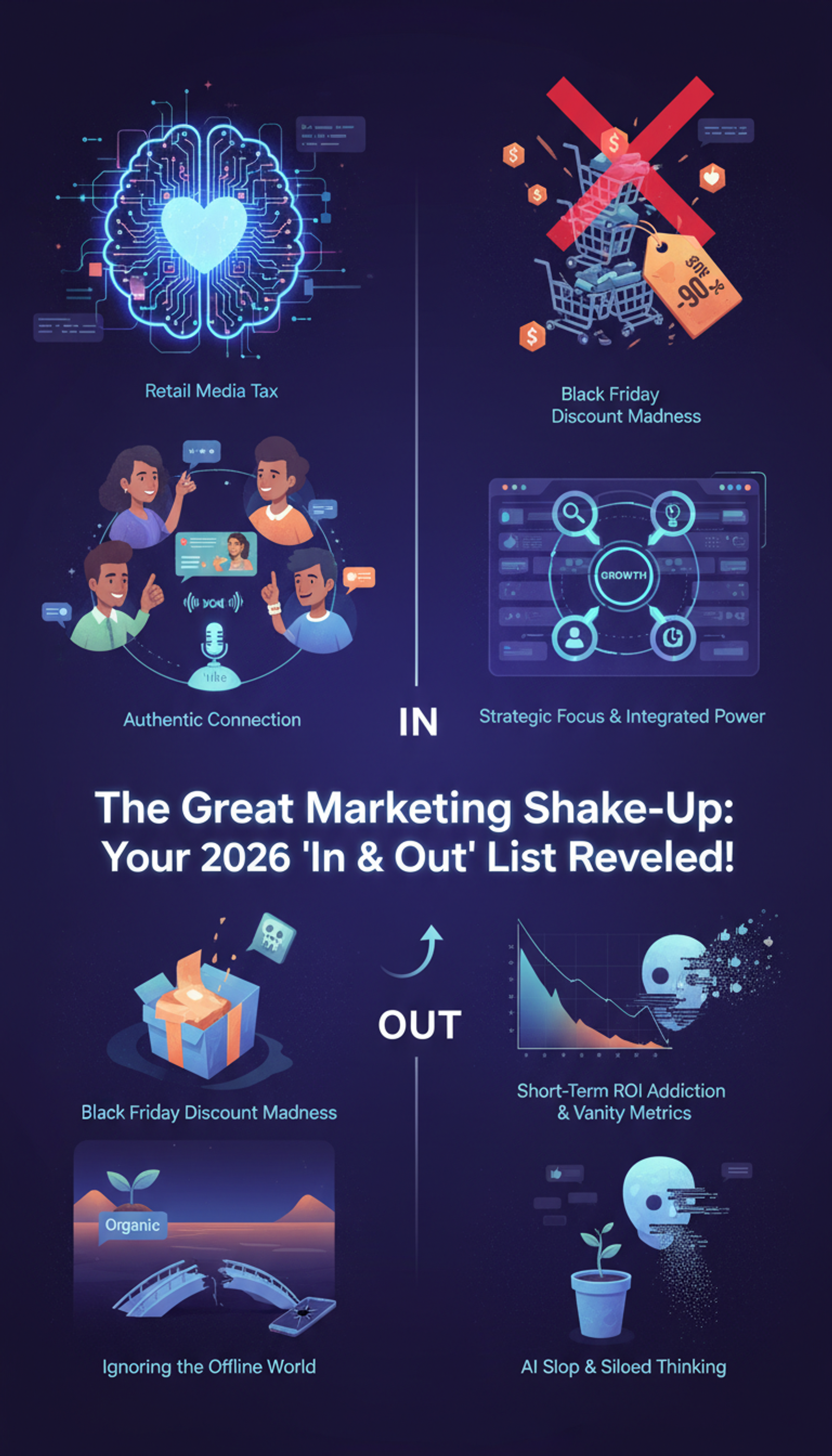

The Great Marketing Shake-Up: 2026 "In & Out" List
This report outlines key shifts in marketing strategy for 2026, emphasizing a move from broad shouting to targeted, meaningful engagement, integrating AI
with human connection, and prioritizing genuine impact over superficial metrics.
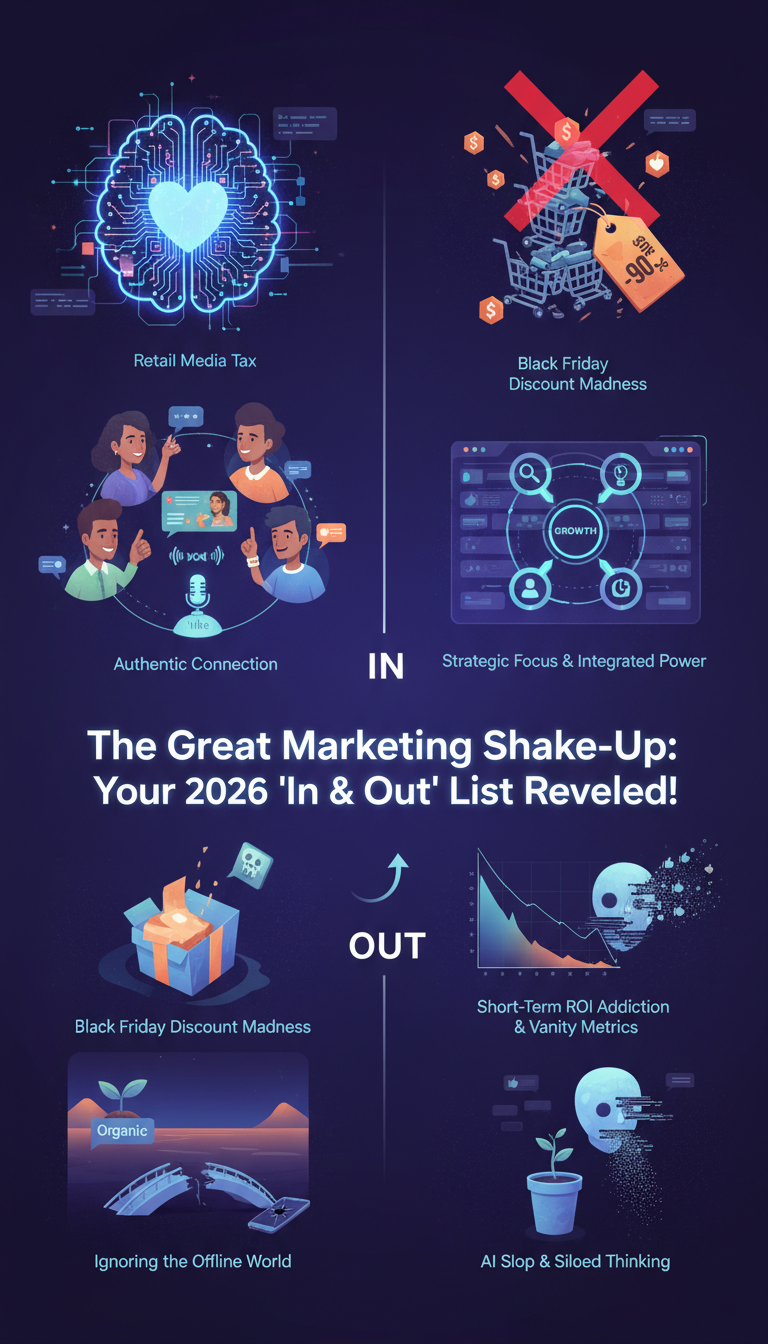
Part 1: What's "IN" for 2026?
1. AI with a Human Heartbeat
AI is evolving from a simple automation tool to a sophisticated co-pilot in marketing, influencing content, customer interactions, and product development.
Key Trends:
- Generative Engine Optimization (GEO): The new SEO, focusing on optimizing content for AI overviews and summaries that shape perception.
- Hyper-personalization: Crafting personalized product experiences in real-time based on individual behavior and preferences, extending beyond targeted ads.
- Human Craft Augmented by AI: Leveraging AI while retaining human oversight and creativity to avoid "AI slop."
2. Authentic Connection
Genuine human connection and transparency are paramount in an AI-driven world, with authenticity becoming a luxury.
Key Trends:
- Human-first media: Engaging audiences in communities, forums, and platforms built on shared interests and genuine interactions.
- Micro- and nano-influencers: Prioritizing relatable expertise from niche individuals over broad celebrity endorsements.
- User-Generated Content (UGC): Utilizing customer stories as a core trust-builder.
3. Sonic Branding
Developing a distinctive and memorable sound identity that evokes brand essence and resonates with the target audience.
Future Outlook:
AI and immersive audio will enable personalized and context-aware soundscapes, enhancing brand interactions across all touchpoints.
4. Strategic Focus & Integrated Power
Concentrating efforts on 1-2 key channels and ensuring all marketing efforts work harmoniously for a cohesive brand experience.
Key Trends:
- Seamless omnichannel experiences driven by collaboration between creative and media teams.
- Marketers will become integrated into product development as "product managers," embedding growth and distribution directly into products.
5. Training & Experimentation
Investing in team development and fostering a "test-and-learn" culture to adapt to constant change.
Key Trends:
- 70:20:10 Rule: Balancing 70% proven strategies, 20% new experiments, and 10% innovative "crazy shit."
- Long creative lunches: Encouraging deep thinking and serendipitous idea generation.
6. Customer Time is Gold
Dedicate significant time to understanding customers' worlds, needs, desires, and aspirations on a deep, human level, prioritizing empathy over mere data.
Future Outlook:
Focusing on Customer Lifetime Value (CLV) and creating frictionless experiences to build long-term loyalty.
Part 2: What's "OUT" for 2026?
1. The "Retail Media Tax" Trap
Brands viewing retail media networks as an unavoidable cost for customer access, leading to a "Faustian bargain."
Controversies:
- Fuzzy Measurement: Difficulty in assessing true ROI and distinguishing between new sales and cannibalization.
- "Walled Gardens" of Data: Limited brand insights due to retailers controlling valuable data.
2. Black Friday Discount Madness
Conditioning consumers to expect and only purchase during significant discount periods, devaluing the brand.
Controversies:
- Damages Brand Reputation: Makes the brand appear cheap and less valuable.
- Creates a "Discount Loop": Customers delay purchases waiting for sales.
3. Short-Term ROI Addiction & Vanity Metrics
Obsession with immediate (e.g., 3-month) paybacks and superficial engagement numbers (likes, shares), sacrificing long-term growth.
Controversies:
- Vanity Metrics: Engagement numbers disconnected from actual business value.
- Last-Click Attribution: Ignores the complex customer journey and influences beyond the final touchpoint.
4. AI Slop & Siloed Thinking
Expecting AI to produce generic, undifferentiated content and treating marketing channels in isolation, leading to a "sea of sameness."
Controversies:
- Generic AI Content: Loss of unique brand voice when AI is over-relied upon without human craft.
- Ignoring AI's Impact on Search: Leading to lost visibility.
5. Pretending Organic Can Do It All & Ignoring the Offline World
Believing organic channels alone can compete with paid media or forgetting the existence of consumers outside the internet.
Organic and owned channels are vital but part of an integrated ecosystem, often supported by paid media. Consumers crave real-world, experiential marketing after prolonged screen time. Offline moments should be designed to be shareable.
Conclusion: Future-Proof Your Marketing!
The future of marketing in 2026 hinges on strategic integration, balancing AI with human creativity, online with offline experiences, and short-term gains with long-term growth. The key is to blend AI's power with authentic human connection, using AI to augment creativity and focusing on building genuine, trust-based relationships with customers. Agility, customer obsession, and relentless innovation are crucial for success.
Share this article
Help others discover this content