

Are You Losing Customers Because Your Website Treats Everyone the Same?
Picture this: Two visitors land on your website. One is a first-time visitor from Chicago searching for budget-friendly options. The other is a returning customer from New York ready to upgrade. Your website shows them the exact same homepage, the exact same offer, the exact same call-to-action. One converts. The other bounces. But which one, and why?
Here's the uncomfortable truth most businesses face—consumers expect you to know them. Research shows that most consumers now expect personalized interactions from brands, and an overwhelming majority get frustrated when this doesn't happen. Yet despite these sky-high expectations, most digital marketing leaders struggle to deliver truly personalized experiences.
For years, businesses have relied on traditional Conversion Rate Optimization methods to squeeze more value from their traffic. A/B testing became the gold standard. Audience segmentation felt revolutionary. But these approaches are showing their limitations. They're slow, resource-heavy, and ultimately designed to find one "winning" experience for an imaginary average user.
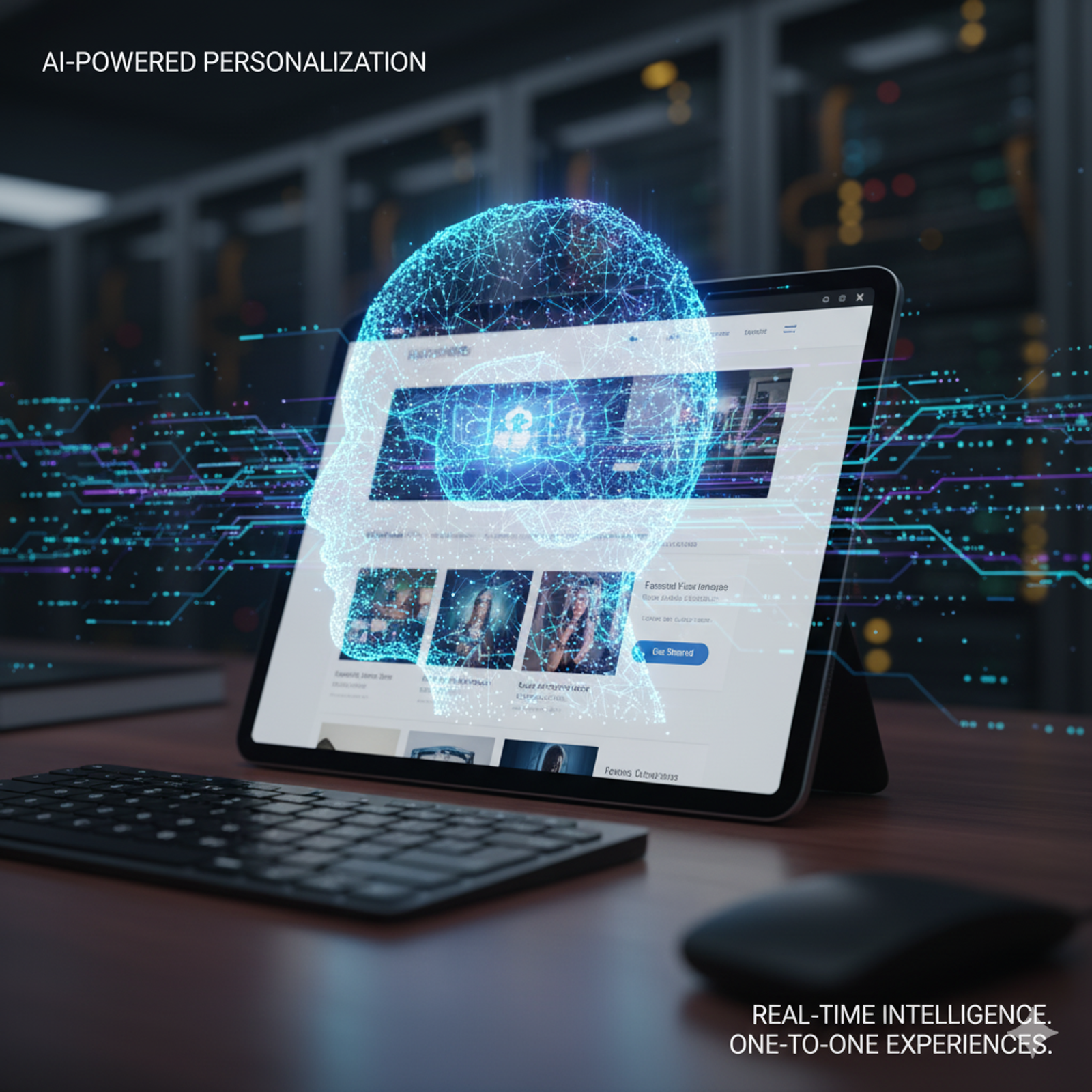
The game has changed. AI-powered personalization isn't just the next trend—it's already reshaping how smart businesses convert visitors into customers. This isn't about slapping someone's first name in an email subject line. It's about using artificial intelligence to understand each visitor's unique intent in real-time and dynamically crafting one-to-one experiences that guide them seamlessly from curiosity to conversion.
Why Traditional CRO Methods Are Running Out of Steam
Let's be honest about traditional CRO. For years, A/B testing and multivariate testing have been the go-to playbook for improving website performance. The approach is familiar: create two versions of a page, split your traffic between them, wait weeks or months to reach statistical significance, declare a winner, and implement it site-wide.
It works. Sort of. But it's starting to show its age.
The Time Trap
Traditional A/B tests are painfully slow. A single test on a key landing page can take weeks or even months to produce reliable results. Need to test multiple elements? You're looking at a testing roadmap that stretches into next year. In today's fast-paced digital landscape where consumer preferences shift rapidly, this sluggish pace creates a serious competitive disadvantage.
The Average User Myth
Here's the fundamental flaw: traditional testing aims to find the single best version of a page for your entire audience. But what if Version A crushes it with new visitors from the West Coast, while Version B resonates more with returning customers from the East Coast? Traditional testing picks one winner and discards the other, leaving massive conversion opportunities on the table.
Think of it this way—traditional CRO is like a clothing store that measures thousands of customers and then manufactures only one size of shirt because it's statistically the "best fit" for the average person. Sure, some people will find it acceptable. But it's too tight for many, too loose for others, and a perfect fit for almost no one.
The Missing "Why"
A/B testing tells you what won, but rarely explains why. It doesn't account for the complex interplay of a user's past behavior, their current context, device type, time of day, or individual preferences. Without this depth of understanding, it's difficult to apply learnings across the entire customer journey. You're left with isolated wins rather than systematic improvements.
The reality is that consumers now carry powerful computers in their pockets and expect experiences as sophisticated as the technology they use. They want to be met where they are, when they want to be met, with exactly what they need. Traditional CRO simply wasn't built for this level of nuance.
What AI-Powered Personalization Actually Means for Your Business
AI-powered personalization represents a fundamental shift from "one-size-fits-all" optimization to genuine one-to-one experiences. Instead of finding the webpage that works best for most people, it creates the perfect version of that page for everyone—simultaneously, automatically, and in real-time.
This isn't science fiction. It's happening right now.
The Technology Powering the Revolution
At the core of AI personalization lies a convergence of powerful technologies working in concert:
Machine Learning algorithms continuously learn from vast datasets of user interactions—every click, scroll, search, and purchase. These algorithms identify complex patterns and correlations in user behavior that would be impossible for human analysts to spot. Over time, they become remarkably accurate at predicting what specific users will respond to best.
Predictive Analytics takes this further by forecasting future behavior based on past and real-time data. These systems can predict a user's likelihood to purchase, their potential for churn, or their probability of abandoning their cart. This predictive power allows businesses to intervene proactively with the right message or offer at precisely the right moment.
Natural Language Processing gives AI the ability to understand and interpret human language, which is crucial for personalizing text content like headlines, product descriptions, and chatbot interactions. It ensures the tone and messaging align with a user's search query or demonstrated interests.
How It Actually Works in the Real World
Here's where theory meets practice. An AI personalization engine continuously ingests a torrent of data: demographics, location, device type, real-time on-site behavior, past purchase history, time of day, and contextual information like weather or trending events. In milliseconds—literally faster than a blink—the AI processes this information, compares it to patterns learned from millions of other user journeys, and makes a decision.
It might dynamically swap the hero image on your homepage. It could reorder product recommendations. It might alter the call-to-action text from "Get Started" to "Continue Your Journey" for returning visitors. It could even modify site navigation to highlight the categories most relevant to that specific user.
Take Netflix as a real-world example. The streaming giant doesn't just personalize what shows it recommends—it even personalizes the artwork you see for each title. Two users browsing the same show might see completely different thumbnail images: one highlighting romance, another emphasizing action, depending on what themes have resonated in their past viewing behavior. This level of personalization has become so sophisticated that no two users see the same Netflix homepage.
Major retailers have seen conversion rates increase substantially when implementing AI-powered product recommendations. Companies using predictive modeling in their CRO strategies report being significantly more likely to see substantial increases in sales compared to those using traditional methods alone.
The Five Pillars of AI-Driven CRO Strategy
Implementing AI-powered personalization isn't about flipping a switch—it's about integrating components that work together to transform static, one-way broadcasts into dynamic, two-way conversations with your visitors.
Dynamic Content That Adapts in Real-Time
This is personalization at its most visible. Instead of showing every visitor the same hero image, headline, and call-to-action, AI swaps these elements in real-time based on who's looking at them.
An outdoor gear retailer might show winter coats to visitors from cold climates while simultaneously displaying hiking gear to someone browsing from a warm region. A software company could present a headline focused on "Enterprise Scalability" to visitors from large corporations while showing "Simple Setup" to visitors from small startups—all based on company size data processed instantly.
The results speak for themselves. One fashion retailer using dynamic content saw order values increase dramatically when switching from generic recommendations to AI-powered personalized suggestions.
Recommendation Engines That Actually Understand Intent
You've experienced this on platforms like Netflix and Amazon, but the technology has become far more sophisticated. Modern AI recommendation engines analyze browsing history, past purchases, and the behavior of similar users to suggest products or content with uncanny accuracy.
This isn't just about improving user experience—it's a powerful tool for increasing average order value and lifetime value. When done right, AI recommendations can boost conversion rates substantially and increase average order values significantly. One seller reported a product's conversion rate jumping dramatically within weeks after implementing AI-generated product descriptions.
Predictive Targeting That Catches Visitors Before They Leave
This is where AI moves from reactive to proactive. Exit intent technology has evolved dramatically. Modern AI systems analyze mouse movements, scroll speed, time on page, and dozens of other micro-signals to predict when a user is about to leave—sometimes before the user even consciously decides to exit.
But here's what makes AI different: instead of triggering a generic "Wait! Don't Go!" popup, it can launch a highly relevant intervention. If a user has been viewing a specific product and shows exit intent, the system might trigger a targeted discount on that exact item, or initiate a chat invitation from a specialist who can answer questions about that product category.
Mobile exit intent technology has proven particularly effective, with some implementations showing the ability to recapture a significant portion of visitors who would otherwise have abandoned the site entirely.
Automated Multivariate Testing at Scale
Traditional A/B testing requires humans to manually set up tests, one at a time. AI transforms this completely. Instead of testing two versions, AI systems can run thousands of micro-tests simultaneously, experimenting with countless combinations of headlines, images, colors, and layouts for different micro-segments of your audience.
These systems automatically identify winning combinations for specific user groups and allocate more traffic to them in real-time. It's continuous optimization that operates far beyond human capability. Companies using AI-powered multivariate testing report being able to achieve in hours what previously took weeks.
Personalized Search and Navigation
A frustrating search experience is a guaranteed conversion killer. AI supercharges site search by reordering results based on individual behavior and preferences. If a user has previously shown interest in a specific brand, products from that brand appear higher in their search results. AI can even personalize navigation menus, highlighting categories or links most relevant to each user.
This seemingly small enhancement can dramatically reduce the time to find desired products, directly impacting conversion rates and customer satisfaction.
Real Results from Real Businesses
The proof isn't just in the technology—it's in the results businesses are seeing:
A travel booking site using AI-driven CRO strategies added millions in revenue by collecting user feedback with AI survey tools, identifying copy issues, and implementing trust signals based on insights. The key? They used AI to understand what was making visitors hesitant and addressed those specific concerns.
A confectionery brand increased conversions significantly through an AI-powered video personalization campaign that allowed customers to create custom gift videos. The emotional connection created by this personalized experience translated directly into measurable business results.
Amazon sellers using AI to generate optimized product descriptions have reported conversion rates climbing substantially within just weeks of implementation—one product jumping from an already-solid conversion rate to an impressive level.
In the financial services sector, companies using AI-driven predictive insights within their CRM systems have reported substantial increases in sales efficiency.
Perhaps most tellingly, research shows that companies excelling at personalization generate significantly more revenue from those activities compared to average performers. The gap between personalization leaders and laggards is widening rapidly.
Getting Started Without Getting Overwhelmed
The scope of AI personalization can feel overwhelming, but implementation doesn't have to be. Here's how to approach it strategically:
Start with Clear Objectives
Before implementing any AI tool, get crystal clear on what you're trying to achieve. Are you focused on reducing cart abandonment? Increasing average order value? Improving lead quality? Use the SMART framework—make goals Specific, Measurable, Actionable, Realistic, and Time-bound. A goal like "increase mobile conversion rate by eight percent within six months" beats "improve conversions" every time.
Assess What You Already Have
Look at your current CRO strategy with fresh eyes. Where are the bottlenecks? What data are you already collecting but not using effectively? Many businesses discover they're sitting on goldmines of customer data that could power personalization efforts if properly organized and analyzed.
Many companies use Customer Data Platforms as the foundation for personalization. These systems consolidate data from multiple sources and make it accessible to AI engines in real-time.
Choose the Right First Use Case
Don't try to personalize everything at once. Pick one high-impact area to start. Homepage hero content is often a great starting point because it's visible to all visitors and relatively straightforward to implement. Product recommendations are another popular entry point with clear ROI metrics.
Address the Challenges Head-On
Be realistic about the challenges you'll face:
Data Quality and Privacy: AI is only as good as the data it learns from. Messy, incomplete, or outdated data produces unreliable insights. Equally important, you must establish strict data management policies to ensure customer data remains secure. With privacy regulations tightening globally, building trust through transparent data practices isn't optional—it's essential.
Integration Complexity: Fitting new AI systems into existing tech stacks can be challenging. The integration often requires specialized skills, and compatibility issues can arise. Plan for this by involving technical teams early and potentially partnering with vendors who offer implementation support.
The Skill Gap: Managing and interpreting AI outputs requires capabilities that many teams don't currently have. You might be excellent at analyzing conversion funnels, but implementing machine learning models or prompt engineering is a different skill set entirely. Address this through training, hiring, or partnerships with specialists.
Balancing Automation with Human Oversight: While AI can automate testing, analysis, and content delivery, it lacks contextual understanding and brand intuition that humans provide. Over-reliance on AI can lead to decisions that ignore brand integrity or specific business goals. The sweet spot is AI providing data-driven recommendations with humans making final strategic decisions.
What's Next: The Future is Already Here
Looking ahead, the trajectory of AI personalization is clear and accelerating:
Hyper-personalization is moving beyond individual web pages to encompass entire customer journeys across all touchpoints. By the end of this decade, the most sophisticated businesses will deliver experiences that adapt in real-time across websites, emails, apps, social media, and even physical stores—all coordinated by AI to maintain consistency while maximizing relevance.
Predictive personalization will become standard practice, with AI anticipating customer needs before customers themselves are aware of them. Systems will move from "you bought this, so you might like that" to "based on your life stage, location, and behavioral patterns, you're likely to need this product in approximately two weeks."
Voice and visual search personalization is emerging rapidly as consumers increasingly use voice assistants and image-based searches. AI will need to personalize not just text but spoken responses and visual results.
Context-aware experiences will factor in an ever-expanding range of signals—from local weather to current events to a user's emotional state as interpreted by AI analyzing their interaction patterns.
The businesses thriving five years from now will be those that started their AI personalization journey today. The technology isn't experimental anymore—it's proven, accessible, and increasingly necessary to remain competitive.
The Bottom Line
The future of CRO isn't about finding the one best experience for an imaginary average visitor. It's about creating the perfect experience for every single visitor, automatically and at scale. AI personalization makes this possible.
Traditional CRO methods aren't dead, but they're no longer sufficient on their own. The winners in today's digital landscape are those combining the rigor of traditional testing with the power of AI to deliver personalization at a level that was impossible just a few years ago.
The question isn't whether AI personalization will become standard practice—it already is among industry leaders. The question is whether your business will be ahead of the curve or scrambling to catch up.
Consumers have spoken clearly: they expect personalized experiences, they reward brands that deliver them, and they abandon those that don't. The tools to meet these expectations are available, proven, and more accessible than ever.
The future of CRO is here. It's personalized, it's powered by AI, and it's transforming how businesses convert visitors into customers. The only remaining question is: are you ready to join the revolution?
Share this article
Help others discover this content