
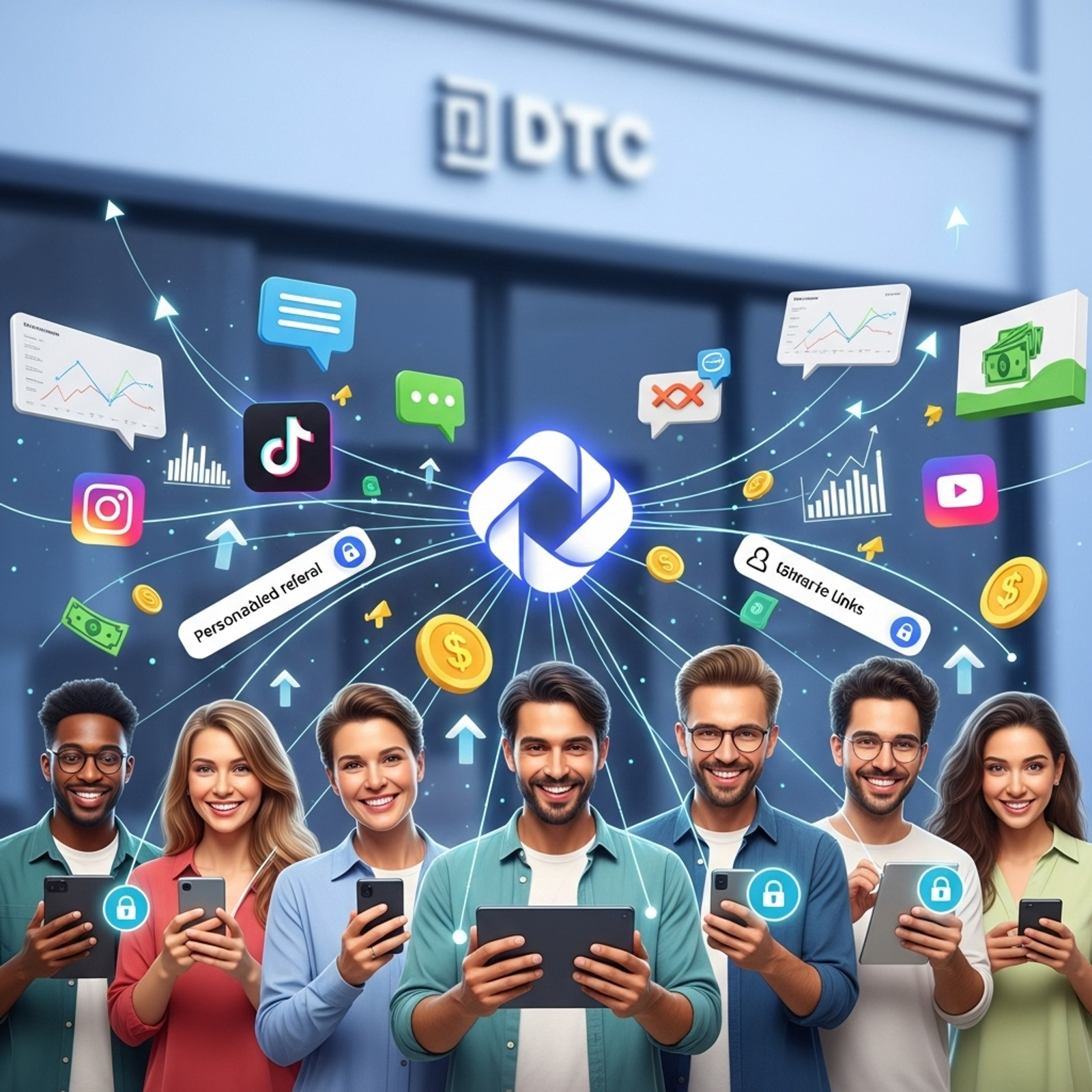

The landscape of affiliate marketing has undergone a fundamental transformation. The traditional approach of relying on static links from bloggers and coupon code websites is no longer sufficient to drive sustainable growth. For today's direct-to-consumer (DTC) brands, the new frontier lies in harnessing the power of modern affiliates: influencers, creators, ambassadors, and most importantly, your own customers. This represents a strategic shift from passive referrals to active, social-powered advocacy that can become your most reliable, high-ROI acquisition channel.
The data overwhelmingly supports this evolution. Businesses using affiliate marketing record an average ROI of $15 for every $1 spent, representing a 1,400% return on investment. With over 80% of brands now leveraging affiliate marketing to drive leads and sales, the industry has grown from $1.7 billion in 2016 to an estimated $24 billion by the end of 2024. This dramatic growth reflects a fundamental shift in how consumers discover and purchase products, with 83% of consumers trusting recommendations from people they know compared to just 33% who trust traditional advertising.
Successfully unlocking this potential requires a strategic blend of seamless technology, smart incentives, and genuine community building. Here's the comprehensive playbook for turning your brand's fans into a thriving army of micro-influencers.
Your Untapped Sales Force: Turn Every Customer into an Affiliate
Forget clunky, old-fashioned "refer a friend" programs that require customers to hunt down a link or fill out a form. The most successful DTC brands have discovered a powerful secret: automatically convert every new customer into an affiliate the moment they complete a purchase. This approach capitalizes on a critical insight - customers are most excited about your brand immediately after making a purchase, when their experience is fresh and positive.
The key is to eliminate all friction. By using modern tech integrations, you can instantly generate a personalized referral link and unique discount code for every customer and display it directly on the post-purchase thank-you page. This is immediately followed up with a post-purchase email containing their unique sharing assets.
This simple, automated step dramatically increases activation rates. The data supports this approach: referral programs see an average conversion rate of 2.35%, but well-designed programs can achieve rates between 10% and 30%, with some exceptional programs reaching 50% conversion rates. You're catching customers at the peak of their excitement and making it effortless for them to share their positive experience with their network. You're not asking them to join a program; you're simply giving them the tools to share a brand they already love.
Beyond Discounts: Why Cash is King for Affiliate Incentives
Many brands default to offering store credit, points, or discount codes as referral rewards. While these can be effective for a customer's first or second referral, their value quickly diminishes. How many 15% off codes can one person really use? For your most active and valuable advocates, these incentives hit a ceiling, and their motivation to keep referring fades.
This is where cash incentives change the game. Current industry data shows that 41% of brands now pay affiliates with cash, compared to 31% who offer free products. This shift reflects the growing understanding that cash remains a compelling and scalable reward, no matter how many referrals someone sends.
Cash incentives respect the value your affiliates create and keep them motivated for the long haul. Top-performing brands leveraging cash-based referral programs often see returns that justify the investment, with referred customers demonstrating 16% higher lifetime value and 37% lower churn rates compared to non-referred customers. This creates a positive feedback loop where higher-quality customers generate more revenue, justifying increased commission payouts.
The most effective commission structure typically ranges between 5% to 30% of the sale value, with many successful programs setting rates at 20-30% of gross profit margin. This balance ensures affiliates are appropriately incentivized while maintaining business profitability.
Keep the Conversation Going: The Power of Active Communication
Setting up an automated affiliate program is a great start, but it's not a "set it and forget it" strategy. Active and consistent communication is critical to keeping the program top-of-mind for your customers. Data shows that 56% of brands state their main purpose for running influencer campaigns is to create user-generated content, highlighting the importance of ongoing engagement beyond simple transactions.
Incorporate reminders into your regular marketing cadence through follow-up emails. More powerfully, integrate the program into your customer support workflow. Train your support team to use macros that plug the referral program at the end of every positive interaction. For example, after a customer's issue has been successfully resolved and they express their satisfaction, a simple message like, "We're so glad we could help! By the way, if you love our products, you can earn cash for sharing us with your friends. Here's your personal link..." can significantly boost referral activity.
Research indicates that 65% of retailers report that affiliate marketing contributes up to 20% of their annual revenue, emphasizing the importance of treating affiliate relationships as a core business function rather than a secondary marketing tactic.
Unify and Conquer: Managing Affiliates Across All Channels
Modern creators don't live on a single platform. They have a presence on Instagram, a store on TikTok Shop, and a community on YouTube. To maximize your reach and their engagement, your affiliate program must meet them where they are. Mobile traffic now accounts for around 62% of affiliate-driven visits, making multi-platform compatibility essential.
The most successful approach involves providing a centralized signup flow and a single dashboard where creators can see their earnings from their Shopify affiliate link, their TikTok Shop commissions, and any other channel, all in one place. This unified view simplifies management for the brand and, more importantly, enhances the experience for the creator, keeping them more engaged.
TikTok's social commerce market is projected to generate over $20 billion in sales in 2024, while Instagram has a conversion rate of 1.08%, meaning around 21.6 million consumers interact with or purchase products from marketing posts. These platforms offer distinct advantages: TikTok leads all platforms in engagement rates, reaching up to 15.04% for smaller accounts, while Instagram remains the preferred platform for 60% of Gen Z shoppers for product discovery.
Brands that unify their affiliate channels under a single system achieve dramatically better results, with some reporting customer acquisition costs as low as $4 - a number that significantly outperforms typical paid social metrics, which can range from $70 to over $1,000 depending on the industry.
Secure Your Margins: Stop Coupon Code Leakage for Good
One of the biggest pitfalls of traditional influencer marketing is coupon code leakage. Static codes like "CREATOR20" inevitably end up on public coupon sites like Honey or RetailMeNot. This leads to two major problems: you pay commissions to the wrong affiliates (the coupon site, not the original creator), and your discount strategy is undermined, eroding your margins.
Industry data reveals that void rates - the percentage of cancelled or fraudulent transactions - can significantly impact affiliate program profitability. The solution is to move away from static codes and embrace secure links. These links generate a unique, single-use discount code in real-time for each genuinely referred customer who clicks through.
This approach ensures two critical outcomes: perfect attribution, where the commission always goes to the creator who drove the traffic, and discount integrity, where your special offers are protected from being scraped by public sites, preserving your profit margins. With average commission rates in affiliate marketing ranging from 5% to 30%, protecting against leakage can represent significant cost savings while ensuring appropriate compensation reaches actual performers.
Leverage the Power of Micro and Nano-Influencers
The data overwhelmingly supports focusing on smaller influencers. Nano-influencers (1K-10K followers) generate 49.7% higher engagement than micro-influencers, with average engagement rates of 2.71% compared to 1.81% for micro-influencers. More importantly, campaigns with nano-influencers can achieve cost-per-click rates roughly 42% lower than those with micro-influencers.
Industry research shows that 44% of businesses prefer working with nano-influencers, while 26% prefer micro-influencers, compared to just 17% favoring macro-influencers and 13% working with celebrities. This preference is driven by performance data: micro-influencers deliver 46% higher engagement than mid-tier influencers, while maintaining more authentic connections with their audiences.
The engagement advantage is particularly pronounced on specific platforms. On Instagram, nano-influencers achieve engagement rates between 1.70% and 4.84%, while accounts with 100,000 to 1 million followers only garner an average engagement rate of 1.06%. This higher engagement translates to better conversion rates and more cost-effective customer acquisition.
Build a Thriving Community, Not Just a Program
To truly scale your micro-influencer strategy, you need to think beyond transactional commissions. The goal is to build a community. Research shows that 70% of brands are working with nano and micro-influencers, making community building essential for competitive differentiation.
Create exclusive groups for your top-performing affiliates and treat them like VIPs. Invite your star creators to a private Discord, Slack, or WhatsApp group. This creates a space for direct communication, feedback, and peer-to-peer connection. The value of this approach is reflected in retention data: referred customers have a 37% lower churn rate and demonstrate higher long-term engagement.
Gamify the experience by implementing tiered commission structures that reward higher performance with better rates. Data shows that tiered commission models can range from 15% for beginners to 25% for advanced performers, providing clear progression pathways that motivate continued participation. Run leaderboard contests and offer milestone gifts (like brand merchandise or new products) to keep your community engaged and motivated.
For the long-tail of your customer affiliates—those who may only refer one or two friends—use automated email flows to nurture them with reminders, tips for sharing, and celebration of their successes. Industry benchmarks suggest that 57.6% of affiliates earn less than $10,000 annually, highlighting the importance of supporting smaller contributors while focusing significant attention on top performers.
By combining high-touch community management for your VIPs with smart automation for everyone else, you can keep your entire affiliate base active and productive. The result is a sustainable, scalable acquisition channel that grows more valuable over time, with affiliate marketing contributing between 5% and 25% of major brands' revenue and delivering consistently strong returns on investment.
The integration of AI and automation tools is revolutionizing affiliate program management, with 63% of marketers planning to use AI in their influencer campaigns. These technologies enable better influencer identification, content optimization, and performance tracking, making it easier than ever to build and scale effective micro-influencer programs.
The future of DTC growth lies in transforming satisfied customers into passionate advocates. By implementing these strategies - from automated onboarding and cash incentives to unified multi-platform management and community building - brands can create a powerful, sustainable acquisition engine that delivers exceptional ROI while building lasting customer relationships.
Share this article
Help others discover this content