
For years, e-commerce brands have followed the same playbook: Run ads → drive traffic → optimize landing pages → hope customers convert.
And for a while, it worked. But in 2026, that traditional funnel is starting to fall apart. Customers no longer follow a predictable path from awareness to purchase. They discover products through Instagram reels, AI assistants, YouTube reviews, creator recommendations, WhatsApp groups, and conversational search tools — often all in the same buying journey. The modern customer journey is messy, fast, and constantly changing. And that’s exactly why brands relying on static funnels are struggling to scale.
The Real Problem Isn’t Traffic — It’s What Happens After the Click
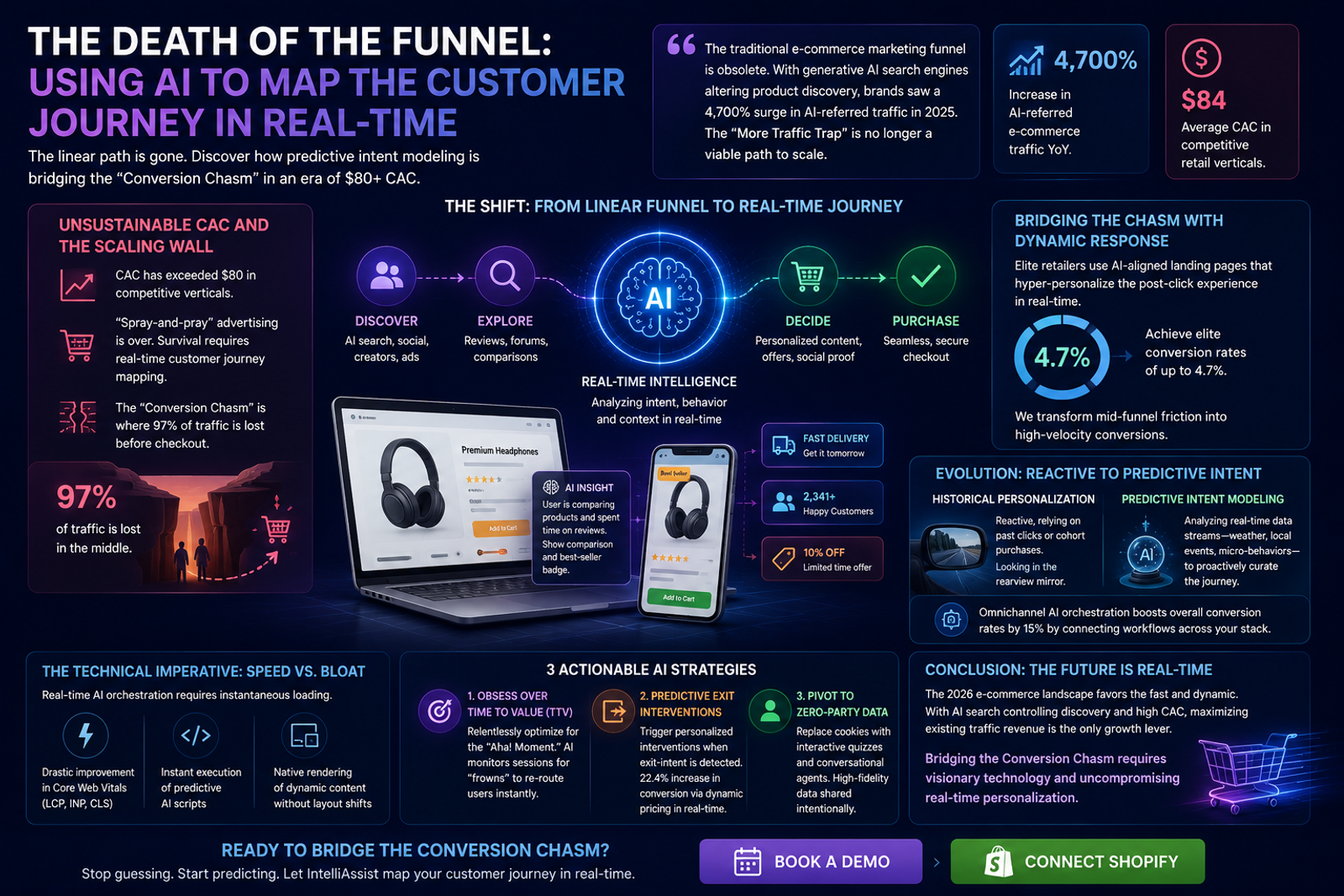
Most brands think they have a traffic problem. In reality, they have a journey problem. Customer acquisition costs have increased dramatically over the last few years. In many competitive industries, brands are now spending $80 or more just to acquire a single customer. That means every click matters more than ever. But despite rising ad spend, most visitors still leave without purchasing.
Why?
Because the experience after the click feels disconnected.A customer clicks on a highly personalized ad… and lands on a generic product page that looks exactly the same for everyone. That gap between customer intent and the actual website experience is what creates the Conversion Chasm. And for most brands, that’s where revenue disappears.
The Funnel Was Built for Predictable Behavior. Customers Aren’t Predictable Anymore.
Traditional funnels assume customers move step-by-step:
Awareness → Interest → Consideration → Purchase. But today’s buyers don’t behave that way. Someone might:
- discover a product through TikTok,
- ask ChatGPT for comparisons,
- read Reddit reviews,
- visit your website three times,
- and finally purchase after seeing a retargeting ad days later.
The journey is no longer linear.
It’s fluid. That’s why modern e-commerce brands are shifting from funnel optimization to real-time journey mapping. Instead of forcing customers through predefined stages, AI helps brands understand intent as it happens.
Why Real-Time Personalization Matters More Than Ever
Consumers today expect relevance immediately. If a website feels slow, generic, or confusing, they leave within seconds. Modern AI systems are helping brands respond to customer behavior in real time by analyzing signals like:
- scroll patterns,
- hover behavior,
- browsing speed,
- returning visits,
- product preferences,
- device type,
- location,
- and even shopping timing.
This allows storefronts to adapt dynamically while the customer is still browsing. For example:
- a first-time visitor may see educational content,
- a high-intent buyer may see urgency-focused messaging,
- and a returning customer may instantly receive personalized recommendations.
The goal is simple: Make the buying journey feel effortless.
Static Product Pages Are Becoming a Growth Bottleneck
Most product pages today are still designed as fixed templates. But customers don’t all think the same way.
Some care about pricing.
Some care about sustainability.
Some want social proof.
Others just want fast delivery.
Showing the exact same experience to every visitor creates friction. That’s why high-growth brands are now investing in dynamic storefront experiences that adapt to different user intents automatically. Instead of treating every visitor the same, AI helps create experiences tailored to the reason they arrived in the first place. And that personalization directly impacts conversion rates.
The Shift From Reactive Marketing to Predictive Intent
Traditional personalization looked backward. It relied on:
- past purchases,
- customer segments,
- or historical behavior.
But modern AI focuses on what the customer is trying to do right now. This is called predictive intent modeling.Instead of reacting after users leave, brands can now identify hesitation while it’s happening.
For example:
- repeated scrolling may indicate confusion,
- fast tab switching may signal comparison shopping,
- and exit behavior may suggest pricing hesitation.
AI systems can then respond instantly with:
- product comparisons,
- trust signals,
- bundles,
- offers,
- or simplified checkout experiences.
That’s the difference between reactive optimization and real-time journey orchestration.
Speed Is No Longer Optional
Personalization only works if the experience remains fast. Customers expect websites to load instantly, especially on mobile.
Even a one-second delay can hurt conversions significantly.
That’s why many modern e-commerce brands are simplifying their websites by:
- removing bloated plugins,
- using lightweight storefront architectures,
- optimizing mobile performance,
- and prioritizing Core Web Vitals.
Because no matter how intelligent your personalization is, it fails if the experience feels slow.
What Smart Brands Are Doing Differently
The brands growing fastest in 2026 are no longer obsessed with getting more traffic.
They’re focused on maximizing the value of the traffic they already have.
That means:
- creating adaptive landing pages,
- reducing friction across the journey,
- using zero-party data instead of relying on cookies,
- and building AI-driven customer experiences that evolve in real time.
Instead of guessing what customers want, they’re learning continuously from live behavior.
The Future of E-Commerce Is Real-Time
The biggest shift happening in e-commerce isn’t just AI-generated content or automation. It’s the move from static experiences to intelligent, responsive journeys. The brands that succeed over the next few years will not be the ones spending the most on ads.
They’ll be the ones creating experiences that understand customers faster, reduce friction sooner, and personalize every interaction more intelligently. Because in a world of rising CAC and shrinking attention spans, relevance wins.
Final Thoughts
The traditional funnel isn’t broken because marketing stopped working. It’s broken because customer behavior changed faster than most brands adapted. Today’s customers expect faster, smarter, and more personalized experiences from the very first click. And as AI continues to reshape discovery, shopping, and decision-making, real-time customer journey mapping will become one of the biggest competitive advantages in e-commerce.
The future doesn’t belong to brands with the most traffic. It belongs to brands that understand intent in real time.
Share this article
Help others discover this content