
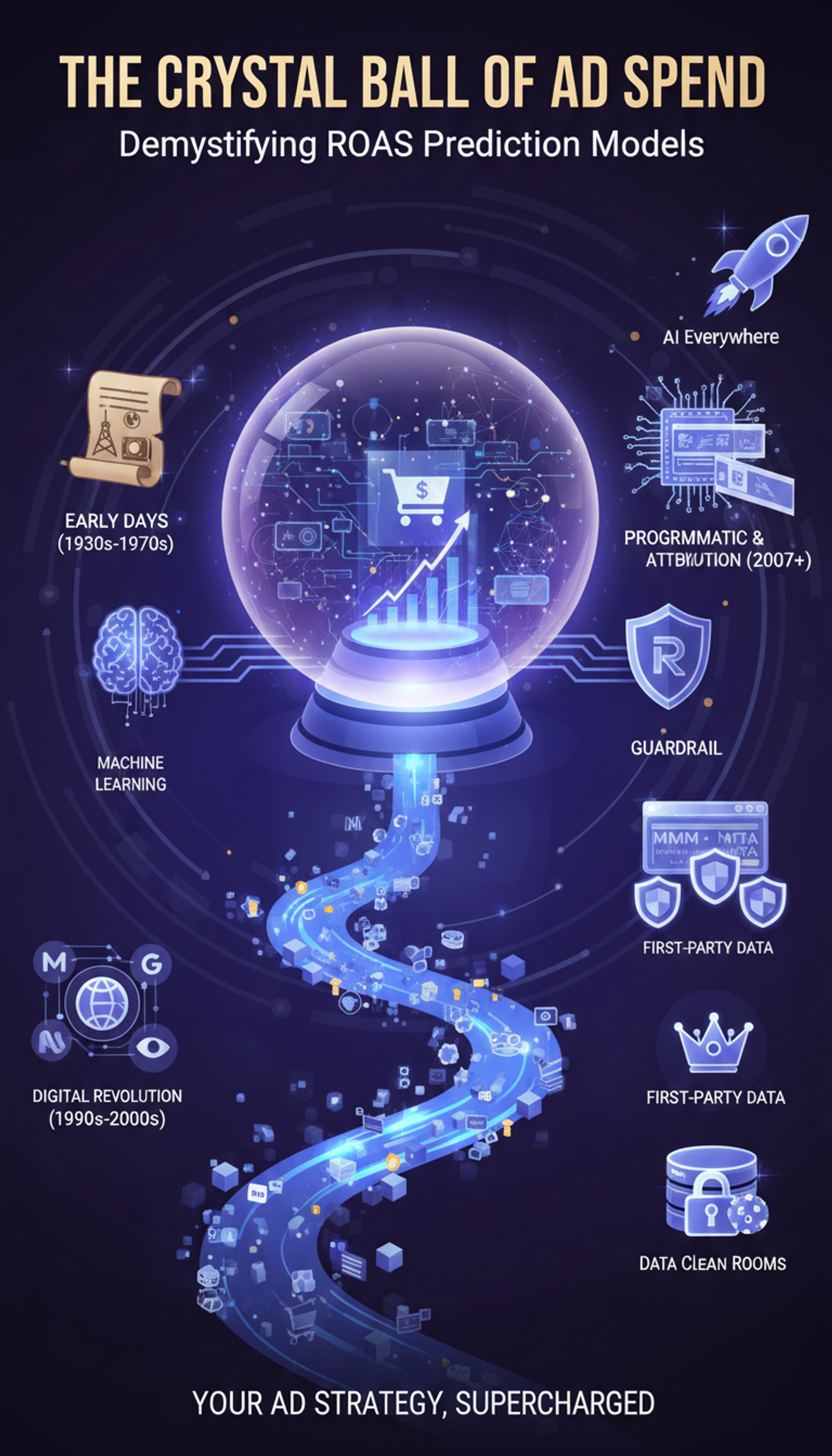

The Crystal Ball of Ad Spend: Demystifying ROAS Prediction Models
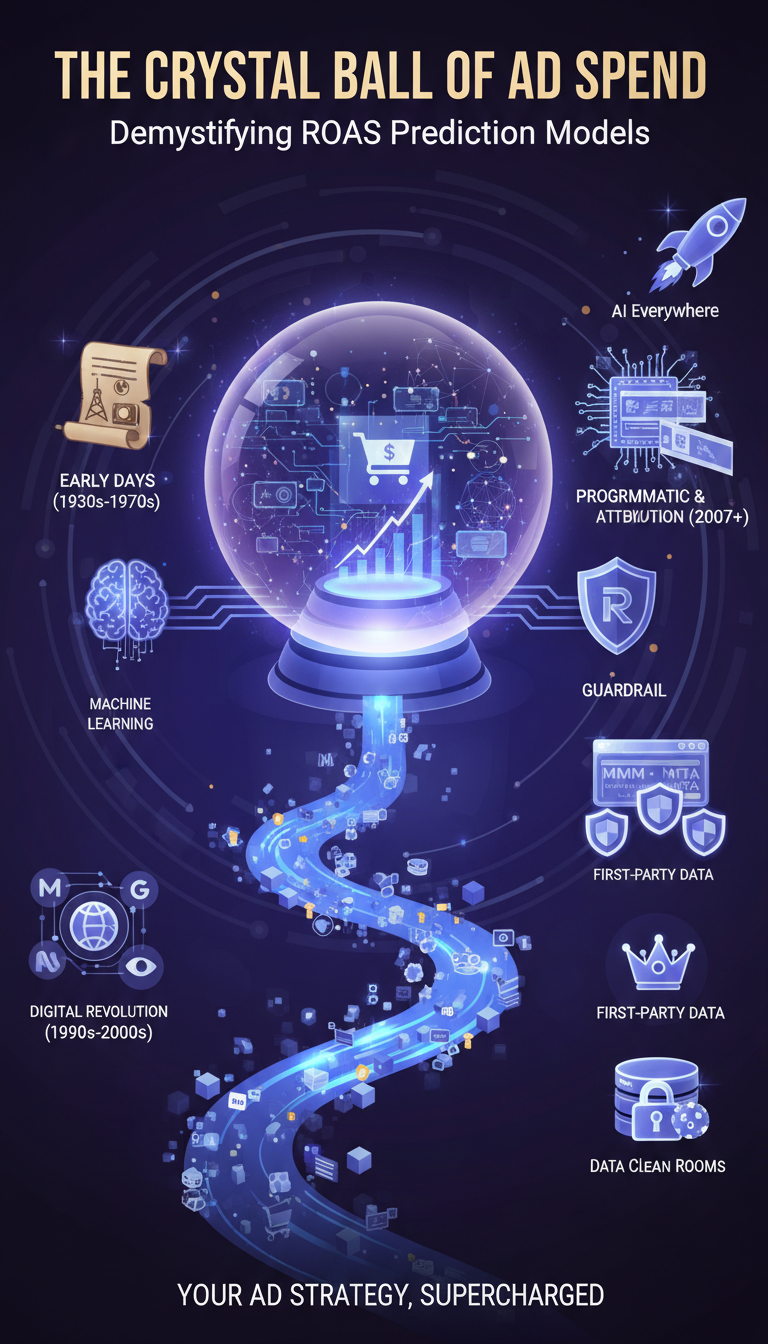
I. Introduction: What if You Could See the Future of Your Ad Spend?
Imagine trading in your rearview mirror for a crystal ball when it comes to advertising. What if, instead of reacting to last month's performance, you could anticipate next month's triumphs (or avoid potential disasters)? That's the promise, the allure, of ROAS prediction models. They offer a glimpse into the future, transforming ad accounts from reactive war rooms into proactive strategy centers.
ROAS, or Return on Advertising Spend, that hallowed acronym whispered in every marketing meeting, is ultimately the holy grail. It's the measure of our efforts, the justification for our budgets, the quantifiable proof that our creativity translates to cold, hard cash. And what if you could see that return before you even spent the money? To scale with confidence, not guesswork. This is what ROAS prediction promises.
II. ROAS Prediction Models 101: Your New Secret Weapon
These aren't your grandfather's reports, simply charting the past. ROAS prediction models are about forecasting "what will happen," not just reporting "what did happen." They attempt to decipher the complex tapestry of consumer behavior and market forces, offering a data-driven premonition of future ad performance.
But how does this magic work? Under the hood, it's a blend of sophisticated technologies and methodologies. Machine learning algorithms form the "brain" of the system, learning from the vast archives of past campaigns, dissecting audience behaviors, recognizing the ebb and flow of seasonality, and identifying the subtle signs of creative fatigue. Think regression analysis, gradient boosting, and even the more complex neural networks like LSTMs, adept at processing time-series data.
However, pure machine learning can sometimes lead to wild, unconstrained predictions. That's where rule-based systems come in, acting as "guardrails," injecting logical constraints to prevent risky or nonsensical recommendations. The real genius lies in combining these approaches – the raw predictive power of machine learning tempered by the wisdom of established rules. For example, understanding how a prospecting campaign today might impact remarketing efforts weeks later.
Of course, even the most sophisticated model is only as good as the data it consumes. These systems require a constant diet of rich, clean data from a multitude of sources: the ad platforms themselves, web analytics, e-commerce platforms, and even contextual data about seasonality or current events. Generally, a model needs around 30-90 days of historical data to learn and provide meaningful predictions.
A truly potent ROAS prediction system possesses several superpowers. It can forecast "what if" scenarios, allowing you to simulate the impact of doubling your budget or shifting it to a new channel. It can predict audience saturation and the inevitable decay of even the most compelling creative. Most importantly, it offers smart budget allocation recommendations, transforming your ad account into a virtual "revenue simulator."
III. A Walk Down Memory Lane: How We Got Here
Our quest to predict ad performance is not new. It's a journey that mirrors the evolution of advertising itself.
In the early days (1930s-1970s), measurement was rudimentary, often limited to tracking radio audience exposure. Then came Marketing Mix Modeling (MMM), employing linear regression to analyze the impact of traditional media campaigns. While a significant step forward, MMM was slow, costly, and largely confined to the budgets of the biggest players.
The digital revolution (1990s-2000s) ushered in a new era. The first banner ads, ad servers, and the advent of Google AdWords brought with them a torrent of digital metrics: impressions, click-through rates, conversions, and ultimately, ROAS.
The era of programmatic advertising and sophisticated attribution (2007 onwards) introduced real-time bidding and attempted to grapple with the complexities of the modern customer journey. Last-click attribution gave way to multi-touch attribution (MTA), seeking to credit all touchpoints along the path to purchase.
Interestingly, MMM has seen a modern resurgence, driven by growing privacy concerns. Cloud-based MMM solutions offer faster, more privacy-safe insights.
And now, we stand on the frontier of AI and predictive modeling, poised to move from a reactive to a proactive marketing stance.
IV. The Double-Edged Sword: Current Opinions and Controversies
The allure of ROAS prediction is undeniable. Everyone wants to know the future.
The promise is enhanced decision-making – the ability to scale when predicted ROAS is strong, to cut spending before it's wasted, and to champion creative assets with staying power. A more holistic view emerges, integrating disparate datasets for a richer understanding. And, of course, the ultimate goal: increased revenue and improved efficiency. Many brands have reported significant ROAS increases through the implementation of AI-driven prediction.
However, the path to predictive nirvana is not without its thorns. The very technologies that offer so much promise also raise significant challenges and criticisms.
Privacy Panic – the great upheaval of 2024 – looms large. GDPR, CCPA, and Apple's iOS 14+ ATT framework have fundamentally altered the landscape of data collection, phasing out third-party cookies and creating "noisy optimization signals." Tracking users across platforms has become significantly more difficult.
Attribution Blind Spots persist, exacerbated by the rise of "Walled Gardens" (Meta, Google, Amazon) that restrict data sharing. We grapple with untrickable offline interactions, the enigmatic realm of "dark social," and the growing phenomenon of zero-click searches. And we must acknowledge the inherent limitations of over-relying on last-click attribution, which often fails to capture the full complexity of the customer journey.
The rise of "Black Box" Algorithms, particularly within platforms like Google PMax and Meta Advantage+, raises concerns about transparency. How are these decisions made? Are they free from bias? And, crucially, are they truly optimizing for your goals, or for the platform's bottom line? Detecting ad fraud becomes an even greater challenge.
We must also acknowledge the inherent limitations of these models. They often struggle with low data volumes, unexpected external shocks (a sudden economic downturn, for example), or major shifts in creative strategy or product offerings. They are not magic; they are probability engines, offering the best possible prediction based on the available data.
Agencies are grappling with these challenges in various ways. Companies like Common Thread Collective emphasize holistic approaches that extend beyond simply maximizing ROAS, focusing on overall profit and employing frameworks like their "Prophit System." Tinuiti's "Bliss Point" suite leverages advanced machine learning for forecasting and scenario modeling. And the major holding companies (WPP, Publicis, Omnicom) are all making significant investments in AI for ROI, though Publicis often receives more positive sentiment for its tangible impact on AI initiatives.
V. Peeking into the Future: What's Next for ROAS Prediction?
The future of ROAS prediction is one of increasing sophistication and integration.
We see the rise of Unified Measurement, integrating MMM, MTA, and incrementality testing for a more complete and privacy-conscious view of the customer journey.
AI will be pervasive, deeply integrated into every aspect of the advertising process, from creative optimization to market condition anticipation to resource allocation. Meta's Andromeda (scheduled for 2025) promises to predict user engagement based on a comprehensive understanding of ad data. We can expect to see AI applied to market research, creative development, and overall campaign orchestration.
First-Party Data will become even more critical. As third-party cookies fade into memory, the ability to collect and leverage first-party data – transparently, with proper consent management – will be essential for personalization and for powering the large language models (LLMs) that drive prediction.
Sophisticated LTV Forecasting will become increasingly commonplace. Real-time, AI-driven models will predict customer behavior, enabling better retention strategies, more effective acquisition efforts, and more personalized marketing. We can expect significant revenue increases and a reduction in analysis time.
Data Clean Rooms will play a crucial role, providing a secure and privacy-preserving environment for comprehensive data analysis, especially for multi-touch attribution and prediction.
Privacy-by-Design Targeting will drive a shift towards contextual and cohort-based targeting methods.
The market itself is booming. The global predictive analytics market is projected for robust growth through 2025 and beyond.
VI. Conclusion: Your Ad Strategy, Supercharged
ROAS prediction models represent a powerful tool, capable of transforming ad accounts from reactive entities into proactive, strategic powerhouses.
However, it is crucial to approach these tools with a clear understanding of both their incredible potential and their inherent limitations and controversies.
The future is bright, but undeniably complex. AI, first-party data, and holistic measurement will define success in the years to come.
Ultimately, ROAS prediction should be viewed as a decision-support layer, empowering smart, intelligent scaling within the dynamic and ever-evolving world of advertising. It is not a replacement for human intuition and strategic thinking, but a powerful complement that can help us navigate the complexities of the modern marketing landscape with greater confidence and precision.
Share this article
Help others discover this content