
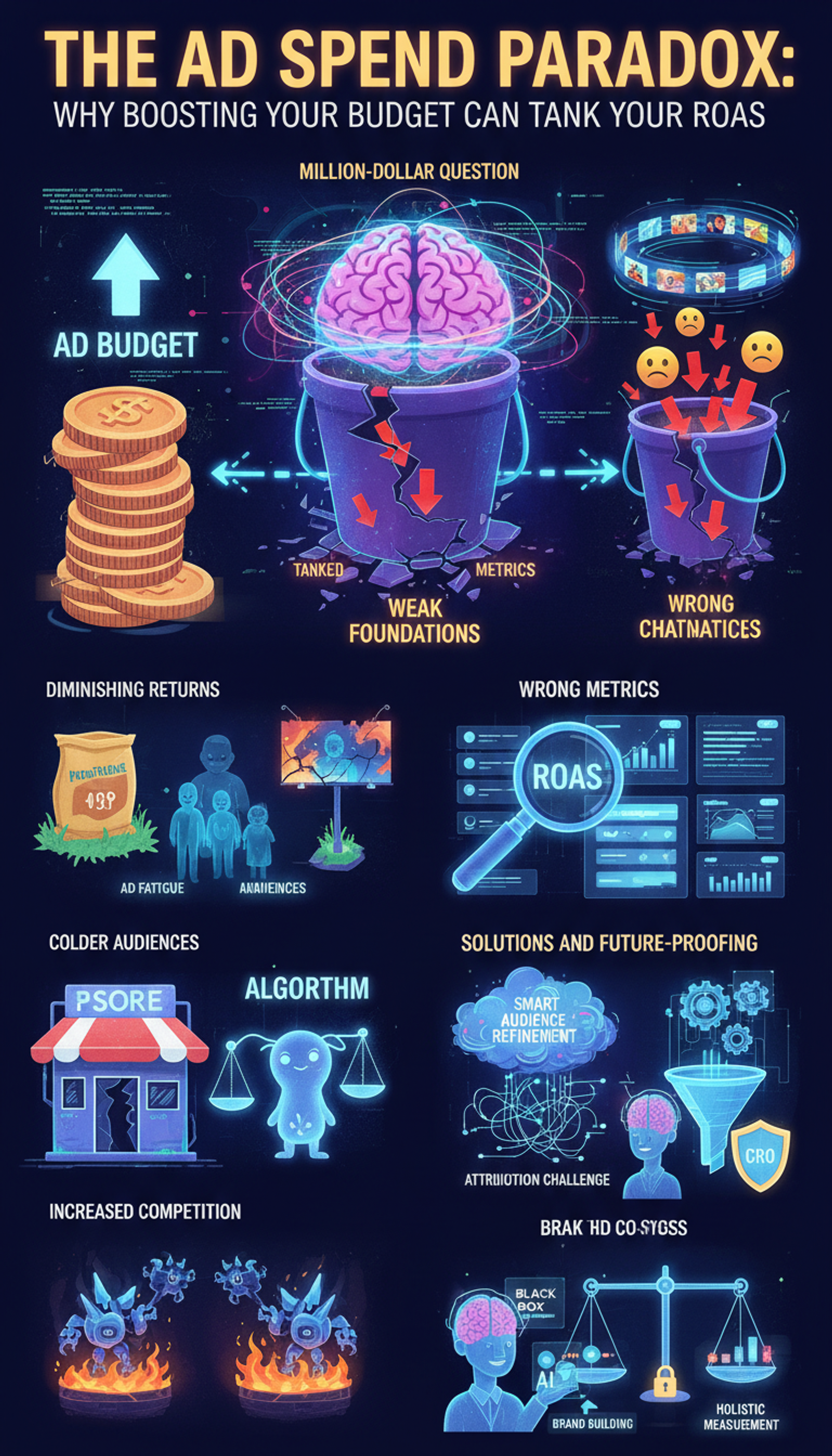

The Ad Spend Paradox: Why Boosting Your Budget Can Tank Your ROAS
You've nurtured your business like a prized garden. Now, with a promising harvest in sight, you're ready to scale. It seems simple, right? More ad spend, more visibility, more sales. Pump up the volume, watch the numbers climb.
But here's the rub, the frustrating reality that keeps e-commerce entrepreneurs up at night: often, pouring more fuel on the ad fire leads to a decrease in Return on Ad Spend (ROAS). The numbers, once a beacon of progress, start flashing red.
"This often boils down to 'weak foundations' and 'focusing on the wrong metrics." — Felix Mayo
I. The Root of the Problem: Why More Ad Spend Can Hurt (The "Weak Foundations")
A. The Age-Old Economic Truth: Diminishing Returns
The invisible hand of economics, ever-present, often ignored in the digital frenzy. The principle of diminishing returns is not some arcane concept confined to textbooks; it's a universal truth. Think of it like this: you add fertilizer to your garden. A little boost yields vibrant growth. But keep piling it on, and you'll find the soil choked, the plants struggling. The same holds true for ad spend.
This isn't a newfangled idea; it's as old as economics itself. 18th-century thinkers like Turgot and Ricardo first observed this phenomenon in farming and factories. Add more workers to a field, and initially, the harvest booms. But eventually, they start getting in each other's way. And so it is with digital ads. The "tipping point" arrives when each extra dollar thrown at your campaign yields less and less impact.
B. Reaching Beyond Your Best Buds: Colder Audiences
Initially, your ads are preaching to the choir – those who already know and love your brand. Warm audiences. Low-hanging fruit. The ROAS is glorious, a testament to the power of targeted marketing.
But scaling demands expansion. You need to reach beyond your inner circle, venture into the unknown territories of "colder" audiences. These are the skeptics, the uninitiated, the ones who need convincing. And convincing them costs more. Conversion rates dip, acquisition costs rise, and that once-stellar ROAS begins to fade.
C. The Boredom Factor: Ad & Creative Fatigue
In the theater of the internet, even the most captivating performances eventually lose their appeal. Your amazing ad creative, that masterpiece of design and messaging, has a shelf life. "Seen it, clicked it...or, more likely, ignored it" becomes the mantra of your target audience as they are bombarded with the same visuals and taglines.
Pumping more money into tired, overused ads is like flogging a dead horse – a waste of resources and energy. Without a constant influx of fresh, engaging content, your audience will tune out.
D. Your Digital Storefront: Sales Funnel Limitations
Imagine a fantastic billboard, strategically placed to capture the attention of every passerby. But what if that billboard leads to a store with a broken door, confusing layout, and empty shelves? All the traffic in the world won't translate into sales.
If your website is slow, clunky, or confusing, if your offer is unclear or uncompelling, even a tsunami of ad-driven traffic will fail to convert. Your sales funnel, that carefully crafted path from awareness to purchase, becomes a bottleneck, a source of frustration for both you and your potential customers.
E. The Algorithm's Quirks: Algorithmic Bias
The algorithms that power our ad platforms are not neutral arbiters of efficiency. They are designed to find "easy wins," to deliver consistent conversions. This can be a blessing and a curse.
As you scale your ad spend, the algorithm may struggle to find new, equally profitable conversions. It might revert to targeting the same audience, optimizing for short-term gains at the expense of long-term growth.
F. The Bidding Battlefield: Increased Competition & Rising Costs
The digital marketplace is a crowded arena, filled with competitors vying for attention. As you increase your ad spend, you inevitably encounter more rivals vying for the same prime ad space.
This increased competition leads to bidding wars, driving up the cost per click (CPC) and cost per mille (CPM). Each conversion becomes more expensive, eroding your ROAS and squeezing your profit margins.
II. The Metrics Maze: Are You Chasing the Wrong Numbers? (The "Wrong Metrics")
A. The ROAS Obsession (and its pitfalls)
ROAS, Return on Ad Spend, the North Star of digital marketing. But what if your North Star is slightly off course? Focusing only on ROAS can lead to a dangerously narrow view of your business. High ROAS isn't always synonymous with high profit.
Consider this paradox: a platform reports a high ROAS, but a significant portion of those sales are from existing customers who would have bought anyway. The platform is essentially "double-counting," taking credit for organic sales.
B. The Attribution Challenge: Who Gets the Credit?
Attribution, the Gordian knot of modern marketing. Traditional "last-click" models, which give all the credit to the final interaction before a purchase, are laughably outdated in today's multi-device, multi-channel world.
Customers embark on complex journeys, bouncing between devices, ads, and content. Accurately crediting each touchpoint is a herculean task, leading to what some call "attribution chaos." And the lack of a unified model fuels endless debates over where to allocate your ad spend.
III. Navigating the Storm: Solutions and Future-Proofing Your Ad Spend
A. Fixing the Foundations (Practical Solutions)
- ⚡Creative Velocity is Key: The antidote to ad fatigue is a constant stream of fresh, engaging content. Consistently test new ad creatives, messages, and formats. Keep your audience on its toes, always offering something new and compelling.
- 🎯Smart Audience Refinement: Don't blindly expand your audience. Refine your existing segments, leverage lookalike audiences strategically, and tailor your messages to resonate with specific demographics and interests.
- 📈Optimize Your Funnel (CRO is your BFF): Make your landing pages lightning-fast, mobile-friendly, and conversion-optimized. A/B test everything, from headlines to calls to action.
- 💰Strategic Bidding & Budgeting: Use automated bidding tools, but monitor them closely. Increase your budgets gradually (e.g., 20% every few days) to allow the algorithms to adapt.
- 🌐Diversify, Diversify, Diversify: Don't put all your eggs in one ad platform basket. Explore new channels to reach fresh audiences and mitigate the risk of algorithm changes or increased competition.
B. Beyond Just ROAS: Embracing Holistic Measurement
- 💖Focus on CLV, not just ROAS: Understand the long-term value of your customers. Acquiring a customer who buys repeatedly is worth a higher initial cost.
- 📊Monitor the Whole Picture: Track a range of metrics, including click-through rate (CTR), cost per click (CPC), conversion rate, average order value (AOV), and customer acquisition cost (CAC).
- 🎯Incremental ROAS (iROAS): Measure the actual uplift in sales caused by your ads, not just sales that would have happened anyway.
- 📈Marketing Mix Modeling (MMM): Use advanced tools to see how all your marketing efforts (ads, brand, content, etc.) contribute to overall sales.
C. The Future Is Now: Emerging Trends and Tech
- 🔒Privacy-First World: Embrace first-party data, contextual advertising, and privacy-enhancing technologies.
- 🤖AI as Your Co-Pilot (But Not the Only Pilot): Use AI for predictive optimization, smart bidding, dynamic creative, and fraud prevention. But exercise caution, and always maintain human oversight.
- 🌟The Brand vs. Performance Balancing Act: Don't sacrifice long-term brand building for short-term ROAS gains. A strong brand reduces acquisition costs over time.
Conclusion: Scaling Smart, Not Just Spending More
Increasing ad spend without a solid foundation and a smart approach to metrics is akin to pouring water into a leaky bucket – a futile exercise in resource depletion.
The path forward isn't about shying away from higher ad spend, but about adopting a strategic, holistic approach. Build robust foundations, diversify your marketing efforts, look beyond vanity metrics, and embrace the future of privacy and AI with a critical eye.
Your ultimate goal isn't just to spend more, it's to grow more profitably.
Share this article
Help others discover this content