
Synergistic Growth: How Product and Landing Page Agents Work Together for 1-to-1 Personalization
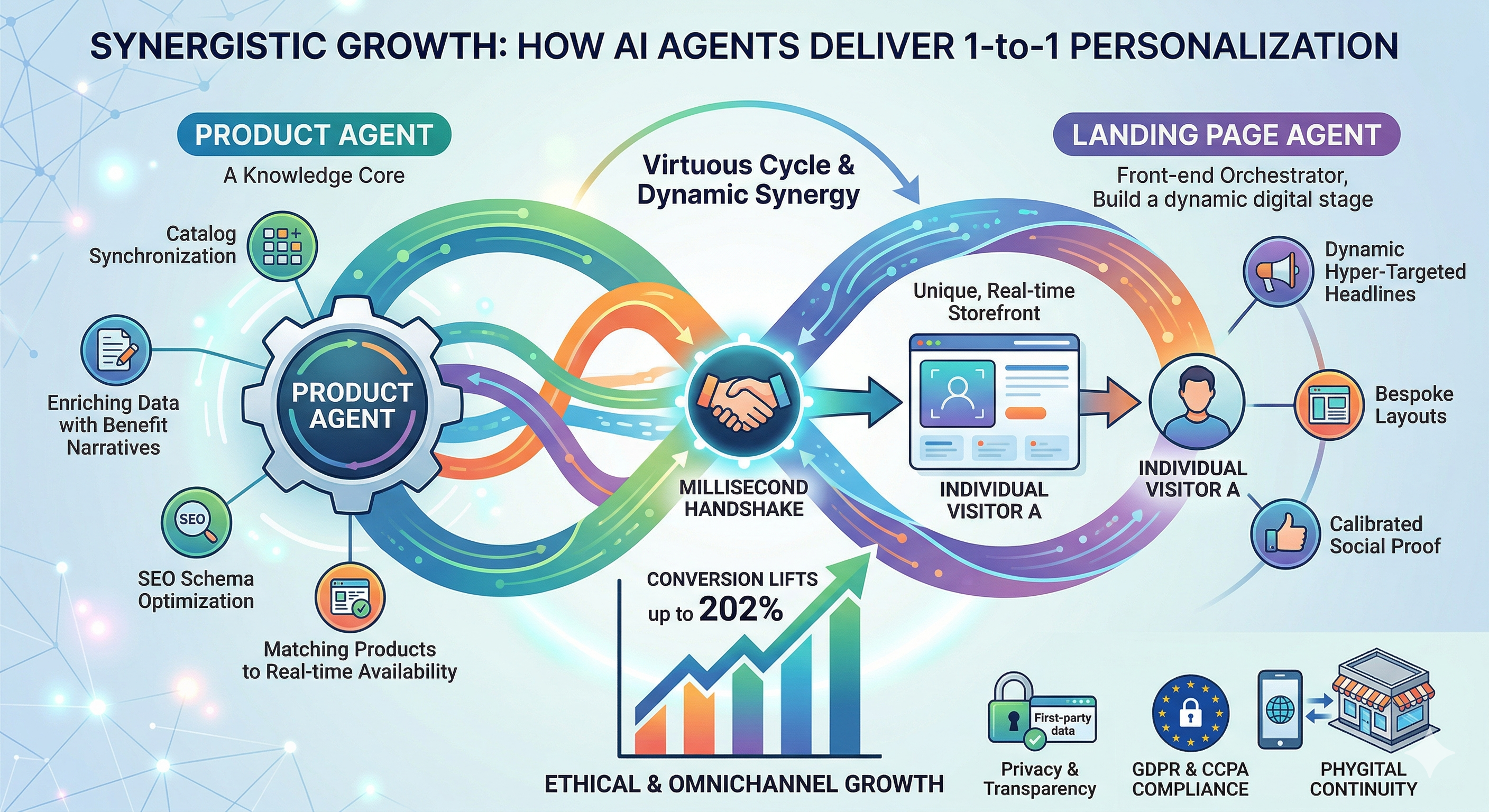
In an era characterized by profound digital fatigue, the concept of the "segment of one" has long hovered on the periphery of marketing lore—a theoretical ideal rather than a practical reality. Yet, we find ourselves at an inflection point. Imagine a digital ecosystem where every individual visitor encounters a unique, real-time storefront, architected in milliseconds and explicitly mapped to their underlying intent. This is no longer mere speculation; it is a conversion reality yielding unprecedented lifts of over 200%. To understand this shift, we must examine the architectural evolution of the systems driving it.
I. The Evolution of Personalization: Entering the Agentic Era
To appreciate the current paradigm, one must trace the lineage of personalization through its distinct technological epochs. We began in the rigid, rule-based era of the 1990s and 2000s, governed by rudimentary "If-Then" logic. It was a time of human-defined segments—blunt instruments attempting to carve nuance out of broad demographics.
The subsequent decade introduced the predictive era, where machine learning models sought the "next-best action" by mining cookies and historical data. Yet, this approach remained inherently reactive. It often felt prescriptive, occasionally uncanny, and was ultimately constrained by its inability to generate novel content on the fly.
We are now traversing into the Agentic Era. Unlike their predecessors, AI agents do not merely execute predefined templates; they operate with autonomy and goal-oriented reasoning. They synthesize, create, and adapt in real-time. This marks the end of the uncanny valley of creepy recommendations, moving us toward a period of genuinely generative, helpful digital experiences that scale without manual intervention.
II. The Power Duo: Meet the Product and Landing Page Agents
The architecture of this new era relies on a symbiotic relationship between two highly specialized entities.
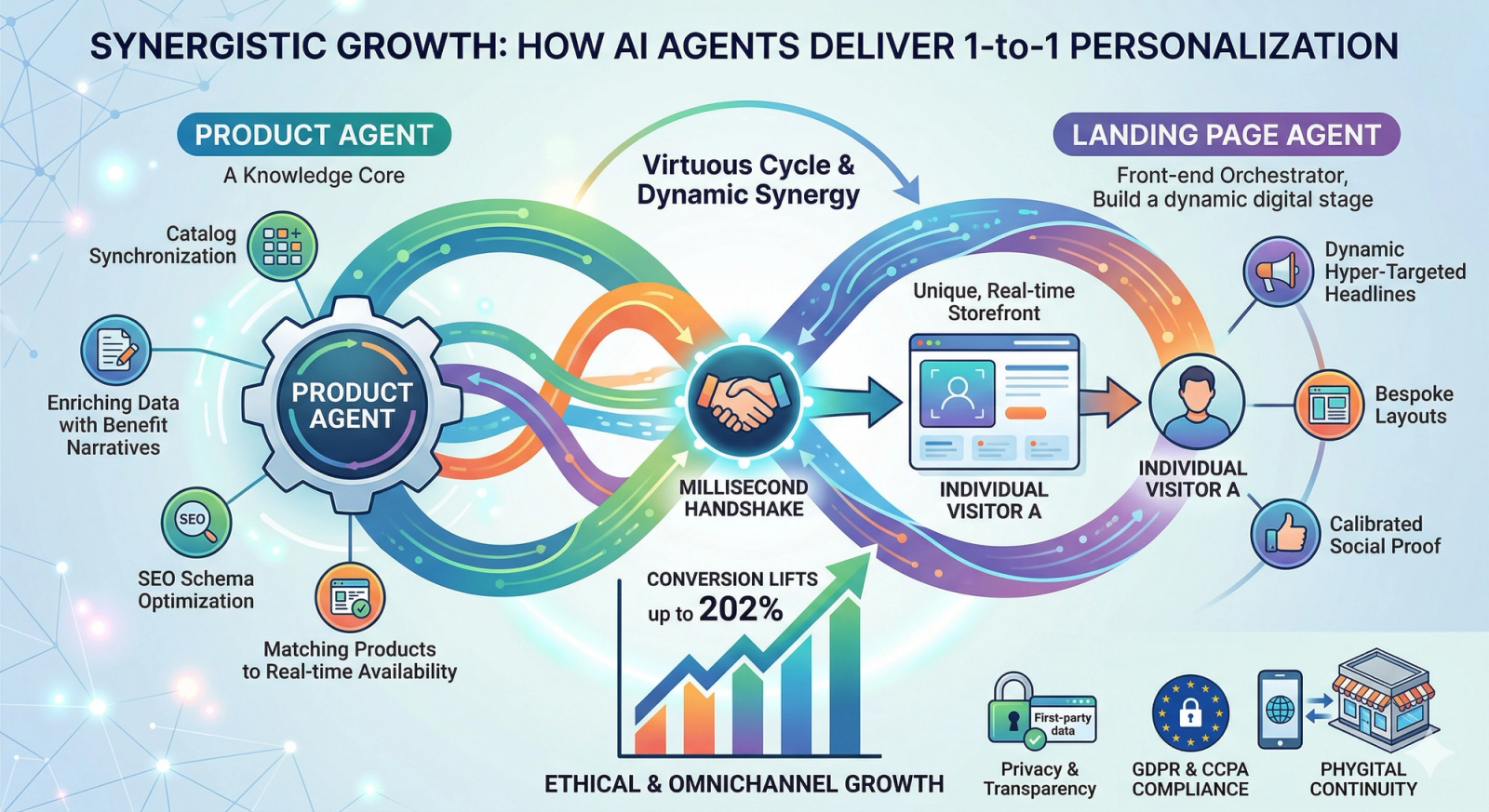
Consider first the Product Agent—the "knowledge core." It operates as an autonomous curator of the "what." By continuously synchronizing with a company’s catalog, it enriches raw data, translating technical specifications into benefit-driven narratives and optimizing SEO schema. It understands not just the inventory, but the historical resonance of each item, matching products to users with calculated precision based on real-time availability.
Conversely, the Landing Page Agent serves as the "front-end orchestrator"—the master of the "how." It receives substantive context from the Product Agent and the psychological context of the referring ad, and proceeds to construct the digital stage. By dynamically generating hyper-targeted headlines, bespoke layouts, and calibrated social proof, it bridges the perilous "conversion gap." It aligns the immediate visual and textual experience precisely with the promise that initially captured the user's attention.
III. Synergistic Growth: The "Segment of One" in Action
The true marvel of this system lies not in the individual capabilities of the agents, but in their interaction—a "millisecond handshake" that balances objective product attributes with persuasive presentation. When a user clicks an ad, the Product Agent and the Landing Page Agent converse in the ether, negotiating the optimal configuration of reality for that specific individual.
This synergy triggers a profound philosophical shift in the role of the human marketer. We are witnessing the evolution from "designer" to "curator." Rather than laboring over the manual construction of fifty static web pages, the modern strategist defines high-level goals and operational boundaries, allowing the agents to iteratively test and generate thousands of automated variations. The efficacy of this synergistic growth is undeniable; platforms leveraging these systems report conversion lifts up to 202%. Operational bottlenecks dissolve, replaced by frictionless, autonomous execution.
IV. Navigating the Personalization-Privacy Paradox
Technological capability, however, must always be weighed against ethical responsibility. We are currently navigating a fraught "Personalization-Privacy Paradox." Empirical data reveals a complex human contradiction: while 64% of consumers engage more deeply with personalized brands, a staggering 75% harbor deep anxieties regarding data misuse.
The specter of "surveillance marketing" looms large in the current discourse. When agents utilize emotional cues or hyper-calibrated "FOMO" (Fear Of Missing Out) nudges to drive sales, they walk a precarious line between helpful facilitation and psychological manipulation.
Resolving this tension requires a structural pivot toward transparency and first-party data—information willingly entrusted to the brand by the consumer. In the shadow of GDPR, CCPA, and the emerging EU AI Act, regulatory compliance is no longer a mere legal hurdle; it is the epistemological foundation of consumer trust. True agentic growth must be rooted in ethical marketing, ensuring that users are continuously aware of how their digital environments are being constructed.
V. The Future of Phygital and Predictive Intent
Looking toward the horizon of the next 12 to 24 months, we must consider how these synergies will permeate the broader human experience. The boundary between the screen and the physical world will blur, giving rise to omnichannel, "Phygital" continuity. An online Product Agent will seamlessly hand off contextual data to a physical retail store agent, ensuring a continuous narrative across all touchpoints without friction or repetition.
Furthermore, we will see the advent of hyper-personalized visual search—agents capable of rendering a product not in a sterilized studio, but within the organic context of the user’s actual environment, such as a localized living room. Perhaps most intriguingly, the utilization of "pre-intent signals" will allow future agents to construct personalized landing pages before a conscious click even occurs, reducing load times to near-zero and challenging our traditional understanding of digital temporal reality.
Key Takeaways
- Collaborative Intelligence: The future belongs to multi-agent frameworks. Product Agents provide the substance (the "what"), while Landing Page Agents provide the context (the "how").
- Massive ROI: Shifting from static pages to agentic systems can yield conversion increases of up to 202% by eliminating the friction of generic user journeys.
- First-Party Priority: Privacy is emerging as a primary competitive advantage. Agents must rely transparently on first-party data to maintain trust and adhere to global regulatory standards.
- Operational Scale: Marketers are evolving into "AI Curators," overseeing autonomous systems capable of generating and analyzing thousands of variations in real-time.
- Omnichannel Future: The synergy between agents will soon bridge the digital-physical divide, transforming both online discovery and physical retail purchasing.
#IntelliAssist #EcommerceGrowth #AIRetail #MarTech #AIPersonalization #RetailInnovation #EcommerceSEO #SmartBusiness #GrowthHacking #AI2026
Share this article
Help others discover this content