
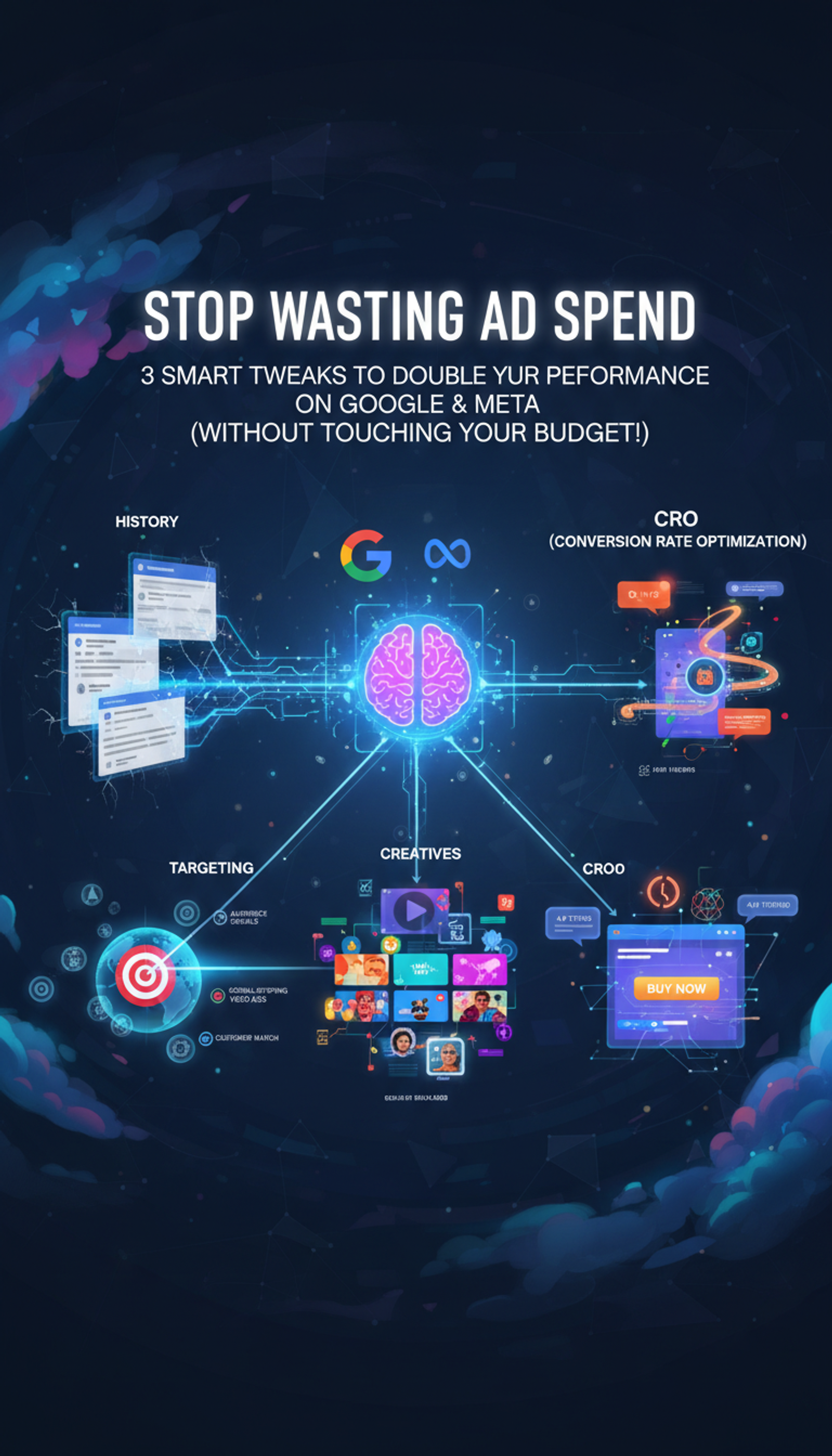

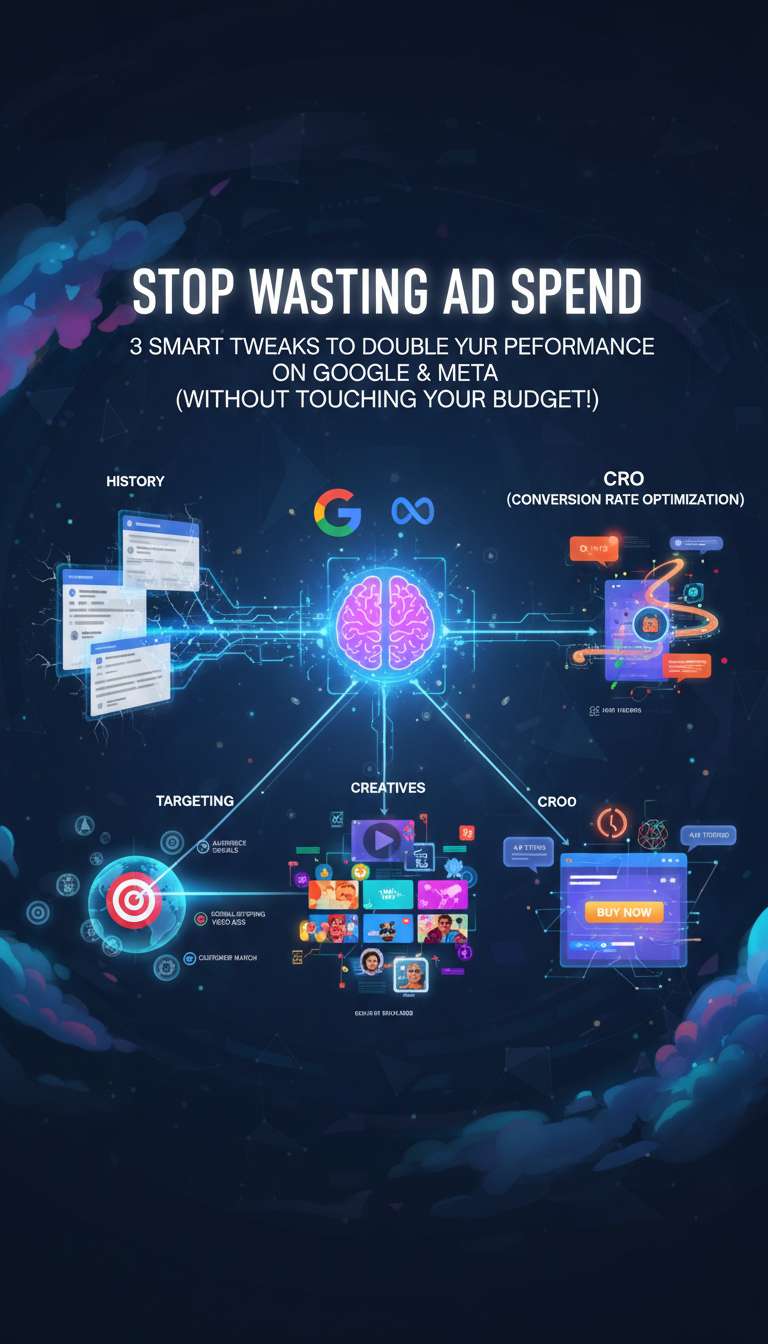
Stop Wasting Ad Spend: 3 Smart Tweaks to Double Your Performance on Google & Meta (Without Touching Your Budget!)
Feeling like your ad budget is vanishing into a digital abyss? You're not alone. True scaling springs from optimizing what you already have.
We're about to unveil three game-changing tweaks for Google Ads & Meta Ads that can consistently boost your ROAS, all without demanding a bigger budget. We'll delve into each tweak – exploring their mechanics, tracing their origins, examining current best practices, acknowledging the inherent challenges, and even peering into their AI-powered future.
Before AI Took Over: A Quick History of Digital Advertising
Before we dive in, a little historical context is crucial. Think back to the Wild West of online ads. Google AdWords, in its nascent, text-based PPC form back in 2000, and Facebook Ads, offering basic demographic targeting around 2007, feel almost prehistoric compared to today's sophisticated systems.
Then came the baby steps toward smarter spending. Quality Score in Google (circa 2005) and Custom Audiences in Facebook (around 2012) felt like revolutionary leaps forward. These innovations paved the way for the machine learning influx, with automated bidding (Google, 2016) and dynamic ads hinting at the AI-driven future we now inhabit.
Why this brief history lesson? Because understanding the evolution of digital advertising helps us navigate today's complex, automated landscape. It reminds us that progress is iterative, and that even the most advanced AI relies on the foundational principles that came before.
Tweak #1: Laser-Focus Your Audience Targeting (Stop Chasing Everyone, Find Your Super-Fans!)
The core idea here is simple but profound: hitting the right bullseye is infinitely more valuable than a scattergun approach. Instead of attempting to appeal to everyone, focus your efforts on identifying and engaging your most likely customers.
The journey towards precision targeting has been fascinating. Google's evolution has taken it far beyond mere keywords, now leveraging "audience signals" like in-market segments, custom intent, and the power of Customer Match. And who can ignore the rise of AI-driven Performance Max?
Meanwhile, Meta's journey has shifted from detailed, manual interest targeting (pre-privacy crunch) to an emphasis on first-party data (via Conversions API), refined lookalike audiences, and increasing trust in their Advantage+ AI.
Current best practices involve layering custom segments, using "Observation" mode for insights, and ensuring your creative speaks directly to your chosen audience. But it's not all sunshine and roses.
The Dark Side: Controversies & Ethical Dilemmas
The pursuit of precise targeting has brought its own set of challenges. The privacy tug-of-war, fueled by GDPR, CCPA, Apple's iOS changes, and Google's impending cookie phase-out, keeps advertisers constantly on edge.
Then there are the accusations of bias in ad delivery, particularly in sensitive areas like job ads and housing. Platforms are working to remove sensitive targeting options (race, religion, health), but the concerns persist. And let's not forget the sticky issue of ads reaching minors or other vulnerable individuals.
Crystal Ball: The Future of Targeting (Hello, AI Overlords!)
Looking ahead, the future of targeting appears to be hyper-personalized ads driven by predictive analytics and real-time signals. By 2025/2026, AI will likely leverage new interaction points (like Meta AI chatbots) to gain an even deeper understanding of user interests.
Tweak #2: High-Intent Keywords & Scroll-Stopping Creatives (Speak to Their Soul & Grab Their Eyes!)
These are the dynamic duo of digital advertising. Brilliant messaging and captivating visuals combined create an ad superpower that demands attention and drives action.
When it comes to keywords on Google, focus on capturing the "I'm Ready to Buy!" signal. Look for transactional terms ("buy," "price"), long-tail phrases, and competitor comparisons. Start with exact/phrase match and wield negative keywords to protect your budget. While this remains crucial, Google's AI increasingly favors broader match types, sometimes challenging the control we once had.
On Meta, creative is king. Visual dominance is paramount. Videos, carousels, authentic user-generated content (UGC), and mobile-first formats are essential for stopping the scroll. Compelling copy should be benefit-focused, concise, and aligned with your brand's aesthetic.
Currently, "creative is the new targeting" – Meta's AI optimizes ad delivery based on the visuals that grab attention.
The Big Battle: Demand Capture vs. Demand Creation (It's Not a Fight, It's a Dance!)
Here's an interesting tension. Google excels at capturing existing demand, connecting with users actively searching for solutions. Meta, on the other hand, shines at creating demand, interrupting feeds with compelling stories and sparking interest where none existed before. Both are vital, but the inherent differences can lead to conflicting strategies.
Advertisers sometimes feel a loss of control as AI automates keyword and creative selection, leading to anxieties around brand safety and messaging consistency.
Tomorrow's Masterpieces: Generative AI for Creatives
Imagine AI automatically writing diverse headlines and descriptions and even generating video ads tailored to specific audiences – a true creative explosion! This future, powered by generative AI, promises to unlock unprecedented levels of personalization and efficiency.
Tweak #3: Conversion Rate Optimization (CRO): Turn Lookers into Buyers!
Ultimately, maximizing conversions from your existing traffic is the most profitable game in town. It's about making the most of the attention you've already earned.
CRO emerged after the dot-com bubble, driven by early A/B testing and tools like Google Website Optimizer (around 2007).
The landing page is your conversion powerhouse. It must match your ad's promise, load quickly, be mobile-friendly, and feature clear, actionable CTAs. Trust-building elements like reviews, security badges, and simplified forms reduce friction.
Continuous A/B testing and holistic UX are paramount for both Google and Meta Ads. But CRO extends beyond the page, encompassing automated bidding strategies, smart ad scheduling, and continuous analysis of conversion tracking data.
The Dark Art of CRO: Beware the "Dark Patterns"!
It's essential to acknowledge the ethical tightrope walk that CRO sometimes involves. Hidden costs, false urgency, trick questions, and "roach motels" that manipulate users are all examples of "dark patterns" that damage trust and erode user experience. True CRO enhances user experience; it doesn't trick people.
Future Forward: The AI CRO Revolution
In the future, AI will provide real-time insights into user drop-off points, suggesting automated landing page improvements and even personalizing content for individual visitors. This level of intelligent optimization will transform CRO from a reactive process to a proactive, data-driven strategy.
Conclusion: Your Budget-Proof Blueprint for Ad Success
To recap: tight targeting, high-intent keywords & creatives, and relentless CRO are your keys to success. The overarching message is clear: don't just spend more; optimize everything to unlock hidden performance and make the most of every marketing dollar.
Embrace the AI era. It's not about replacing marketers but empowering them to be more strategic and creative, freeing them from repetitive tasks and allowing them to focus on higher-level thinking.
Share this article
Help others discover this content