
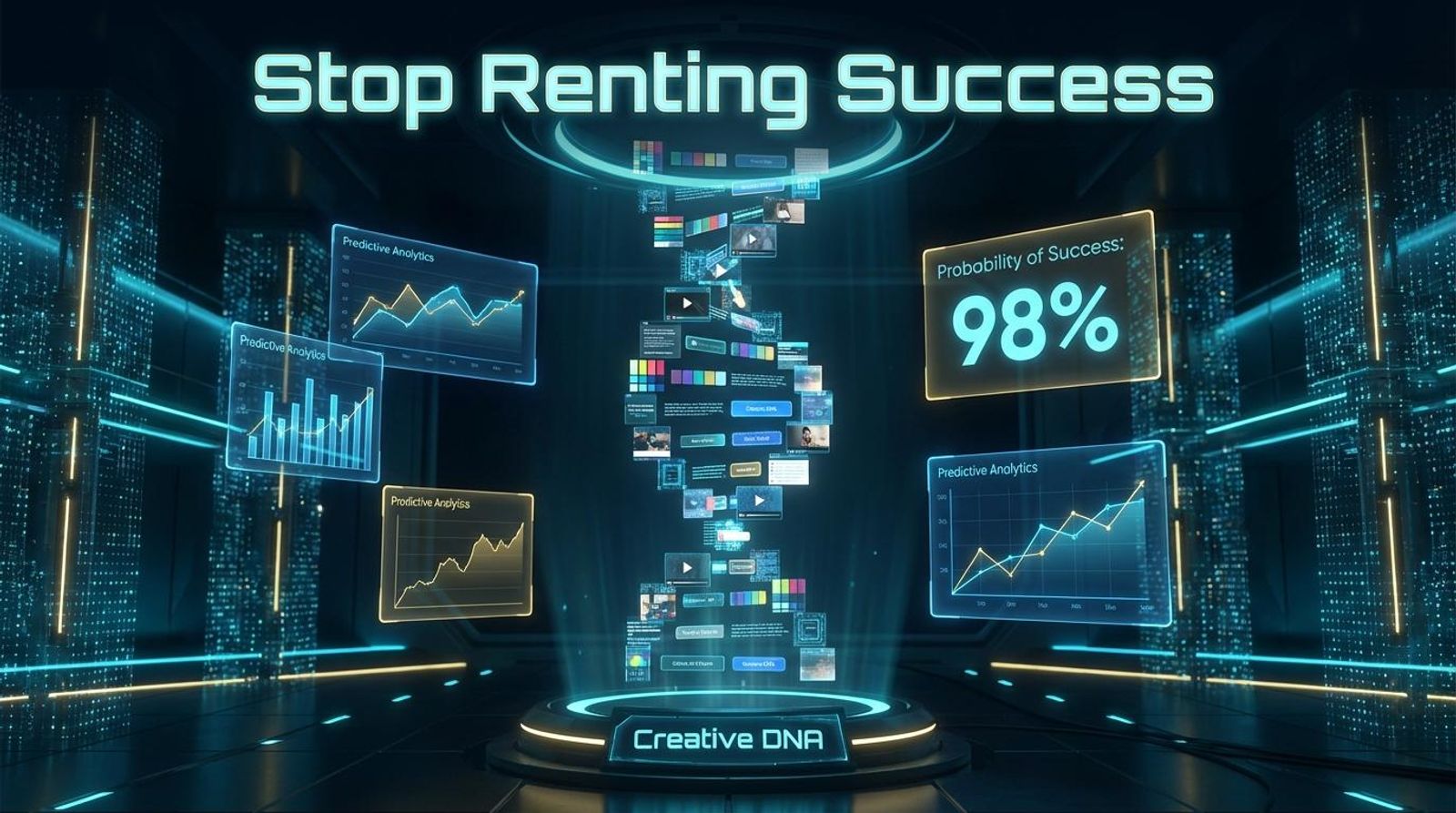

Stop Renting Success: The Dawn of Predictive Ad Analysis
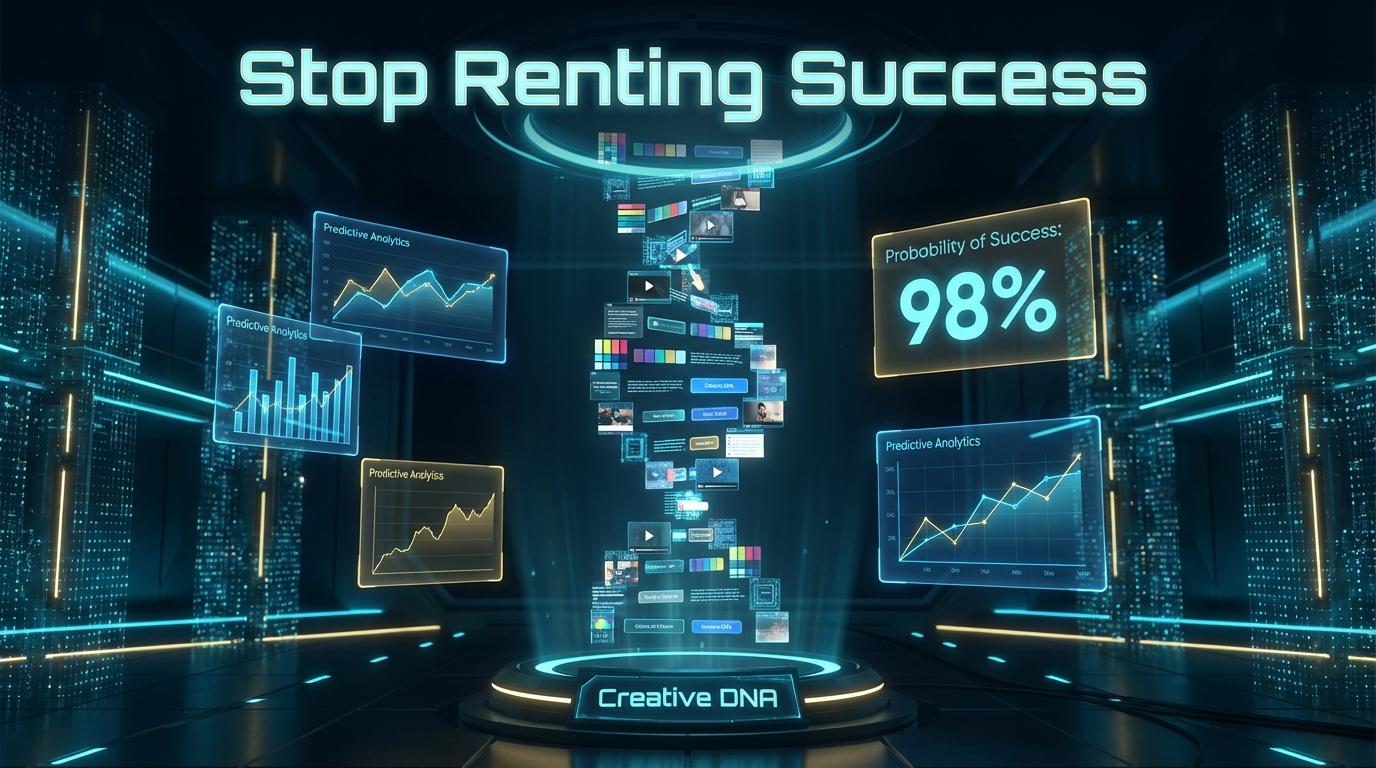
Consider the modern digital landscape. For over a decade, brands have operated under an unspoken, slightly insidious social contract: they are not business owners, but rather digital tenants. In the economies of Meta, Google, and TikTok, companies "rent" their success through the perpetual injection of capital into ad spend. When the budget flows, the metrics spike. But the moment the spending ceases, the traffic, the data flow, and the conversions evaporate entirely. This is the chimera of "rented success"—a systemic treadmill of Ad Spend Inflation and rising Customer Acquisition Costs where brands must spend exponentially more simply to maintain the same ephemeral visibility.
We are, however, standing at a precipice. The transition from this reactive "test-and-learn" furnace to a proactive "predict-and-perform" engine marks a profound evolution in commerce. Through Predictive Ad Analysis (PAA), brands are finally discovering how to put a down payment on a digital architecture they actually own.
A Genealogy of Measurement: From Wanamaker to the Silicon Solution
To understand the magnitude of this paradigm shift, one must trace the lineage of ad analysis. It began in the Intuition Era of the late 19th and 20th centuries, summarized perfectly by John Wanamaker’s famous dilemma: "Half the money I spend on advertising is wasted; the trouble is I don't know which half." Advertising was an anecdotal art form, governed by the subjective instincts of Madison Avenue and measured only through delayed post-mortems of reach and frequency.
The dawn of the internet ushered in the Descriptive Era—a tracking gold rush fueled by the digital pixel and the third-party cookie. Marketers finally had real-time visibility into what happened, transitioning from pure guesswork to direct response. Yet, they were still driving while looking solely in the rearview mirror. This naturally evolved into the Diagnostic Era of the 2010s, characterized by the Attribution Wars. Multi-Touch Attribution (MTA) and heatmaps attempted to decipher the why behind consumer behavior, though the industry remained plagued by last-click bias and the sprawling complexity of cross-device consumer journeys.
Today, we have entered the Predictive Era. Catalyzed by the "Privacy Wall"—most notably Apple’s App Tracking Transparency (ATT) and the slow death of third-party cookies—deterministic tracking has fractured. Forced into probabilistic modeling, the industry has birthed the Silicon Solution: using historical data, machine learning, and statistical algorithms to forecast the effectiveness of an asset before a single dollar is spent. Predictive Analysis is no longer a luxury; it is the fundamental bridge over the data gaps left by modern privacy regulations.
The Quantification of Art and the ROI of Foresight
The intellectual allure of predictive analysis lies in its ability to reconcile the subjective nature of art with the rigorous demands of commerce. Traditionally, creative assets were the "soft" side of the ledger. Today, advanced AI treats creativity as structured data through the extraction of "Creative DNA." By deconstructing a video frame-by-frame—analyzing color palettes, pacing, syntactical sentiment, and the presence of human faces—algorithms can assign a "Probability of Success" score prior to launch. It is the alchemy of advertising transformed into chemistry.
The economic justification for this shift is undeniable. A 2024 McKinsey study revealed that companies extensively deploying predictive marketing recognized an average 15–20% increase in marketing ROI. In a high-interest-rate environment where the mantra of "growth at all costs" has been replaced by an efficiency mandate, this ability to simulate outcomes is revolutionary. Chief Marketing Officers are no longer relying on predictive tools merely as reporting enhancements; they are deploying them as active decision-making engines to prioritize high-value accounts and optimize Customer Lifetime Value (CLV).
The Friction: The Algorithmic Average and the Privacy Paradox
Yet, no technological leap is without its shadows. The reliance on predictive data has sparked fierce philosophical and ethical debates within the industry.
Chief among these is the "Creativity Crisis," often referred to as the "Brandification of Brands" or the "Algorithmic Average." If every brand utilizes the same historical data to predict what works, a homogenization of culture occurs. The AI, optimizing for past success, begins to strip away the avant-garde, the disruptive, and the beautifully strange, leaving us with an internet plastered in optimized blue buttons and generic, emotionally vacant copy. When models are trained on AI-generated data optimized by previous models, we face "Model Collapse"—a loop that ultimately loses touch with human nuance.
Furthermore, there is the inherent tension of the "Black Box." Many enterprise predictive platforms operate as closed ecosystems. Marketers are expected to surrender their budgets to an algorithm that says, "Trust our AI," without providing the granular transparency required to audit why specific decisions were made.
Coupled with this is the "Privacy Paradox." As frameworks like GDPR and CCPA rightfully protect consumer data, predictive models must tread a delicate line. When an algorithm becomes so sophisticated that it can predict a consumer's moment of highest psychological vulnerability—engaging in what ethicists call "hyper-nudging"—we must critically examine the boundary between hyper-personalization and manipulation.
Prescriptive Futures: Synthetic Audiences and Edge AI
Looking ahead, the trajectory of predictive analysis bends toward autonomous, "agentic" marketing. We are witnessing the birth of "Synthetic Audiences"—where Large Language Models (LLMs) are used to construct synthetic personas based on billions of data points. Brands can now interview and test creative assets against these digital humans in milliseconds, effectively conducting infinite, bias-adjusted focus groups without a single real-world participant.
Simultaneously, the industry is solving the privacy-vs-personalization debate through technologies like Federated Learning and Edge AI. In the near future, predictive models will live locally on the consumer's device. The smartphone itself will learn the user's habits, predict their desires, and "pull" the relevant ad from the cloud, rather than the brand "pushing" it via server-side surveillance. The data never leaves the device, harmonizing absolute privacy with perfect predictive accuracy.
Owning Your Future
The dawn of Predictive Ad Analysis is not merely the introduction of a new marketing tool; it is a fundamental restructuring of digital economics. To continue pouring capital into the reactive furnace of trial-and-error is an act of fiscal masochism. By transitioning from a mindset of "test-and-learn" to "predict-and-perform," brands can finally step off the landlord's treadmill. It is time to stop renting visibility and start owning your success.
Key Takeaways
- Shift from Renting to Owning: Predictive analysis liberates brands from the perpetual cycle of temporary, spend-dependent visibility, allowing for sustainable, asset-based growth.
- The ROI of Efficiency: Adopting predictive marketing models yields an average 15–20% increase in ROI, fundamentally altering the economics of customer acquisition.
- Creative DNA: The era of expensive trial-and-error is over. Historical data and machine learning can now decode the specific visual and textual elements that drive human behavior before a campaign launches.
- The Creative Challenge: Marketers must consciously balance predictive data with genuine human ingenuity to avoid the "Algorithmic Average" and the subsequent brandification of their brand.
- Future-Proofing: Innovations like Synthetic Audiences, Federated Learning, and Edge AI will allow predictive marketing to thrive ethically in a stringent, privacy-first world.
Social Toolkit
Ready to stop renting your growth and start owning your future? Discover the power of proactive strategy—Book a Demo with IntelliAssist today and transform your marketing architecture.
#IntelliAssist #EcommerceGrowth #AIRetail #MarTech #AIPersonalization #RetailInnovation #EcommerceSEO #SmartBusiness #GrowthHacking #AI2026
Share this article
Help others discover this content