
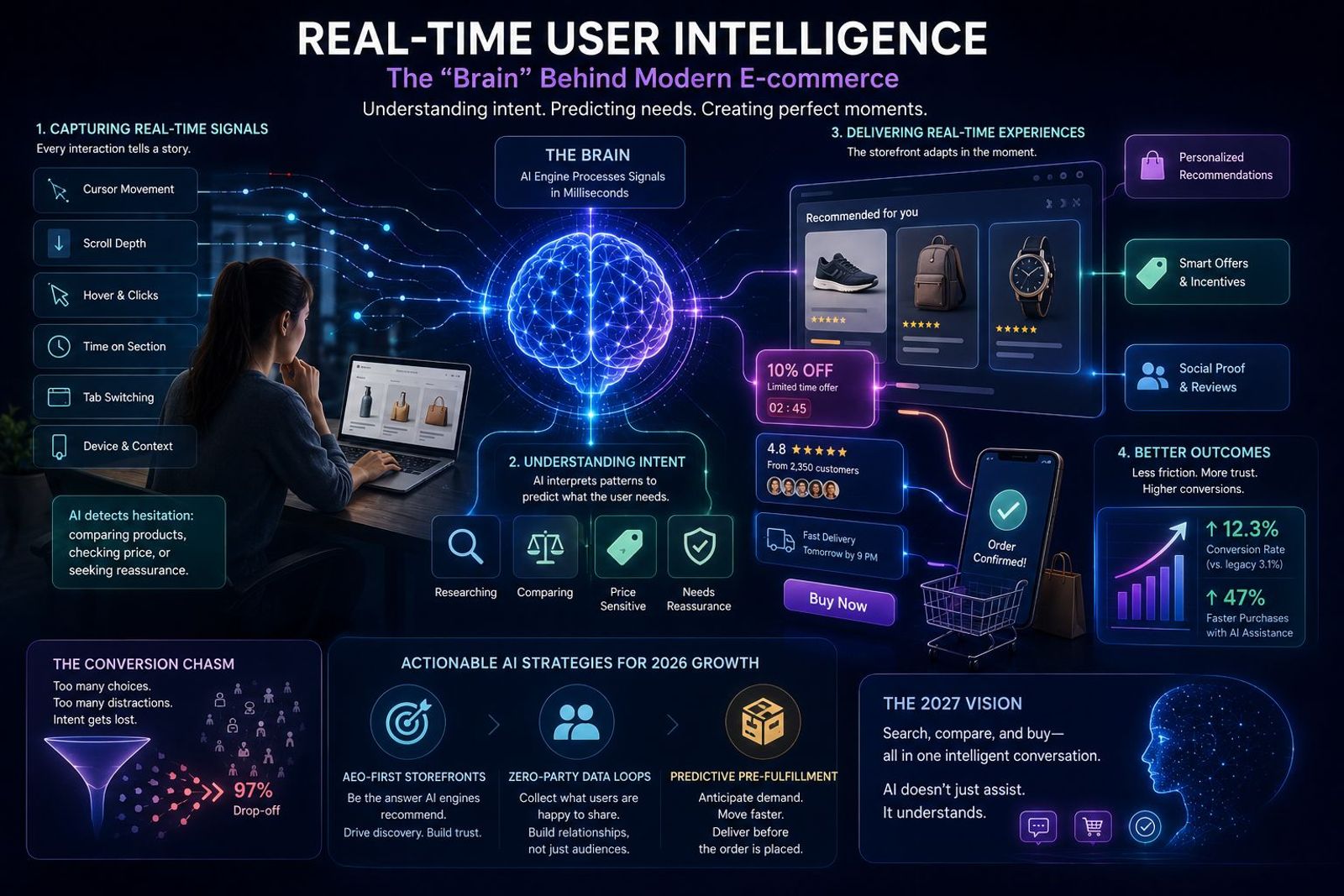

How AI is helping brands understand customers before they leave
The biggest problem in e-commerce today isn’t traffic.
It’s understanding what customers are feeling in the exact moment they’re shopping. Most online stores still work the same way they did years ago — static pages, fixed product grids, and generic recommendations shown to everyone. But customer behavior has changed dramatically. In 2026, shoppers expect online experiences to feel fast, personal, and intuitive. They don’t want to spend 15 minutes searching through endless products or comparing dozens of tabs. If a website feels confusing or irrelevant, they leave instantly.
That’s where real-time user intelligence comes in.
At IntelliAssist, we see it as the “brain” behind modern e-commerce — a system that continuously understands user behavior, predicts intent, and adapts the shopping experience in real time.
Instead of reacting after a customer leaves, AI now helps brands understand hesitation before it becomes abandonment.
The Anatomy of a Smarter E-commerce Experience
Traditional analytics tell you what users did after they leave. Real-time intelligence focuses on what users are doing right now. It’s not just about demographics anymore. It’s about behavior in the moment.
Micro-Behavioral Analysis
Every small interaction on a website tells a story.
AI can now analyze signals like:
- cursor movement,
- hover pauses,
- scrolling speed,
- repeated clicks,
- tab switching,
- and hesitation patterns.
For example:
If a shopper keeps comparing products across multiple tabs, that often signals uncertainty around pricing or value. Instead of losing the customer, AI can instantly respond by showing:
- product comparisons,
- customer reviews,
- limited-time offers,
- or personalized recommendations.
The goal isn’t to interrupt the user — it’s to reduce friction before they leave.
Contextual Fluidity: Shopping That Adapts in Real Time
Modern shoppers don’t all browse in the same situation.
Some are casually exploring.
Some are rushing between meetings.
Some are shopping late at night on mobile devices.
Others already know exactly what they want.
AI-powered storefronts can now adapt based on real-time context.
For example:
- A stressed or hurried shopper may see a simplified “express checkout” experience.
- A returning customer may immediately see previously viewed products.
- Someone browsing during bad weather could see faster delivery messaging or locally available inventory.
The experience becomes less like browsing a catalog and more like interacting with a smart shopping assistant.
Bridging the Conversion Chasm
One of the biggest challenges in modern e-commerce is what many brands call the Conversion Chasm — the massive gap between customer interest and actual purchase. Today’s shoppers discover products across:
- Instagram,
- TikTok,
- AI assistants,
- YouTube,
- marketplaces,
- and conversational search tools.
But once they click through to a generic storefront, momentum disappears. This happens because modern consumers face something called the Paradox of Choice.
Too many products.
Too many decisions.
Too much information.
And when people feel overwhelmed, they delay buying altogether. That’s why AI-driven storefronts are becoming so powerful. Instead of forcing users to search endlessly, they guide shoppers toward decisions faster and with less effort. Brands using AI-assisted shopping experiences are already seeing:
- higher engagement,
- faster purchase decisions,
- stronger conversion rates,
- and lower abandonment rates.
Actionable AI Strategies for 2026 Growth
1. Build AEO-First Storefronts
Search behavior is changing rapidly.
Customers are increasingly discovering products through AI tools like ChatGPT, Gemini, and Perplexity instead of traditional search engines. That means brands need to optimize for Answer Engine Optimization (AEO) — making their content structured, trustworthy, and easy for AI systems to understand. The brands that become the “best answer” inside AI-generated recommendations will dominate future discovery.
2. Create Zero-Party Data Loops
Third-party tracking is disappearing, and customers care more about privacy than ever before. Instead of collecting hidden data, successful brands are now focusing on zero-party data — information customers willingly share.
This could include:
- preferences,
- shopping goals,
- style interests,
- skin concerns,
- sizing information,
- or delivery priorities.
When customers feel understood, personalization becomes more accurate and much more valuable.
3. Predict Customer Needs Before Checkout
One of the most exciting shifts in e-commerce is predictive fulfillment. AI can now identify high-purchase-intent behavior before the customer even completes checkout. This allows brands to:
- prepare inventory faster,
- optimize logistics,
- reduce delivery times,
- and improve customer satisfaction.
In the future, commerce won’t just react to purchases — it will anticipate them.
Beyond the Click: The Future of ROAS
For years, brands measured success using clicks. But in the era of AI-driven commerce, influence matters more than clicks.
The customer journey is no longer linear. A single recommendation from an AI assistant can influence a purchase long before a user ever visits a website. That’s why modern ROAS strategies are shifting toward:
- personalization,
- predictive intelligence,
- conversational discovery,
- and real-time optimization.
The brands winning in 2026 aren’t necessarily spending the most on ads. They’re simply creating experiences that feel more relevant.
The 2027 Digital Reality
The future of shopping is becoming increasingly seamless. Customers won’t “search, compare, and buy” the way they used to. Much of that process will happen through intelligent AI systems that already understand preferences, intent, and urgency.
Generic storefronts won’t survive in that environment. The brands that succeed will be the ones that:
- understand customers in real time,
- personalize experiences instantly,
- and remove friction before it happens.
Because in the next era of commerce, intelligence isn’t an extra feature. It’s the foundation of the entire customer experience.
Share this article
Help others discover this content