
Performance Marketing Isn’t What It Used to Be
A few years ago, performance marketing was mostly about managing campaigns manually. Marketers would:
- Launch ads
- Test creatives
- Adjust bids
- Monitor ROAS dashboards
- Scale what worked
But in 2026, that workflow is changing rapidly. The biggest shift isn’t just better automation. It’s the rise of AI agents that can think, adapt, optimize, and execute decisions in real time. And honestly, this is changing the entire way brands grow online.
The Era of Manual Marketing Is Fading
Modern marketing moves too fast for purely human decision-making. Consumer behavior changes by the second. Attention spans are shorter. Competition is more intense. And ad platforms are becoming increasingly automated.
That’s why brands are now moving toward AI-powered systems that can react instantly instead of waiting for teams to manually optimize campaigns. This doesn’t mean marketers are disappearing. It means marketers are evolving from operators into strategists. Because AI agents are starting to handle the repetitive, data-heavy work humans simply can’t process fast enough anymore.
What Exactly Are AI Agents?
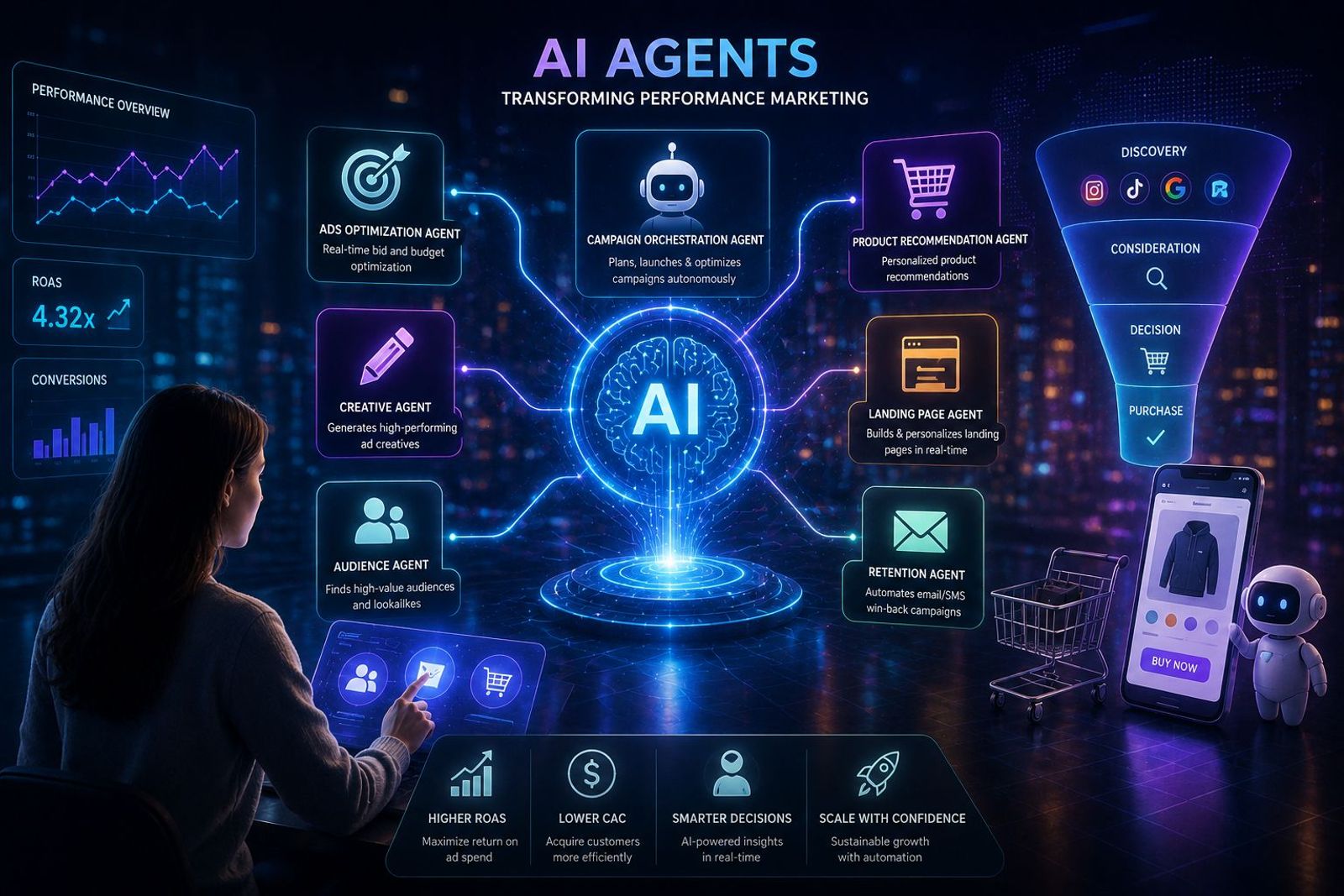
Think of AI agents as intelligent digital systems designed to complete specific marketing tasks autonomously. Instead of just providing insights, they take action. Some agents focus on:
- Ad optimization
- Creative testing
- Product recommendations
- Landing page personalization
- Audience analysis
- Retention campaigns
And the most advanced systems allow multiple agents to work together simultaneously. Almost like a high-performing marketing team operating 24/7.
Marketing Is Becoming Real-Time
Traditional campaigns used to stay static for weeks. Now, AI can continuously adapt campaigns based on:
- User behavior
- Platform trends
- Purchase signals
- Search intent
- Engagement patterns
This means marketing is becoming dynamic instead of fixed. For example:
A customer interested in sustainability might instantly see:
- Eco-focused messaging
- Sustainable product recommendations
- Green packaging highlights
While another customer looking for affordability sees:
- Pricing comparisons
- Bundled offers
- Discount-focused creatives
All automatically. That level of personalization simply isn’t possible manually at scale.
The Rise of Agent-to-Agent Commerce
One of the biggest shifts coming to e-commerce is something most brands still aren’t preparing for: AI interacting with AI. Consumers are increasingly using AI assistants to:
- Research products
- Compare alternatives
- Get recommendations
- Make purchase decisions
Which means brands won’t just market to people anymore. They’ll market to decision-making systems. This is why visibility in AI-generated recommendations is becoming incredibly important. Because if your brand isn’t understood by AI systems, it risks being ignored completely.
Why SEO Alone Is No Longer Enough
Traditional SEO focused on ranking webpages. But modern discovery is becoming conversational. Customers now ask platforms like ChatGPT, Gemini, and Perplexity direct questions instead of browsing endless links. That changes everything. The goal is no longer just:
“Can customers find your website?”
The real question is:
“Can AI confidently recommend your brand as the best answer?”
This is where Answer Engine Optimization (AEO) becomes essential.
The Shift from Keywords to Context
AI systems don’t just analyze keywords anymore. They analyze:
- Context
- Relevance
- Authority
- Product clarity
- Structured information
Brands that structure their content intelligently become easier for AI systems to understand and recommend. That’s why modern e-commerce brands are rebuilding product pages, FAQs, reviews, and metadata around conversational intent—not just search rankings.
The Mid-Funnel Is Becoming the Most Important Layer
Most brands focus heavily on:
- Getting traffic
- Closing sales
But the biggest drop-offs often happen in between. This is the mid-funnel:
The moment where customers are interested—but uncertain. And this is where AI agents are becoming incredibly powerful. Because they can identify hesitation in real time and respond instantly.
For example:
- Showing personalized recommendations
- Offering relevant bundles
- Simplifying decisions
- Triggering tailored incentives
- Adapting landing page messaging dynamically
Instead of waiting for customers to leave and retargeting them later, AI can reduce friction while intent still exists.
Personalization Is No Longer Optional
Modern consumers expect relevance immediately. Generic experiences now feel outdated. Customers want brands to understand:
- What they’re looking for
- Why they clicked
- What matters to them specifically
AI agents make this possible at scale. Not through basic segmentation—
But through continuous adaptation. Every shopper can experience a slightly different storefront, journey, and conversation based on their intent.
The Metrics Are Changing Too
For years, marketers obsessed over metrics like:
- CTR
- CPC
- Impressions
But in the AI era, those metrics only tell part of the story. Because discovery itself is changing. Visibility increasingly depends on whether AI systems:
- Mention your brand
- Recommend your products
- Trust your information
This is why concepts like Share of Model (SOM) are becoming more important. In simple terms: How often does AI choose your brand when customers ask for recommendations? That may become one of the most valuable growth metrics of the next decade.
What Smart Brands Are Doing Right Now
The brands preparing for 2026 are already:
- Building AI-readable content
- Structuring product data properly
- Investing in adaptive storefronts
- Using AI for personalization
- Creating faster customer journeys
- Connecting marketing, product, and retention data together
Because the future won’t belong to brands with the biggest budgets. It’ll belong to brands with the smartest systems.
The Bottom Line
AI agents aren’t replacing marketing. They’re reshaping it.
The brands that continue relying only on manual optimization and static experiences will struggle to keep up with the speed of modern commerce. But brands that embrace AI-driven personalization, intelligent automation, and conversational discovery will create experiences that feel faster, smarter, and far more relevant. And in 2026, relevance is everything.
The Future of Marketing Is Already Here
The question is no longer:
“Should we use AI?”
It’s:
“How quickly can we build systems that understand customers better than our competitors do?”
Ready to Build an AI-Powered Commerce Experience?
Transform your storefront into a smarter, adaptive growth engine with IntelliAssist.
Share this article
Help others discover this content