
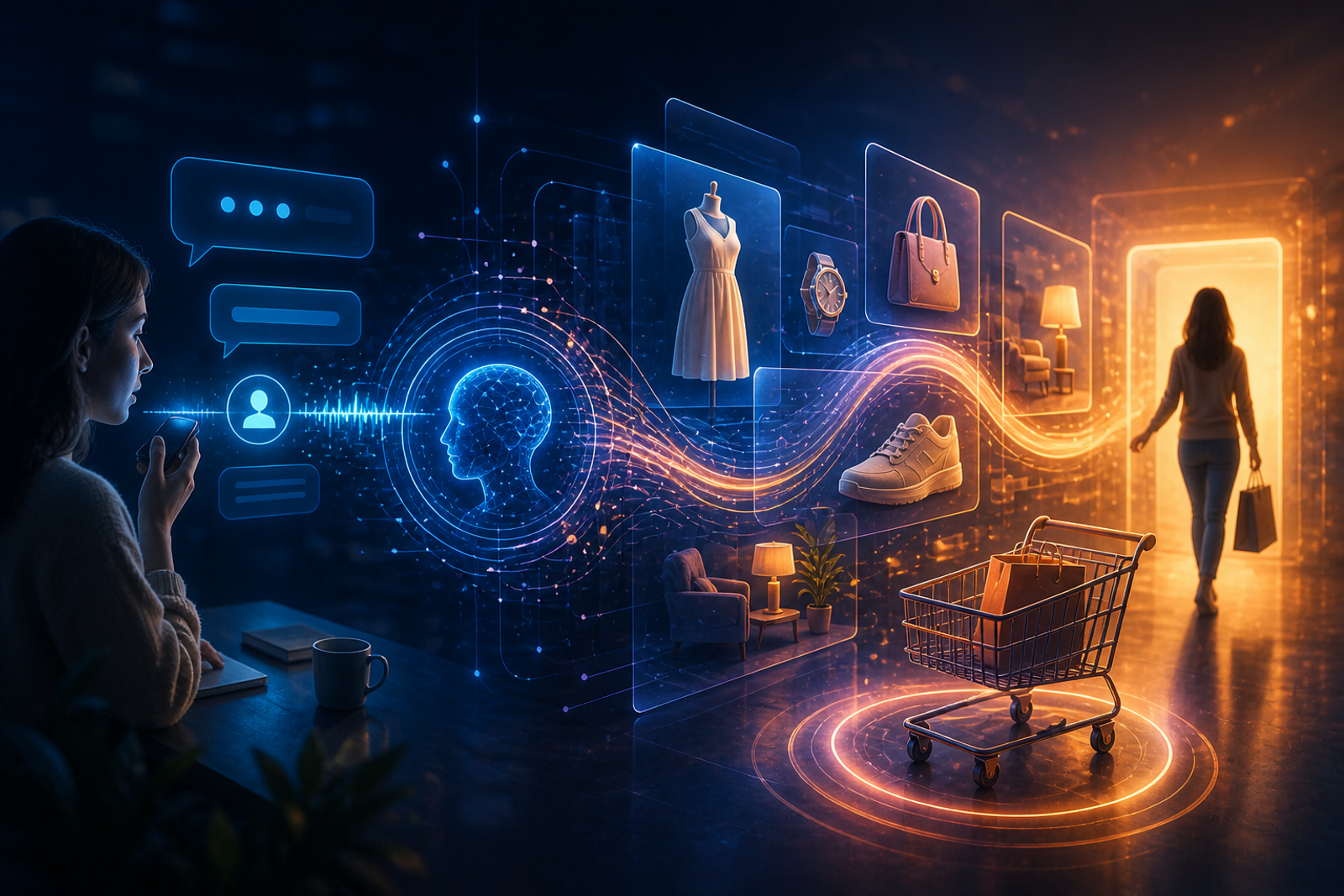

The Shift You Can’t Ignore
For years, e-commerce followed a simple formula:
Run ads → get clicks → drive users to a page → hope they convert.
And for a long time, that worked.
But today, something has changed.
Customers aren’t browsing the way they used to. They’re not clicking through endless links or comparing dozens of tabs. They’re asking questions.
And they expect instant, relevant answers.
That’s why e-commerce in 2026 doesn’t run on clicks anymore.
It runs on conversations.
The journey from “I want this” to “I bought this” is no longer a series of steps.
It’s a single, fluid interaction—powered by AI.
The End of the Blue Link and the Rise of AEO
Think about how you search today. You don’t just type keywords—you ask full questions. And instead of a list of links, you often get a direct answer. That’s the biggest shift happening right now.
Traditional SEO is losing ground to Answer Engines—platforms that don’t just show options, but decide what’s most relevant and present it directly.
Which means: If your brand isn’t part of that answer, it’s invisible.
This is where Answer Engine Optimization (AEO) comes in.
It’s no longer about ranking higher. It’s about being chosen. To make that happen, brands need to rethink how their data is structured:
- Clear, factual product information
- Context-rich descriptions
- Content designed to answer real questions
Because AI doesn’t “browse” your website. It interprets it.
The Demise of the Static Landing Page
Here’s another hard truth:
Static landing pages don’t match how people behave anymore. A user coming from an AI conversation expects continuity. But most landing pages feel disconnected—generic, one-size-fits-all. That gap creates friction.
And friction kills conversions.
Welcome to the idea of the Liquid Storefront.
Instead of showing the same page to everyone, your store adapts in real time:
- Different users see different products
- Layouts shift based on intent
- Content changes based on behavior
It’s no longer a “page.” It’s a live experience.
What This Looks Like in Practice
Imagine this: A customer is planning a trek. They ask an AI assistant for hiking gear.
Instead of showing a standard product page, your store:
- Highlights boots suited for their terrain
- Shows visuals tailored to their trip
- Suggests complementary products instantly
It feels less like browsing… and more like being guided. That’s where e-commerce is heading.
Solving the Mid-Funnel “Conversion Chasm”
Most brands focus on two things:
Getting traffic → Closing the sale
But what about everything in between? That middle phase—the consideration stage—is where most users drop off.
Why?
Because brands don’t know what customers are thinking in that moment. AI changes that. Instead of relying on outdated signals, it reads micro-behaviors:
- How long someone hovers
- What they scroll past
- Where they hesitate
And based on that, it responds instantly. Not with generic pop-ups—but with relevant nudges:
- A comparison when someone is unsure
- A testimonial when trust is low
- A bundle when intent is high
This is how you turn hesitation into action.
The Rise of Conversational Commerce
This isn’t a small shift—it’s massive. Conversational commerce is expected to drive hundreds of billions in spending in the coming years. And the expectations are changing fast. Today’s customer doesn’t just want a store.
They want a shopping assistant.
Something that:
- Remembers preferences
- Suggests better options
- Helps them decide faster
For Gen Z and Gen Alpha, this is already normal. They don’t want to search.
They want to ask and get. And increasingly, those interactions aren’t just text-based. They’re visual.
Users can show what they like—and AI responds with recommendations, styling advice, and availability in real time.
The Business Impact Is Real
This shift isn’t just about experience—it directly affects growth. Brands using AI across their customer journey are seeing:
- Lower acquisition costs
- Higher repeat purchases
- Better customer lifetime value
Why?
Because they’re not forcing users through a funnel. They’re adapting to them in real time.
What Brands Need to Do Next
This isn’t about small optimizations anymore. It’s about rethinking the foundation.
1. Move Beyond Landing Pages
Think of experiences, not destinations. Start interactions with context, not just content.
2. Build for AI, Not Just Humans
Your website should be easy to understand—for both people and machines. Structured data isn’t optional anymore.
3. Create Modular Content
Instead of fixed pages, build flexible components:
- Product blocks
- Visual assets
- Copy variations
So AI can assemble the right experience dynamically.
4. Keep the Human Touch Where It Matters
AI can handle scale. But high-intent, high-value moments still benefit from human interaction. The winning brands combine both.
The Verdict
This shift is already happening.
Customers have changed how they discover, evaluate, and buy. And the brands that continue to rely on old models—static pages, keyword SEO, rigid funnels—will slowly fade out of relevance. Because in 2026, visibility doesn’t come from ranking. It comes from being part of the conversation.
Evolve or Get Left Behind
E-commerce is no longer about getting clicks. It’s about guiding decisions. And the brands that understand this shift early won’t just keep up— They’ll define what growth looks like next.
Share this article
Help others discover this content