
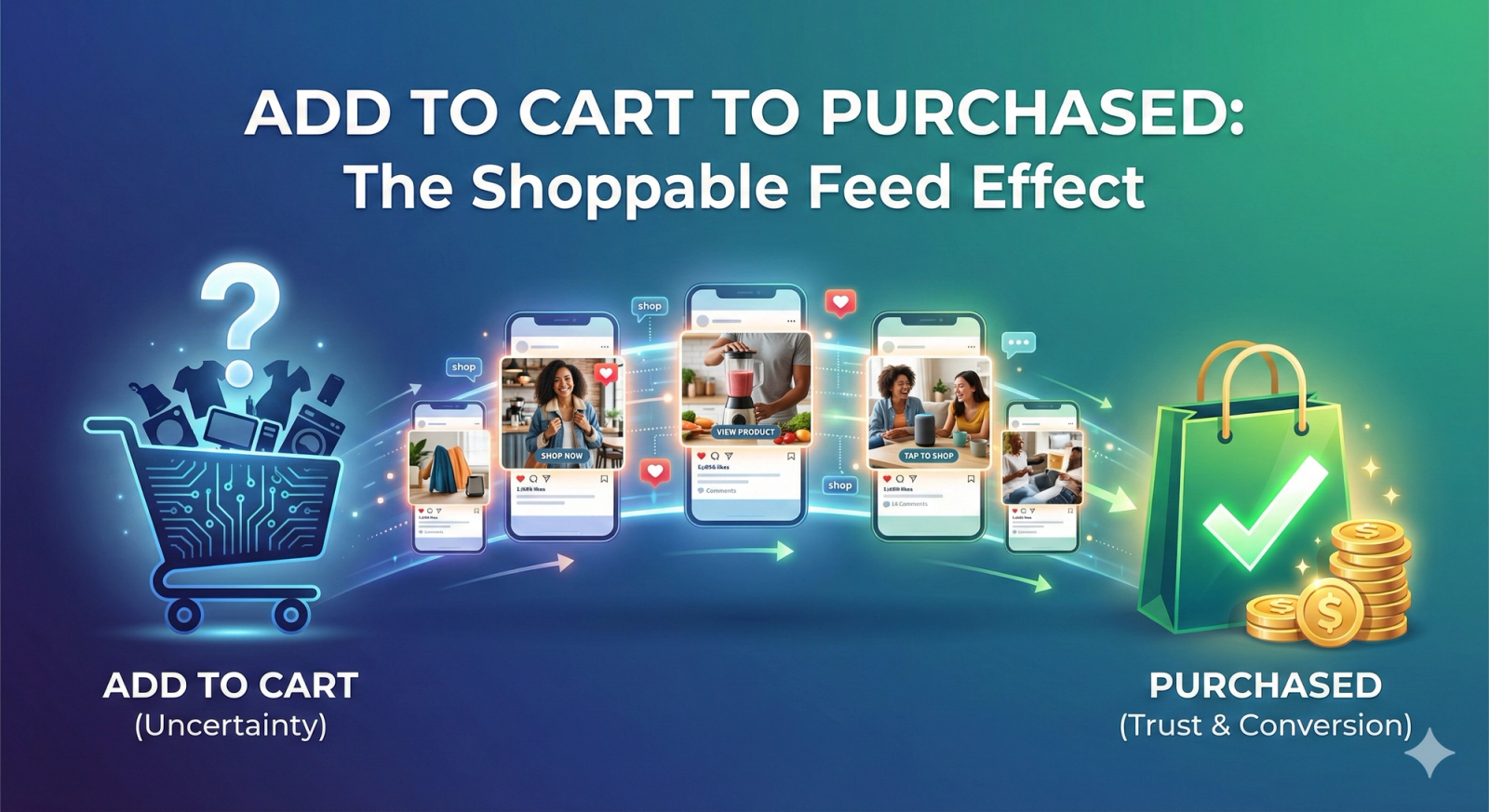

Let’s be honest for a second. Is there anything more frustrating in the world of e-commerce than looking at your analytics and seeing a mountain of "Add to Carts" followed by a valley of... nothing?
It’s the digital equivalent of a customer walking into your store, picking up an item, carrying it to the counter, and then suddenly turning around and walking out the door without saying a word.
Why does this happen? Usually, it’s not the price. It’s not the shipping. It’s uncertain.
The customer is asking themselves: "Will this actually look good on me?" "Is the material cheap?" "Does it really fit in a living room like mine?"
Professional product photos are great, but they are polished, perfect, and—sometimes—a little too good to be true. Your customers are craving reality. They are craving trust.
This is where the magic of Shoppable Instagram Feeds comes in.
The "Trust Gap" is Real
When a customer is on the fence, they don't want to hear you talk about how great your product is. They want to hear what Sarah from Ohio or Mike from London thinks about it.
In the past, we relied on star ratings and text reviews. Those are still vital. But in 2025, we are visual creatures. We scroll, we tap, we watch.
Integrating a live, shoppable Instagram feed onto your product page bridges the "Trust Gap" instantly. It shows your product in the wild—wrinkles, lighting, messy backgrounds and all.
Why Shoppable Feeds are the Ultimate CRO Hack
1. It Anchors the Product in Reality
Studio lighting makes everything look perfect. User-Generated Content (UGC) makes everything look real. When a shopper sees a real person wearing that dress or using that coffee maker, the brain switches from "Is this a scam?" to "I can see myself using this."
However, "reality" doesn't happen by accident. You can't just sit back and hope high-quality photos appear. You need to actively source this content—finding the authentic posts where customers are advocating for you—and, crucially, track which photos are actually driving revenue. By using a platform like Refunnel to automate the sourcing and tracking of this UGC, you ensure you aren't just displaying random photos, but showcasing the high-performing content that is proven to convert.
2. It Keeps Them on Your Site
How many times have you left a product page to check the brand’s Instagram for "tagged photos"? Probably a lot. And once you leave the site, distraction hits. You get a DM, you see a funny reel, and boom—the sale is lost.
By bringing the feed to the product page, you stop the leak. You give them the social proof they need without them ever hitting the "back" button.
3. The "Bandwagon Effect"
There is a psychological comfort in doing what others are doing. A lively, updated Instagram feed on your site screams, "People are buying this! This brand is alive! We are a community!" Silence kills sales; activity breeds confidence.
How to Execute This Strategy (Without Looking Cluttered)
You don't need to be a coding wizard to make this happen. Here is the human-friendly guide to getting it right:
- Curate, Don't Just Aggregate: Don't let every single tagged photo auto-publish. Use a tool Intelliassist to hand-pick the photos that align with your brand vibe.
- Make it Shoppable: This is the "Double Your Checkout Rate" secret. Ensure that when a user clicks a photo in the gallery, they can add the specific product in that photo directly to their cart. Reduce the friction.
Placement Matters: Don't bury it in the footer. Place your shoppable gallery above the fold on mobile, or right under the "Product Description." It needs to be part of the decision-making process, not an afterthought.
The Bottom Line
Conversion Rate Optimization isn't always about changing button colors or A/B testing headlines. Sometimes, it's just about being human.
Your customers want to trust you. They want to know they aren't making a mistake. By letting your community do the selling for you through shoppable feeds, you aren't just selling a product; you're inviting them into a club.
So, take a look at your product pages today. Do they look like a catalogue, or do they look like a community? The difference might just be your missing revenue.
Share this article
Help others discover this content