
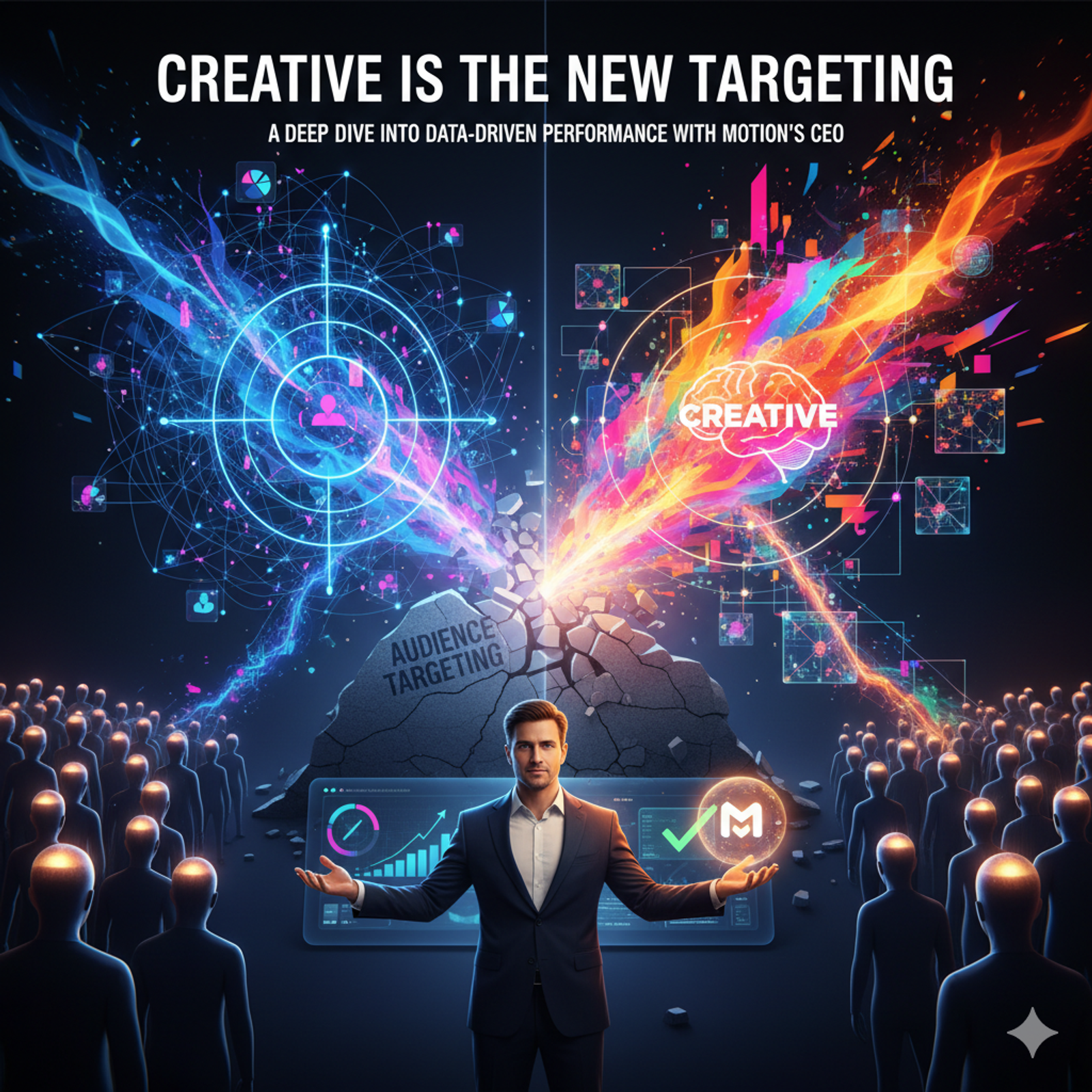

The digital marketing landscape has undergone a seismic shift. The old playbook of meticulously crafting audiences and targeting granular demographics has been upended. In its place, a new king has been crowned: creative. According to industry leaders including Reza Khadjavi, CEO of the creative analytics platform Motion, we've moved firmly into an era where your creative content is your targeting strategy. Following the privacy-centric changes of iOS 14.5 and the ever-smarter platform algorithms, the content of an ad now dictates who sees it, making the quality and strategy behind your creative more critical than ever.
This evolution demands a new way of thinking, a new team structure, and a new set of metrics. It's about breaking down the age-old walls between data-driven growth teams and art-focused creative teams. It's about building a systematic, data-informed process to not only produce a high volume of content but also to consistently elevate its performance. Let's explore the key insights on how to master this new reality and put the "motion" in your marketing "emotion."
The Seismic Shift: Why Creative Replaced Audience Targeting
Not long ago, the path to performance marketing success was paved with hyper-specific audience targeting. Marketers would spend hours in Ads Manager, layering interests, behaviours, and lookalike audiences to find the perfect customer pocket. That era is decisively over.
Around 2020-2021, a perfect storm of platform changes permanently altered this dynamic. The most significant factor was Apple's iOS 14.5 update, which limited tracking capabilities and made it much harder for platforms like Meta to rely on user data for targeting. The impact was immediate and dramatic: the percentage of iPhone users sharing their unique Identifier for Advertisers (IDFA) with apps dropped from 70% to as low as 10%. This massive data loss forced platforms to fundamentally rethink their approach to ad delivery.
Simultaneously, the advertising algorithms themselves became exponentially more powerful. Meta's platforms now increasingly use machine learning and AI for ad delivery, with the company preferring broad audience targeting over narrow segments, stating that its AI will find the right audiences without marketers needing to segment them manually. These platforms realized they could achieve better results by analysing the content of the ad itself—the visuals, the copy, the sounds—to understand who would be most receptive to it.
The algorithm now does the heavy lifting of audience selection. Your job is no longer to tell the platform who to target, but to feed it creative assets that give it the right signals. As algorithms continue to evolve, Meta has implemented new AI-powered campaign types, including Advantage+ Shopping Campaigns, which further automate audience selection based on creative content analysis. In this new paradigm, the creative has become the primary lever for performance. A powerful, resonant ad will find its audience, while a weak one will fail, no matter how perfectly you think you've defined your target demographic.
Rise of the Creative Strategist: The Linchpin of Modern Marketing
This shift from audience-led to creative-led strategy has given rise to a new, essential role: the Creative Strategist. This individual is the crucial bridge between two traditionally separate worlds: the analytical, data-obsessed growth team and the artistic, concept-driven creative team. The role has become so critical that creative strategists are now considered the new linchpins in high-growth teams, functioning as brand thinkers, content architects, performance hawks, and AI operators all in one.
The Creative Strategist is a hybrid professional who possesses a unique blend of skills:
Analytically Minded: They can dive into performance data, understand metrics like click-through rates and conversion rates, and identify patterns in what's working and what isn't. With global creative management platform market size reaching $1.12 billion in 2024 and projected to grow at a CAGR of 8.1% through 2032, the demand for professionals who can navigate these sophisticated analytics platforms continues to surge.
Creatively Fluent: They understand the principles of good design, compelling storytelling, and effective copywriting. They can speak the language of the creative team and translate raw data into actionable creative briefs. As 80% of marketers now see creative quality as key to marketing success, these professionals must bridge the gap between artistic vision and performance metrics.
Strategy-Focused: Creative strategists merge new ideas with careful planning to connect a brand's vision with its goals. They conduct market research, analyse trends, and gather insights that shape a brand's creative approach, ensuring every creative effort supports overall business objectives.
This role is responsible for creating the feedback loop that is fundamental to modern marketing success. Instead of creatives working in a vacuum and "throwing assets over the wall" to the growth team, the Creative Strategist ensures that performance learnings are systematically analysed and channelled back into the creative workflow. They answer the critical question: "We know what worked, but can we figure out why it worked and how to replicate that success?" By embedding this role within a team, organizations can move from a disconnected process to an integrated, learning-based system where every ad campaign informs the next.
Breaking Down the Silos: Forging a Data-Driven Creative Culture
The historic friction between growth and creative teams is no secret. Growth marketers, laser-focused on metrics and revenue, can view creatives as too artistic and detached from business goals. Creatives, in turn, can see growth teams as stifling their vision with spreadsheets and rigid demands. In the current landscape, this internal division is a recipe for failure.
Success requires intentionally building a culture of collaboration and dismantling these silos. The importance of this integration has never been clearer: as algorithms and automation increasingly dominate marketing processes, unique and personalized content and creative are becoming key differentiators. Companies are investing more heavily in Digital Experience Platforms (DXPs), content marketing, and AI-driven creative production, while reducing investment in traditional strategies like programmatic advertising and conversion rate optimization due to their diminishing effectiveness.
The key is to establish a robust feedback loop where data isn't used to criticize but to inform. When a piece of creative performs well, the data should be used to deconstruct its success and provide insights for future projects. When it underperforms, the data should be a tool for learning, not blame.
This data-driven creative process looks like this:
Launch: Creative assets are pushed live across multiple channels, with brands now publishing an average of 18 videos per month to maintain competitive engagement rates.
Analyse: Performance data is collected and analysed to identify top and bottom performers, utilizing sophisticated creative analytics tools that can provide real-time insights while campaigns are running.
Translate: The "why" behind the performance is distilled into clear, concise insights (e.g., "UGC-style videos with a direct-to-camera hook are outperforming polished studio ads").
Inform: These insights are fed back to the creative team through actionable briefs, guiding the next round of production with data-driven recommendations.
By making data an integral part of the creative process, teams can move away from guesswork and subjective opinions, aligning everyone around the shared goal of producing content that doesn't just look good, but also drives measurable results.
Metrics That Matter: Measuring Creative Success Beyond Clicks
In a world where creative is paramount, legacy metrics like clicks and impressions only tell a fraction of the story. To truly understand creative performance, you need a more nuanced framework that measures an ad's ability to capture attention, hold it, and drive action. The first and most crucial metric in this new stack is the Thumb Stop Ratio.
Thumb Stop Ratio (or Hook Score): This is the foundational metric for creative effectiveness. It measures how well your ad does its first job: stopping a user from scrolling past it in their feed. The calculation is straightforward: 3-Second Video Views ÷ Impressions × 100.
Industry benchmarks show that a good Thumb Stop Ratio is 30% or higher, with some top-performing ads achieving rates above 37%. This metric has become so important that marketers are now optimizing specifically for it. A low Thumb Stop Ratio indicates that the first few seconds of your ad are failing to capture interest, meaning the rest of your message is never heard. Before you can optimize for conversions, you must first earn the user's attention.
Research shows that marketers now have just 2.7 seconds to engage potential customers before they scroll past, making this metric absolutely critical. The power of the first three seconds cannot be overstated—videos under 90 seconds with strong opening hooks have a 50% repeat viewing rate.
Beyond this initial hook, a comprehensive creative analytics framework should measure the full funnel:
Hook (Attention): Measured by the Thumb Stop Ratio. Are you grabbing eyeballs in those crucial first moments?
Hold (Retention): Measured by video watch-through rates and audience retention graphs. Once you have their attention, are you keeping them engaged throughout your message?
Action (Conversion): Measured by click-through rates and, ultimately, conversions. Are you successfully motivating the user to take the desired next step?
By analysing creative through this Hook-Hold-Action lens, teams can pinpoint exactly where an ad is succeeding or failing and make more precise, impactful optimizations. This systematic approach to creative measurement has become essential as the creative analytics market has grown to $6.2 billion in 2024, reflecting the critical importance of data-driven creative optimization.
The Future is Now: AI, Automation, and the Democratization of Content
The forces changing the creative landscape are only accelerating, with artificial intelligence leading the charge. Two major trends are set to define the next era of marketing, both powered by the rapid advancement of AI technologies.
First is the concept of "Service as Software." The SaaS model is evolving beyond simply providing dashboards and data. The future lies in tools that don't just show you what happened, but deliver actionable recommendations and outcomes. AI-driven platforms will increasingly function like a professional service, analysing your data, identifying opportunities, and suggesting specific creative strategies. With 78% of marketing teams planning to upgrade or enhance their AI capabilities, and 76% investing specifically in generative AI, these automated intelligence systems are effectively replacing some traditional agency functions.
The integration of AI into marketing automation is transformative. Predictive AI analyzes marketing data to forecast future performance, while reinforcement learning allows AI systems to make autonomous decisions that drive sustainable, performance-driven change. Marketing professionals report that AI assists across various tasks—from crafting creative briefs and generating user-generated content to analysing vast datasets and uncovering actionable insights.
Second is the democratization of content creation. High-quality video production once required expensive equipment, large teams, and specialized skills. Today, with advanced AI video generators, user-friendly editing apps, and the powerful camera in everyone's pocket, the barrier to entry has all but disappeared. Anyone can create visually appealing content. This shift means that the strategic element—the "what" to create and "why"—becomes the ultimate differentiator.
With social media platforms now video-first environments where video dominates feeds, the technical execution is becoming a commodity. YouTube attracts over 2.7 billion monthly users, TikTok delivers the highest engagement per session across all platforms, and Instagram Reels boost brand engagement by up to 30% compared to traditional posts. Success will be determined by the quality of a brand's insights and its ability to build a data-driven creative engine that can produce the right content at the right volume.
Building a Winning Workflow: From Insight to High-Volume Output
In this fast-paced environment, the most successful brands operate with a workflow built for rapid testing and learning. Gone are the days of spending months on a single, massive "hero" campaign. The new model is about agility, iteration, and volume. With brands now producing an average of 18 videos per month to maintain competitive engagement, the emphasis has shifted from perfection to performance-driven iteration.
However, success isn't just about producing more ads. It's about combining volume with quality, where "quality" is defined by performance. The goal is to continuously increase the average performance of each asset you produce. This is achieved through a systematic process that leverages both human insight and AI-powered optimization.
Establish Foundational Insights First: Before you start testing minor variations like button colours or hooks, you must first identify the core messaging, value propositions, and audience pains that consistently resonate. Research shows that messaging around "future-proofing" saw conversion rates rise by 748%, while "digital transformation" messaging drove a 34% uplift. Nail down these foundational pillars before moving to micro-optimizations.
Implement Rapid Testing Cycles: Run quick, focused tests with clear hypotheses. The goal is to shorten the feedback loop between launching an ad, gathering data, and applying the learnings to the next creative sprint. Modern creative analytics platforms can provide real-time adjustments, allowing teams to make quick pivots and maximize what's working rather than waiting for post-campaign analysis.
Build a Systematic Learning Agenda: Don't just test randomly. Develop a structured approach where each test builds on the last. This creates a repository of knowledge that compounds over time, making your entire creative operation smarter and more effective. With creative management platforms now enabling brands to produce 5,000 image and video ads in two hours—a process that previously took five days—the focus shifts to strategic planning rather than production logistics.
By adopting this rigorous, process-driven approach, marketing teams can move beyond chasing fleeting viral hits and build a sustainable engine for creative excellence. The most successful brands are those that can systematically learn, adapt, and scale their creative insights across multiple campaigns and channels.
Leveraging Platform Algorithm Evolution
Understanding and adapting to platform algorithm changes has become crucial for creative success. Meta's 2024 algorithm updates represent a fundamental shift toward content-based targeting, with several key implications for creative strategy.
The platform now prioritizes video content, particularly short-form video content and Reels, over static content even more aggressively. This preference reflects broader consumption patterns, with 89% of marketers noting that short-form video content generates higher engagement compared to other formats. Meta's algorithm changes are a direct response to this engagement trend, with platforms like TikTok continuing to influence user expectations for dynamic, engaging content.
Meta has also implemented stricter preferences for structured ad campaigns with clear conversion goals, while deprioritizing individual boosted posts not attached to particular campaigns. This shift toward campaign structure requires marketers to think more strategically about their creative distribution and performance measurement.
The platform's increasing use of machine learning means that broad audience targeting often outperforms narrow segments, as the AI can identify patterns in creative content that human marketers might miss. This represents a fundamental shift from the detailed targeting exclusions that were removed in 2024, forcing marketers to rely more heavily on creative signals to reach their intended audiences.
The Economic Impact of Creative-First Strategy
The economic implications of this creative-first approach are substantial. Global digital ad spending is projected to reach $870.85 billion by 2027, with 81% of total ad spending worldwide coming from digital sources by 2030. Within this massive market, creative quality and performance have become the primary differentiators as technical barriers to content creation continue to fall.
Digital advertising revenue surged 15% year-over-year in 2024, reaching $258.6 billion, with digital video accounting for $62.1 billion (24% of total digital ad revenue) and growing at 19.2% annually. Social media advertising reached $88.8 billion with an impressive 36.7% growth rate, largely driven by increased investment in user-generated content and creator-driven partnerships.
The shift toward performance-based creative strategies is evident in retail media's explosive growth, with the channel growing 32% in 2024 and projected to maintain 17.7% annual growth through 2026. This growth is fueled by new ad formats that go beyond traditional retailer websites, supported by higher standards of cross-channel measurement that creative strategists can leverage to optimize performance.
Conclusion: Data is the Soulmate of Creativity
The message from today's top marketers is clear: creative and data are no longer opposing forces; they are essential partners. In a marketing world driven by intelligent algorithms, your creative strategy is your business strategy. Success is no longer found in simply outspending or out-targeting the competition, but in out-learning them.
The creative management platform market's growth to $2.07 billion by 2032 reflects the increasing recognition that systematic, data-driven creative processes are not just beneficial—they're essential for survival in an increasingly competitive landscape. Brands that use creative platforms report saving 90% of the time they previously spent producing and distributing creatives, allowing them to focus on strategic optimization rather than tactical execution.
By breaking down internal silos, embracing the role of the Creative Strategist, focusing on metrics that truly matter, and building a systematic workflow for testing and iteration, brands can build a formidable competitive advantage. The integration of AI-powered insights, real-time creative analytics, and automated optimization tools creates unprecedented opportunities for brands to scale their creative operations while maintaining performance quality.
The future belongs to those who can master the art and science of putting the motion in emotion. In this new era, success comes not from perfect audience targeting or massive media budgets, but from the ability to create compelling content that algorithms can effectively distribute to engaged audiences. The brands that thrive will be those that embrace data-driven creativity as a core competency, building systematic processes that turn insights into high-performing creative assets at scale.
As we move forward, the convergence of human creativity and artificial intelligence will continue to reshape how brands connect with consumers. The most successful organizations will be those that view this convergence not as a threat to traditional creative processes, but as an opportunity to enhance human insight with machine precision, creating marketing experiences that are both emotionally resonant and measurably effective.
Share this article
Help others discover this content