
Beyond the Buy Button: Supercharging Your D2C Funnel with Dynamic Landing Pages (and a little AI magic!)
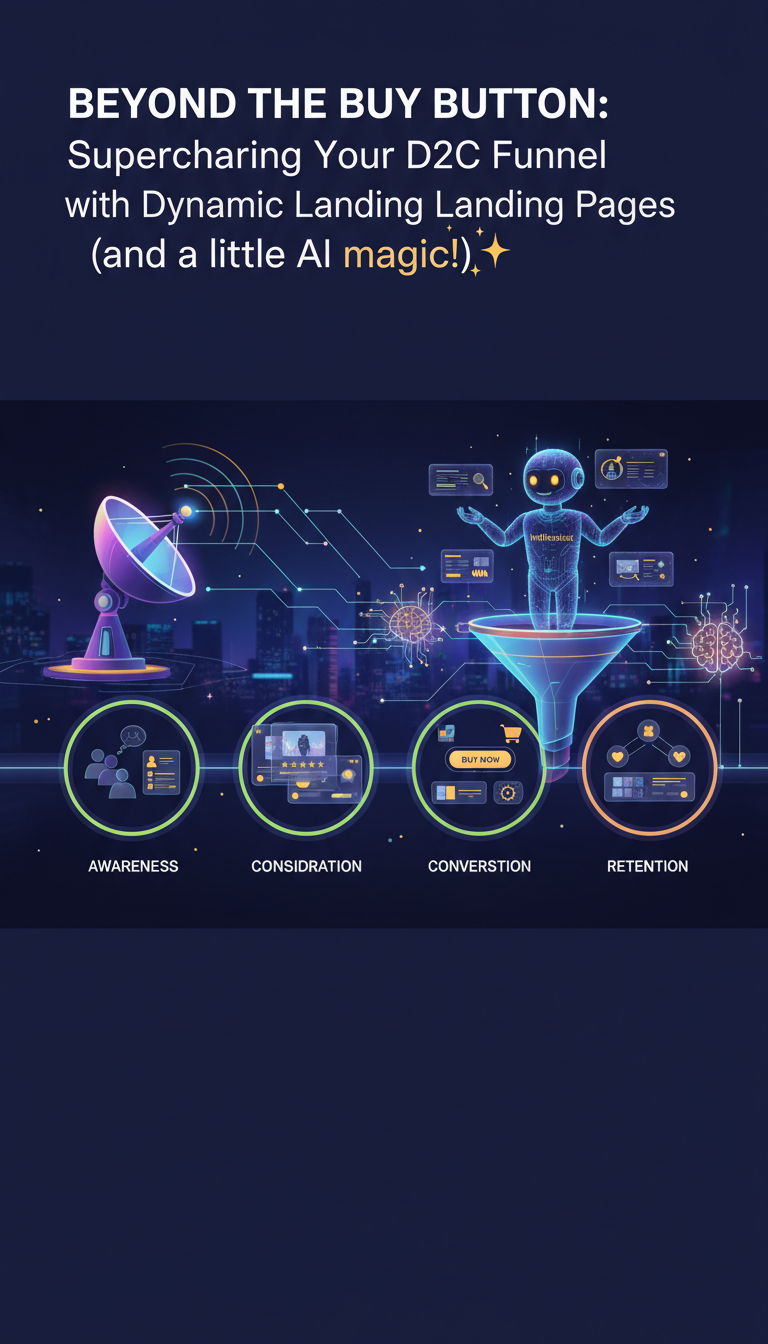
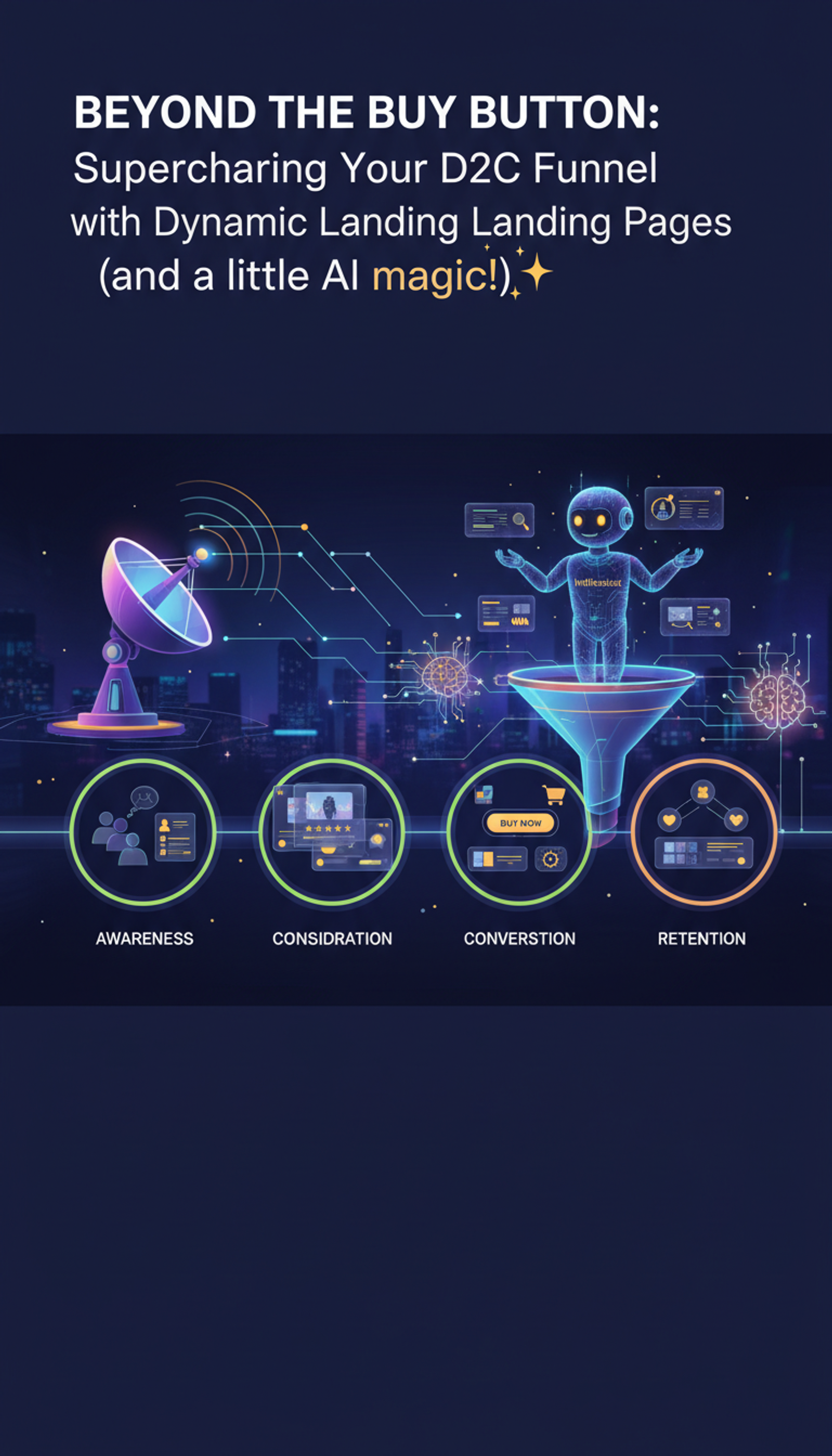
This document outlines a paradigm shift in Direct-to-Consumer (D2C) e-commerce, moving from static landing pages to dynamic, personalized experiences tailored to each stage of the customer sales funnel. It emphasizes the need to meet customers where they are, transforming them from strangers into loyal fans through a smarter, more engaging approach. The article details how to map specific landing page types to the Awareness, Consideration, Conversion, and Retention funnel stages, discusses relevant Key Performance Indicators (KPIs), and highlights the role of AI tools like Intelliassist in creating personalized customer journeys.
The Evolution of Landing Pages
Early 2000s (Blast from the Past)
Landing pages were basic, static online pamphlets, often just lead capture forms. Dell was an early direct seller, but the web was nascent.
Mid-2000s to Early 2010s (Age of Optimization)
A/B testing became prominent, enabling brands to identify effective strategies. Tools like Unbounce democratized this process. Landing pages integrated with email and CRM systems.
Mid-2010s to Early 2020s (Mobile & Personalization)
The rise of smartphones necessitated mobile-first landing pages. Increased customer data allowed for personalization, tailoring content to individual preferences.
Early 2020s to Present (AI Revolution)
The current era is characterized by hyper-personalization and automation. AI dynamically generates content, runs complex multivariate tests, and predicts customer needs. Intelliassist is presented as a key tool in this revolution.
Mapping Your D2C Journey: Landing Pages for Every Stop
The core idea is to avoid sending all customers to the same page, instead matching landing page types to different customer intents at each funnel stage.
1. Awareness: Turning Strangers into Curious Explorers
Goal: Grab attention, introduce the brand, and spark interest without forcing a sale.
- Pre-sell / Advertorials: Story-driven pages that present a problem and subtly introduce the product as a solution.
- Quizzes & Lead-Gen Pages: Interactive experiences offering personalized recommendations.
- Content/Educational Pages: Blog posts, guides, or "Reasons Why" pages that provide value.
- Key Metrics: Click-through rate, lead capture rate, time on page, scroll depth.
- Content Focus: Curiosity-driven headlines, educational storytelling, low-friction CTAs.
Intelliassist's Role: Auto-generates awareness pages based on product feeds and ad angles, dynamically testing different hooks. The "Intelliassist AI in E-commerce Report 2026" indicates these AI-generated pages achieve a 30% higher engagement rate than static pages.
2. Consideration: From "Hmm" to "Tell Me More!"
Goal: Nurture interest, build trust, and provide detailed information for customer evaluation.
- Click-through Pages: Warm up visitors with benefits, FAQs, and social proof.
- Comparison / "Why Us" Pages: Directly address alternatives, highlight unique differentiators.
- UGC/Social Proof Pages: Feature customer reviews, testimonials.
- Key Metrics: CTR to product/checkout, add-to-cart rate, engagement with proof blocks.
- Content Focus: Clear value propositions, robust social proof, objection-handling FAQs.
Intelliassist's Role: Detects incoming traffic sources and audiences to dynamically rearrange page sections and A/B test layouts. The "Intelliassist AI in E-commerce Report 2026" shows a 22% increase in add-to-cart rates with dynamic content arrangement.
3. Conversion: Ready to Say "YES!"
Goal: Convert warm prospects into buyers with clear offers and a smooth path to purchase.
- Product Landing Pages: Campaign-specific versions of PDPs with long-form storytelling.
- Bundle / Offer Pages: Designed around kits, routines, or limited-time offers.
- Key Metrics: Conversion rate, AOV, checkout completion rate.
- Content Focus: Urgency/scarcity elements (ethically), risk-reversal, clear shipping info, upsell/cross-sell.
Intelliassist's Role: Syncs inventory and pricing, suggests cross-sells/bundles, and dynamically tests different offers. The "Intelliassist AI in E-commerce Report 2026" reports that dynamic offer testing increases conversion rates by an average of 15%.
4. Retention & Advocacy: From Buyers to Brand Believers
Goal: Foster loyalty, encourage repeat purchases, and turn customers into advocates.
- Post-Purchase / Thank-You Pages: Beyond order confirmation to include upsell, education, onboarding.
- Referral & Loyalty Pages: Dedicated pages explaining tiers, rewards, community benefits.
- Win-back Pages: Offer specific incentives or content to re-engage lapsed customers.
- Key Metrics: Repeat purchase rate, time to second order, post-purchase upsell take rate, referral sign-ups.
- Content Focus: Order reassurance, personalized recommendations, how-to videos, loyalty program explanations.
Intelliassist's Role: Triggers different post-purchase and loyalty page variants based on order data, testing content combinations to maximize LTV. The "Intelliassist AI in E-commerce Report 2026" shows an increase in LTV by 20% through AI-driven, personalized post-purchase experiences.
The Dark Side of Landing Pages: Ethical Quandaries and Controversies
The drive for conversions can sometimes lead to aggressive sales tactics. Ethical design builds long-term trust and prevents legal issues.
- Pressure Tactics: Aggressive sales tactics for conversions.
- Data Privacy: Requires transparent policies and explicit consent (GDPR, CalOPPA).
- Dark Patterns: Intentionally deceptive design choices:
- False Urgency & FOMO: Fabricated countdowns or stock indicators.
- Hidden Costs: Unexpected fees revealed at checkout.
- Confirm-Shaming: Guilt-tripping users for not opting in.
- Hard to Cancel: Obscuring the process for unsubscribing or returning items.
The Future is Now: AI as Your Landing Page Orchestrator
- Hyper-Personalization: AI predicts needs and dynamically adjusts all page aspects in real-time.
- Generative AI for Content: AI rapidly creates tailored content at scale.
- Agentic AI: Self-learning systems autonomously optimize customer experiences.
- Omnichannel Magic: AI facilitates seamless, integrated customer journeys across all touchpoints.
**Intelliassist as an AI Playbook:** Orchestrates dynamic journeys, personalizing content, and optimizing for maximum Return on Ad Spend (ROAS) and LTV. The "Intelliassist AI in E-commerce Report 2026" suggests companies adopting such AI-driven systems see an average ROAS increase of 40%.
Conclusion: Build Smarter Funnels, Not Just Pages
D2C success hinges on having the right landing pages at the right time, guided by customer intent, from initial curiosity to lifelong loyalty. The article urges readers to move beyond isolated landing pages and embrace dynamic, AI-driven journeys for a connected and converting D2C funnel. It poses a question about how to leverage AI responsibly and ethically to create truly human customer experiences.
Share this article
Help others discover this content